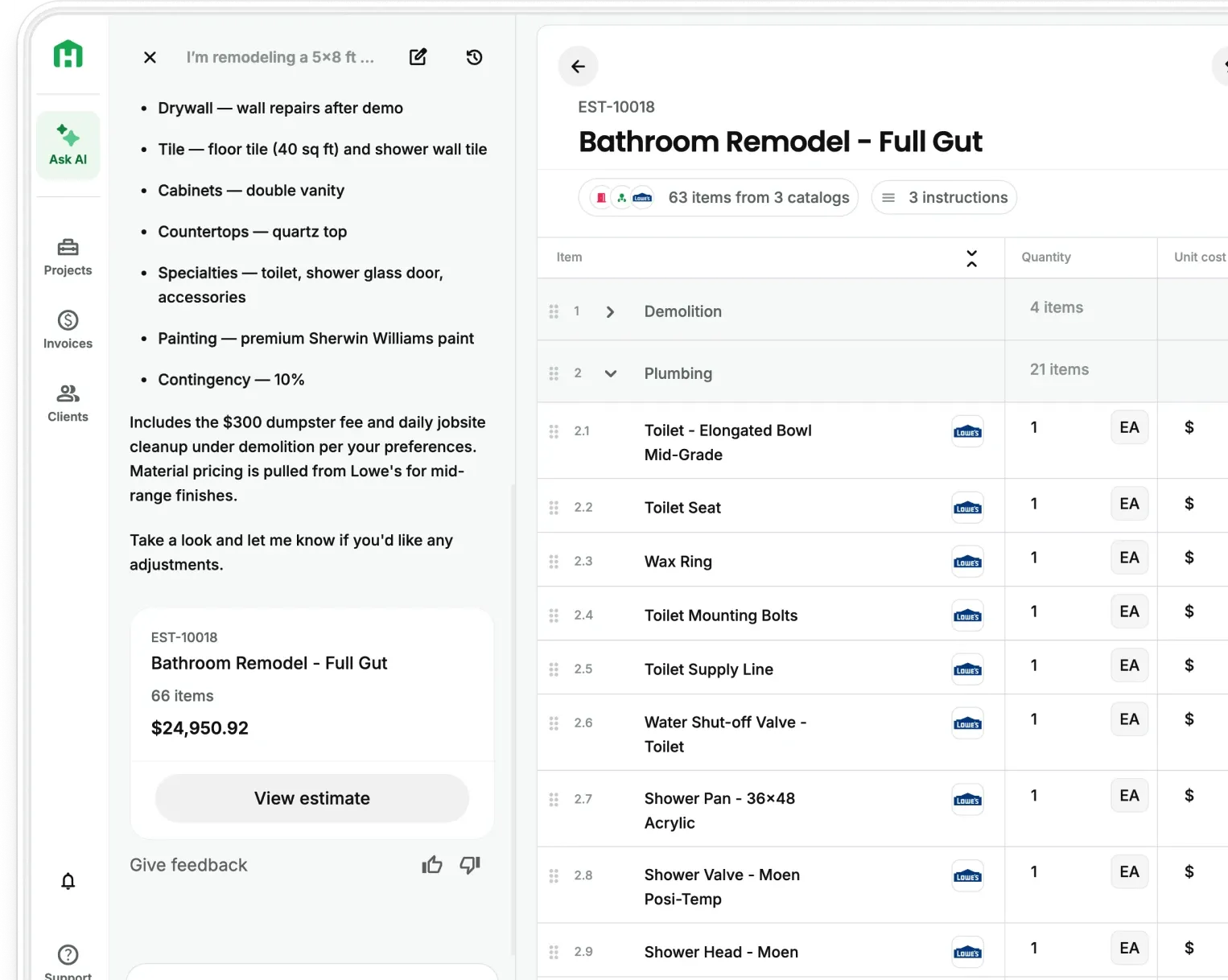
Most contractors using ChatGPT are making the same mistakes. They're asking AI to replace their thinking instead of sharpen it, and the result is generic proposals, wasted hours, and bids that don't win. The fix isn't to stop using ChatGPT for contractors. It's to use it on the right parts of your business, and pair it with tools built specifically for construction estimates and how you actually work.
Why ChatGPT Keeps Letting Contractors Down
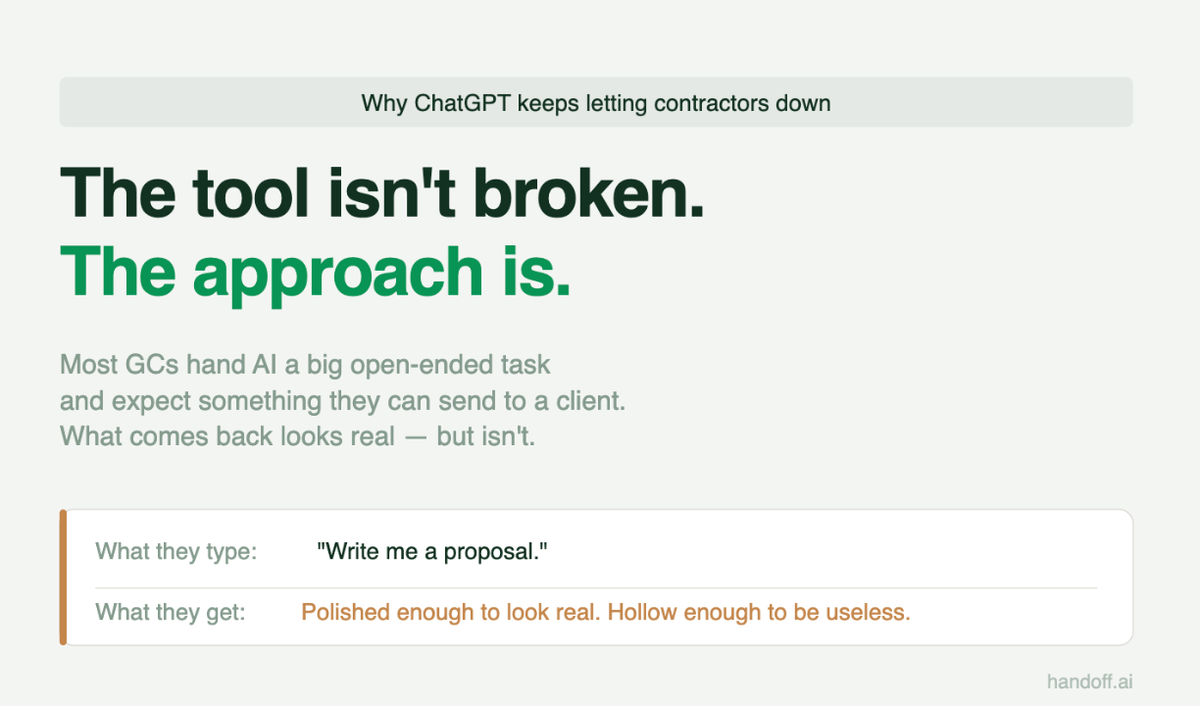
There's a reason so many contractors try ChatGPT, get excited for a week, and then quietly stop using it.
The tool isn't broken. The approach is.
Most GCs treat AI like a new hire who already knows everything. They hand it a big open-ended task: "write me a proposal," "give me a pricing strategy," "create a scope of work." They expect something they can send to a client. What comes back is polished enough to look real but hollow enough to be useless. It doesn't reflect how you actually price a job. It doesn't match your market. It doesn't sound like you.
According to a 2024 survey by the Associated General Contractors of America, more than half of construction firms reported experimenting with AI tools, but very few had a clear strategy for using them. That gap between "trying it" and "getting value from it" is where most contractors live right now.
The good news: the fix is simple. You don't need a new tool. You need a better way to use the one you have. And for the parts of your business where accuracy matters most, like construction estimates, proposals, and change orders, you need tools built specifically for how contractors work. That's what Handoff AI was designed to be.
Here are the seven mistakes to stop making today.
Mistake 1: Using AI to Write Your Estimates
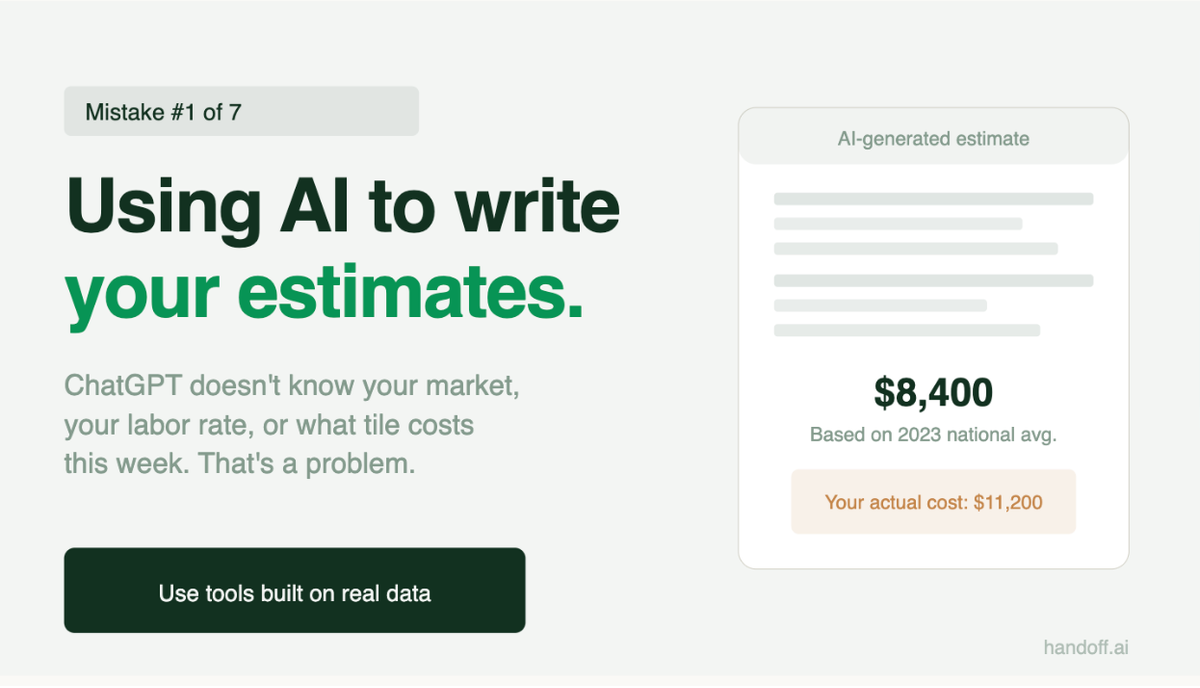
This is the biggest one, and it's where ChatGPT for contractors falls apart the fastest.
A homeowner asks for a price on a bathroom gut and remodel. You're busy, so you ask ChatGPT to "write an estimate for a master bath remodel." What comes back looks like a real estimate: line items, numbers, scope. You tweak a few things and send it.
Here's the problem: ChatGPT doesn't know what tile costs in your market this week. It doesn't know your labor rate, your sub markup, your overhead, or the fact that the job is on the third floor with no freight elevator. It pulls from averages across thousands of sources, none of which are your business.
You might win the job at a number that loses you money. Or you might lose the homeowner entirely with numbers that are wildly off for your area. One contractor using Handoff caught a missed $2,500 bathroom scope item, not from a smarter prompt, but from uploading a jobsite photo and letting a purpose-built tool read what was actually in front of it.
AI estimates built on real construction data are a different thing entirely from what ChatGPT produces. For a full breakdown of how AI estimating is supposed to work, read AI Estimating Software: The Ultimate Guide for Contractors (2026).
Use AI to organize your thinking before you estimate. Don't use it to do the estimating.
Mistake 2: Generic Prompts for Client-Facing Proposals
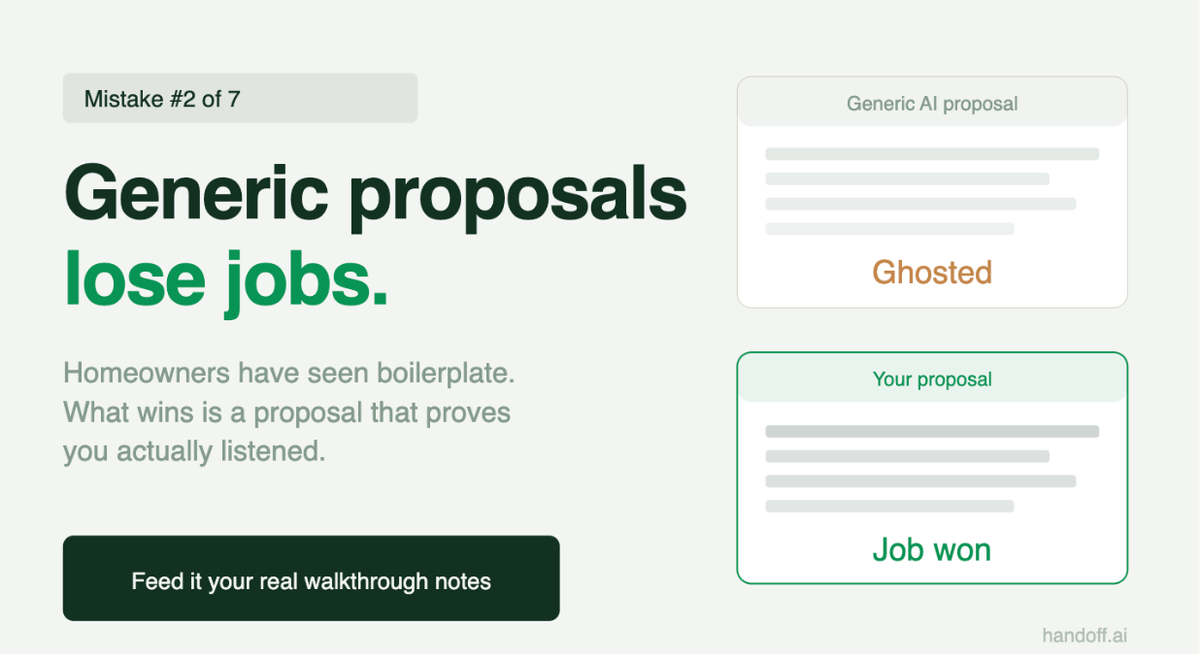
"Write me a professional proposal for a kitchen remodel."
That prompt produces a document that sounds like every other AI-generated proposal a homeowner has already seen from the last three contractors they talked to. It has all the right words. It says nothing real.
Homeowners today are sharper than you think. They've seen boilerplate. What wins jobs is a proposal that shows you actually listened during the walkthrough, that you remember the detail they mentioned about wanting soft-close cabinets, that you flagged the water-damaged subfloor no one else called out.
If you want AI to help with proposals, give it real input. Paste in your notes from the walkthrough. Tell it what the client's biggest concern was. Give it the specific scope, not a category. Then ask it to help you tighten the language, not invent it.
A proposal built on your real observations, formatted cleanly and sent the same day you walked the job, will beat a generic AI document every time. For a deeper look at what separates winning contractor proposals from ones that get ghosted, read How to Write a Remodeling Proposal That Actually Wins Jobs. That's exactly how Handoff's AI proposals are built: your walkthrough details, your pricing, your scope, turned into a professional client-ready document in minutes.
Mistake 3: Trusting AI for Local Material Pricing
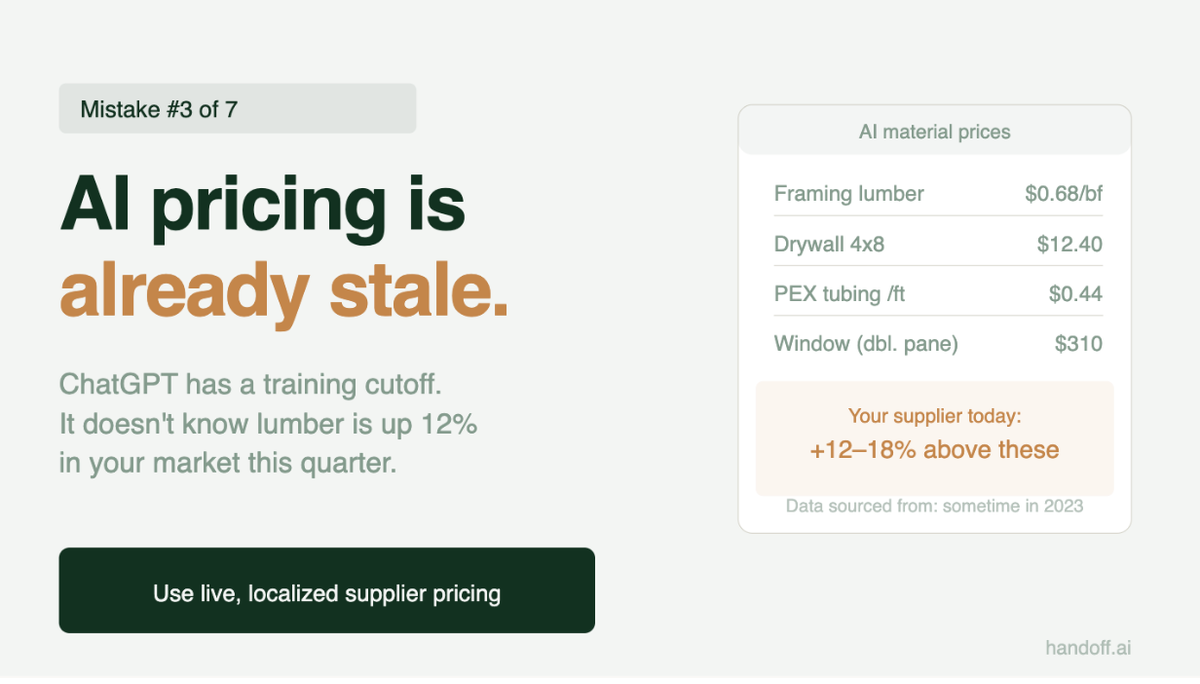
ChatGPT's training data has a cutoff. It doesn't know what lumber is doing this month. It doesn't know that your local supplier raised structural framing prices 12% in Q1, or that a particular window line is sitting on a fourteen-week lead time right now.
Contractors who've used AI-generated pricing as a starting point, without checking against current supplier costs, have found themselves in contracts they couldn't execute profitably. This isn't a rare edge case. It's a predictable failure when you use a general tool for a market-specific problem. The same issue shows up with AI takeoffs built on stale data: the quantities might look right, but the pricing behind them is off.
Handoff AI updates material costs daily across every city in the US by pulling directly from supplier catalogs. That's what localized AI pricing actually means, not an average from some point in the past. If you want to understand what separates reliable AI pricing from guesswork, including the markup-vs-margin math error that quietly costs most GCs thousands per year, read this guide on how AI helps contractors price projects more profitably.
Use AI to organize line items and structure your cost categories. For the actual numbers, use a tool built around real-time, localized pricing.
Mistake 4: Letting AI Write Your Scope of Work
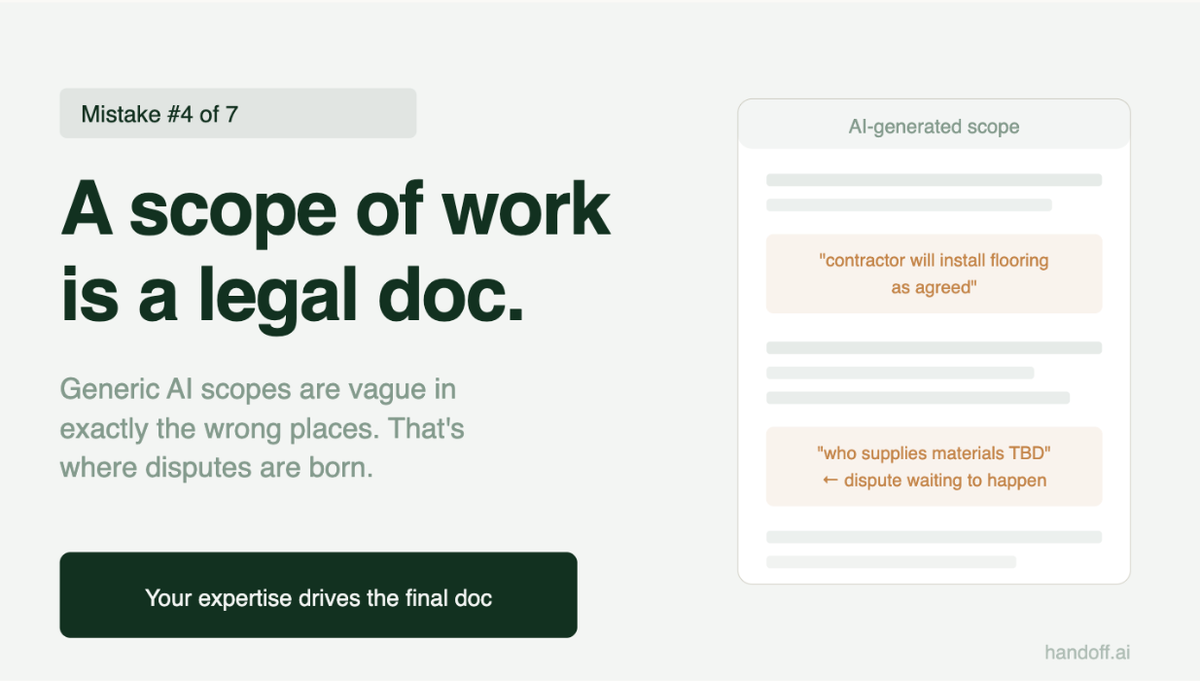
A scope of work is a legal document. It defines what you're doing, what you're not doing, and who's responsible when something goes sideways. That's not the place for AI output you haven't verified word by word.
Generic AI scopes are vague in exactly the wrong places. They'll say things like "contractor will install flooring as agreed" without specifying who supplies it, what the tolerances are, or what happens to existing flooring. Those gaps are where disputes are born.
There's nothing wrong with using AI to give you a starting outline, a checklist of what to cover, a reminder of exclusions you often forget to list. But the final document needs your expertise behind it. And it needs to connect to your estimates, change orders, and invoices so that when something changes mid-job, you have a paper trail. That's what Handoff Projects was built to handle: estimates, proposals, change orders, and invoices all tied to a single job record, not scattered across your inbox.
Mistake 5: Using AI Instead of a Real Job Workflow
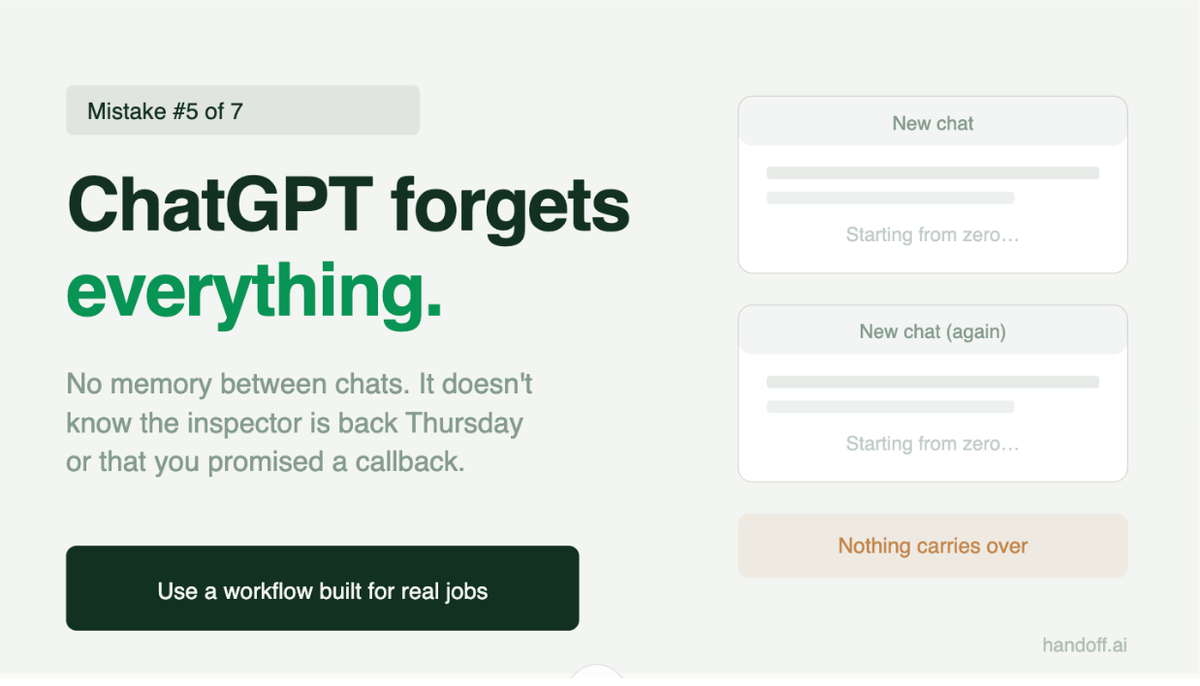
Some contractors are using ChatGPT as a productivity system, asking it to track follow-ups, draft emails, remember job details, keep them on top of what needs to happen next.
It doesn't work. ChatGPT has no memory between conversations. It doesn't know that you promised to call the homeowner on Thursday or that the inspector comes back next week. Every time you open a new chat, you're starting from zero.
What you actually need is a workflow that keeps jobs organized from lead to close without you holding everything in your head. And when scope changes mid-job, as it always does, you need to handle it cleanly. Handoff is the only platform that generates change orders using AI, tied to the original estimate, sent for digital signature, with payment collection built in. No more handshake agreements that turn into arguments at the end of the job.
AI is a thinking tool. It's not a job management system.
Mistake 6: Expecting AI to Sound Like You
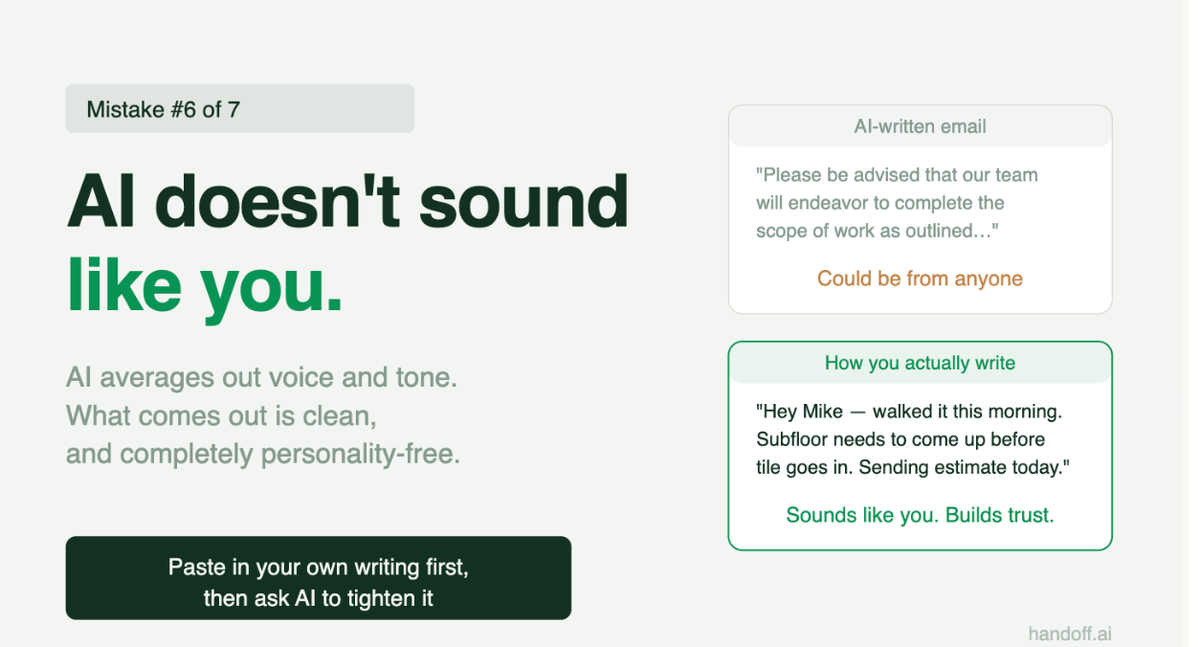
One of the most common frustrations GCs have with AI-written content, proposals, emails, website copy, is that it doesn't sound like them. It sounds like it was written by someone who's never been on a job site.
That's because AI writes from the middle. It averages out voice, tone, and style across everything it's learned. What comes out is grammatically clean and completely personality-free.
If you want AI to help you write something that actually sounds like you, you have to teach it. Paste in something you wrote yourself, an old email or a text you sent a client. Tell it "I want to sound like this, but cleaner." That works. Asking it to invent a voice for you doesn't.
Your reputation is built on trust, and part of that trust is how you communicate. The contractors winning with AI right now aren't replacing their voice with a robot's. They're using tools that already understand how contractors work and what clients need to see, which is a core part of what separates Handoff AI from a general-purpose language model.
Mistake 7: Skipping the Human Review
This one seems obvious. It's still where things go wrong.
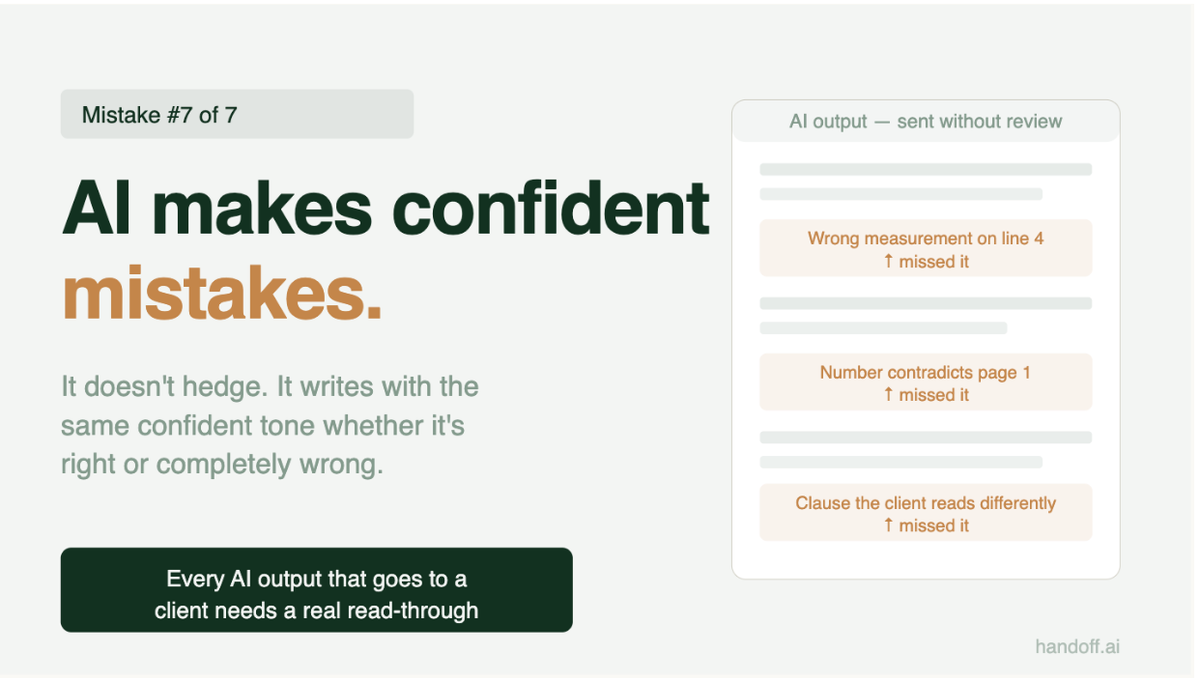
Contractors paste AI output into a proposal, a client email, or a scope document without reading it carefully, and something slips through. Wrong measurements. A number that doesn't match the line above it. A clause that contradicts page one. A sentence the client interprets differently than you intended.
AI makes confident mistakes. It doesn't hedge. It writes with the same tone whether it's right or wrong.
Every piece of AI-assisted output that goes to a client needs a real read-through first. Not a skim. An actual review. That takes five minutes, far less than dealing with a confused client later. The contractors getting the most from AI use tools that get close to right the first time, so the review is a quick pass instead of a full rewrite. That's the standard Handoff AI holds its output to.
What AI Actually Does Well for Contractors
None of this means AI isn't useful. It means it's useful in specific ways.
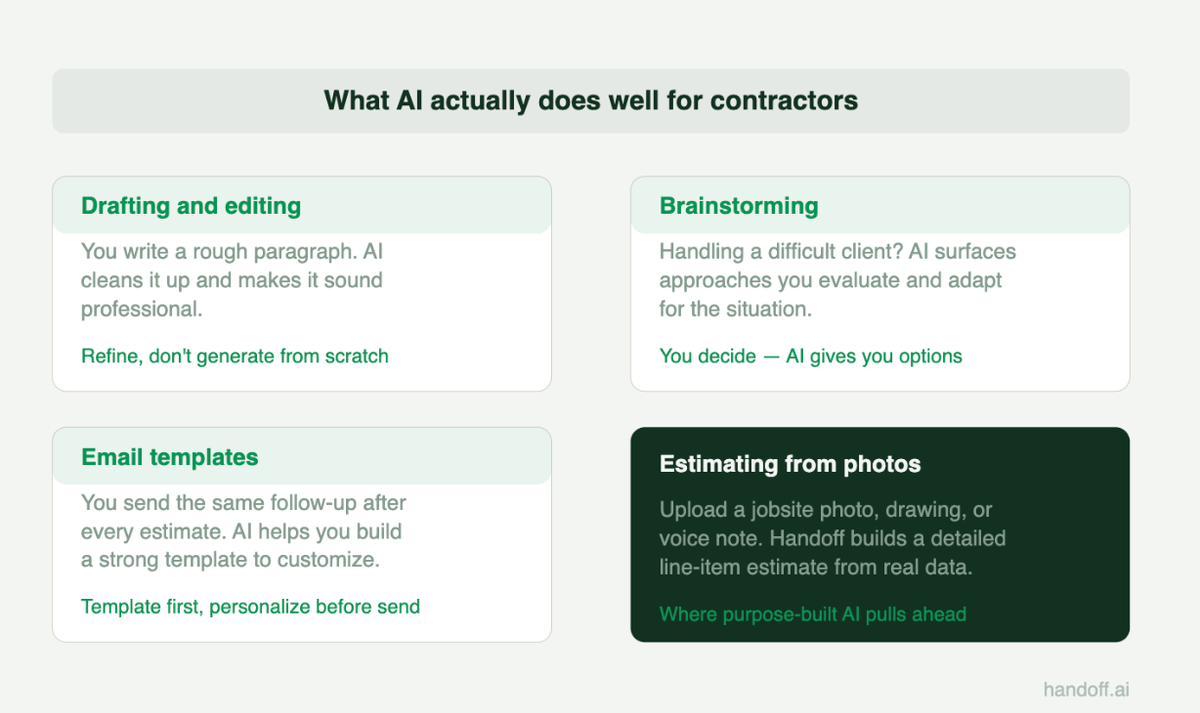
Drafting and editing is a strong one. You write a rough paragraph explaining a change order. AI cleans it up and makes it sound professional. Brainstorming works too: you're handling a difficult client situation, and AI can surface approaches you evaluate and adapt. Email templates are another good use. You send the same follow-up email after every estimate, and AI helps you build a strong template you customize before sending.
Generating construction estimates from photos and drawings is where purpose-built AI tools separate from ChatGPT entirely. Handoff's AI agents can produce a detailed, line-item estimate from a jobsite photo, a drawing, a voice note, or a video walkthrough, and the output is accurate because the model was trained on real construction data, not averaged text from the general internet. For more on how that process works, read How to Write a Construction Estimate That Actually Gets Accepted.
For a side-by-side look at how AI tools compare across a contractor's business, 5 Powerful AI Tools for General Contractors That Actually Work is worth a read.
The pattern is consistent: AI works when you feed it real inputs and use it to refine, not replace.
The Right Way vs. The Wrong Way
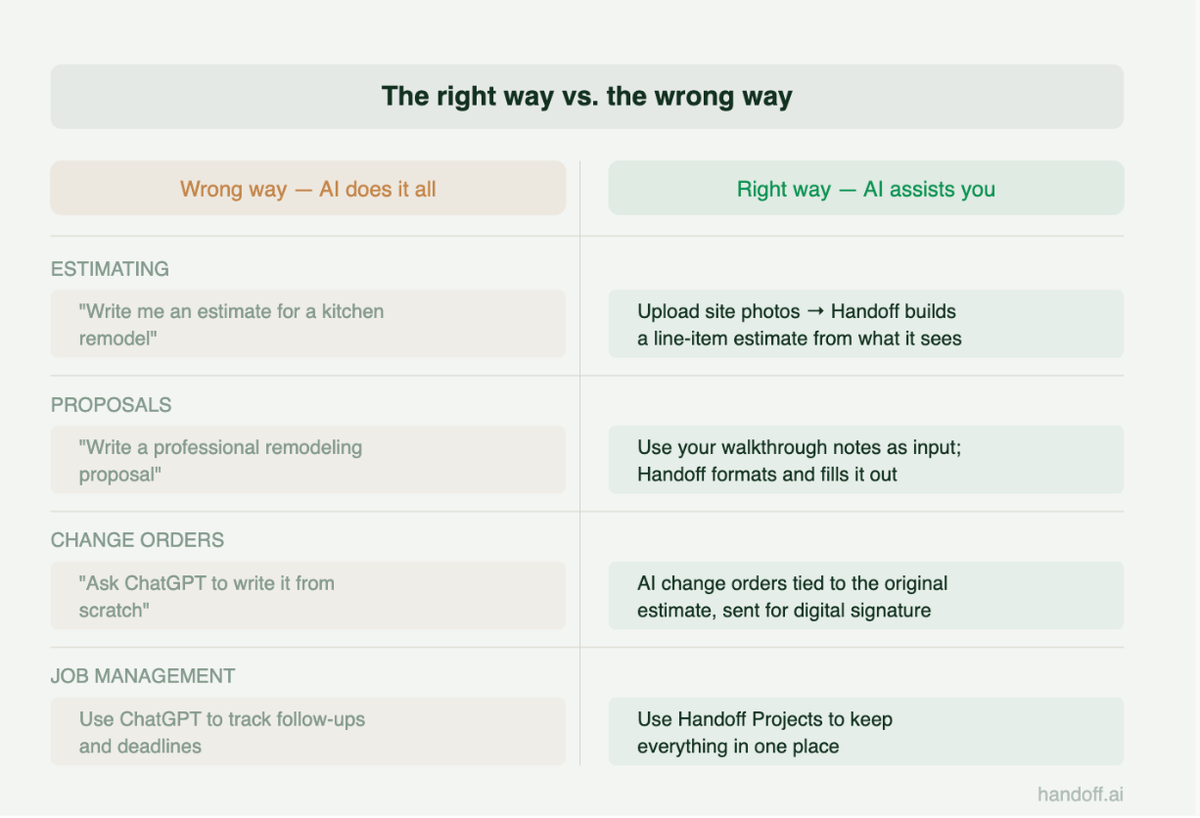
Table: The difference between using AI as a replacement vs. using it as a tool.
FAQ
Is ChatGPT useful for contractors? Yes, but only when used the right way. ChatGPT is most useful for drafting, editing, brainstorming, and organizing information. It's not reliable for estimating, local pricing, legal scope language, or anything that requires your specific business data. For those tasks, purpose-built tools like Handoff AI are the better fit.
Can I use AI to write estimates for remodeling jobs? Not with ChatGPT, not without real risk. ChatGPT doesn't know your local material costs, your labor rates, or your overhead. An AI-generated estimate without real data behind it can win you a job at a loss. For AI that actually knows construction pricing, read AI Estimating Software: The Ultimate Guide for Contractors (2026).
Why does AI-generated content sound generic? AI is trained on a massive range of sources and produces output that reflects the average across all of them. Without specific input, your voice, your job details, your client's concerns, it has nothing real to work with. The result is content that could have come from anyone.
What's the best way to prompt ChatGPT as a contractor? Start with real input. Instead of "write me a proposal," try: "Here are my notes from today's walkthrough, help me turn this into a clear proposal." The more specific and real your input, the more useful the output. For estimating and proposals that go directly to clients, use a tool built around your actual pricing, like Handoff.
How is Handoff AI different from ChatGPT for contractors? ChatGPT is a general-purpose language model. Handoff AI is purpose-built for residential GCs and remodelers. It handles estimating, proposals, change orders, and project management using your actual data, your pricing, and your workflow. It integrates live supplier pricing and connects every document in a job to the same record.
Should I stop using AI tools for my contracting business? No. The goal isn't to avoid AI, it's to use it where it actually helps. Use ChatGPT for drafting and communication. Use purpose-built AI like Handoff for estimating, proposals, and job management, the parts where accuracy directly affects your bottom line.
The Bottom Line
ChatGPT is a useful tool. It's not a contractor. It doesn't know your market, your subs, your clients, or what a fair price is for the work you do. The contractors getting real value from AI are the ones using it to sharpen their own thinking, not handing it the wheel on their most important documents.
For the parts of your business where speed and accuracy actually matter, estimating, proposals, change orders, project management, you need tools built for the way you work. Handoff AI is designed for residential GCs and remodelers who want to estimate faster, send better proposals, and win more jobs without spending their evenings staring at a spreadsheet.
If every hour you spend on construction estimates is an hour you're not on the job site, something has to change. Handoff was built so you can send your next estimate the same day you walk the job, without guessing, and without starting from scratch.
Ready to win more jobs with less manual work? Try Handoff free →