Most contractors who try AI use it like a fancier Google search. They paste in a question, get a generic answer, and wonder why it never sticks. The contractors actually pulling 20 hours a week back from admin and estimating work are using these five tools, set up so they work together.
This is the stack one contractor built over three months that changed how he estimates, markets, follows up with clients, and runs his business day to day. Watch the full breakdown here, then keep reading for how to apply it.
The difference between using AI and using AI well
There's a reason most contractors try ChatGPT once, get a mediocre proposal draft, and never open it again. The tool isn't the problem. What you put into it is.
AI tools produce generic output when you give them generic input. The contractors winning with AI have stopped treating these tools like a search bar. They feed them context — their pricing philosophy, their ICP, their margins, their voice, their services. Once the tool knows your business, it stops sounding like a robot and starts sounding like a senior project manager who actually knows your work.
That shift from tool to system is what the five-tool stack below is built around.
The 5 AI tools contractors are using every day
1. ChatGPT — the writing engine for your whole business
ChatGPT handles every word-based task in the business: video scripts, proposal language, sales follow-ups, client education emails, objection handling, social content, marketing campaigns, customer email responses.
The difference between contractors who get value from it and those who don't comes down to what they've put into it upfront. The ones winning have trained ChatGPT with their ideal customer profile, their pricing framework, their estimating rules, their tone of voice, their services, and real case studies. After that, every output sounds like it came from someone who knows the business — not a template.
- Instead of: "Write me a bathroom remodel proposal"
- Try: "Using my pricing framework, margin rules, homeowner education model, and bathroom estimating processes, create a scope of work and proposal for a mid-range bathroom remodel in Austin, Texas."
The second prompt gets you professional trust-building language, timeline expectations, warranty language, upgrade options, change order language, and objection prevention — every time.
2. Handoff — the estimating and proposal engine
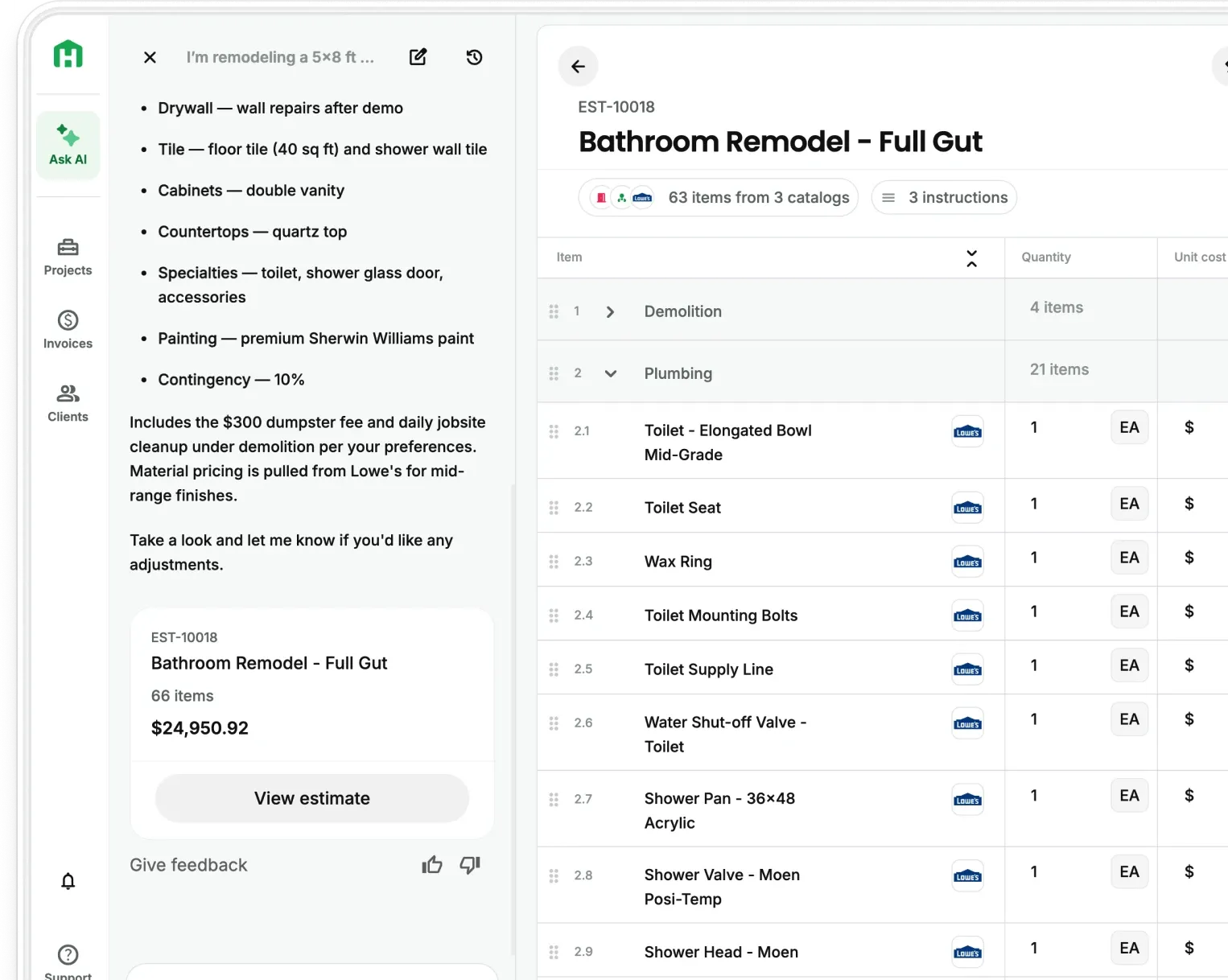
This is where the stack pays off most directly for contractors. Handoff replaces the manual process — the Word docs, the spreadsheets, the photos scattered across a phone, the inconsistent pricing, the slow proposals that lose jobs to someone who responded first.
Upload plans or job site photos, answer a few structured questions, and Handoff generates a full estimate and proposal in minutes. Not a number but a real scope of work with line items, labor logic, materials, margin protection, client-friendly formatting, change order clarity, and payment structure. Proposals, payments, invoices, project documentation, and workflows are all connected in one place.
The way one contractor put it: ChatGPT handles messaging and marketing. Handoff handles pricing, project management, and structure. Marketing and operations working together — that's the modern contractor stack.
With Handoff, he's turning out four estimates a day in a couple hours, with minimal editing required.
3. Ideogram + Canva — the visual production system
Text alone doesn't close jobs anymore. Homeowners want visual clarity, professional branding, and graphics they can actually understand before they sign. Trust is built before the first conversation, and a lot of that trust comes from what your business looks like online.
Ideogram generates images in seconds and for pennies. This includes YouTube thumbnails, infographics, process diagrams, social carousel backgrounds, lead magnet visuals, and before-and-after concepts. Canva is where you apply your branding: logo, colors, titles, resizing for every platform.
- Example Ideogram prompt: "Create a bold YouTube thumbnail for 'How much does a kitchen remodel cost in Austin, Texas in 2026' with a modern contractor aesthetic, high contrast, and space for large readable text."
- The result: Professional visual content without a graphic designer, without Fiverr, without Photoshop, without waiting. Most contractors leave this gap wide open. The ones filling it look like a bigger, more established business than they are.
4. Manus — the research and strategy engine
This is the tool that makes everything else smarter. Manus doesn't answer questions — it researches like a full team. It scrapes data, identifies trends, finds content gaps, builds reports, and produces strategy documents.
This is how the contractor built his pricing frameworks, estimating rules, customer avatars, content strategy, keyword plans, and homeowner education system. One prompt like "Research the top renovation and remodeling search trends in Phoenix, identify high-volume low-competition keywords and content gaps, and build a 30-day content strategy" — and Manus runs for five to ten minutes and delivers market trends, keyword lists, opportunity analysis, downloadable documents, and action steps.
Then those documents go back into ChatGPT. Now ChatGPT isn't guessing. It's powered by real research. This is why Manus supercharges tool number one — it gives the writing engine actual data to work from.
5. Lovable — landing pages and lead conversion
Content without conversion is a hobby. Lovable builds landing pages, funnels, lead magnet pages, booking pages, and free estimate pages — from a single prompt.
- Example: "I'm a general contractor in Dallas. Create a landing page for a free home renovation cost guide for 2026 with email and phone capture, credibility sections, and a call to action."
- In under two minutes: a full landing page with design, copy, lead forms, and layout. No expensive funnel builders, no developers, no $5,000 websites. The workflow becomes: traffic → funnel → lead → proposal → client.
How the five tools work together
This isn't five separate tools, but one system.
- Manus does the research and builds the strategic foundation
- ChatGPT is the writing engine powered by that research
- Handoff is the estimating engine that turns site visits into proposals
- Ideogram + Canva are the visual machine for every piece of content
- Lovable is the conversion system that turns content into leads
Together they handle content creation, lead generation, proposal building, client education, trust building, and sales without hiring a full back office.
You don't need 30 tools. You need five tools set up correctly.
Where to start if you're not using any of this yet
Pick one. The fastest win for most contractors is estimating because it eats the most time and has the most direct connection to revenue.
If you're still building estimates in spreadsheets or Word, start with Handoff. Upload photos from your next site visit and generate a full estimate and proposal before you get back to the office. That alone gives back hours every week.
Once estimating is off your plate, the rest of the stack becomes much easier to layer in.
For a deeper walkthrough of the full system — including how to use these tools for lead generation, marketing, and sales — the Handoff Modern Contractor Webinar Series covers a new topic every week. See what's coming up.
More FAQs about saving money as a contractor
What AI tools do contractors actually use to save time?
The five tools contractors are getting the most value from right now are ChatGPT for writing and client communication, Handoff for estimating and proposals, Ideogram and Canva for visual content, Manus for research and strategy, and Lovable for landing pages and lead generation. The key is setting them up to work together as a system, not using each one in isolation.
Is AI estimating accurate enough to use on real jobs?
Yes, when you give it the right inputs. AI estimating tools like Handoff generate full scopes with line items, labor logic, and materials based on the photos, plans, or notes you upload. The output needs a quick review — but it's a starting point that takes minutes, not hours, and contractors using it consistently are turning out four estimates a day.
Do I need to be technical to use AI tools in my contracting business?
No. The tools in this stack are built for people who use apps and texting, not developers. The biggest requirement is giving each tool enough context about your business upfront — your services, your pricing, your customers. After that initial setup, the output gets significantly better and the tools run largely on their own.
Ready to win more jobs with less manual work? Try Handoff free →