Most contractors working with AI right now are already ahead of the field. The ones who aren't are still rebuilding estimates from scratch every time, chasing leads that went cold, and finding out a job lost money at tax time when there's nothing left to do about it.
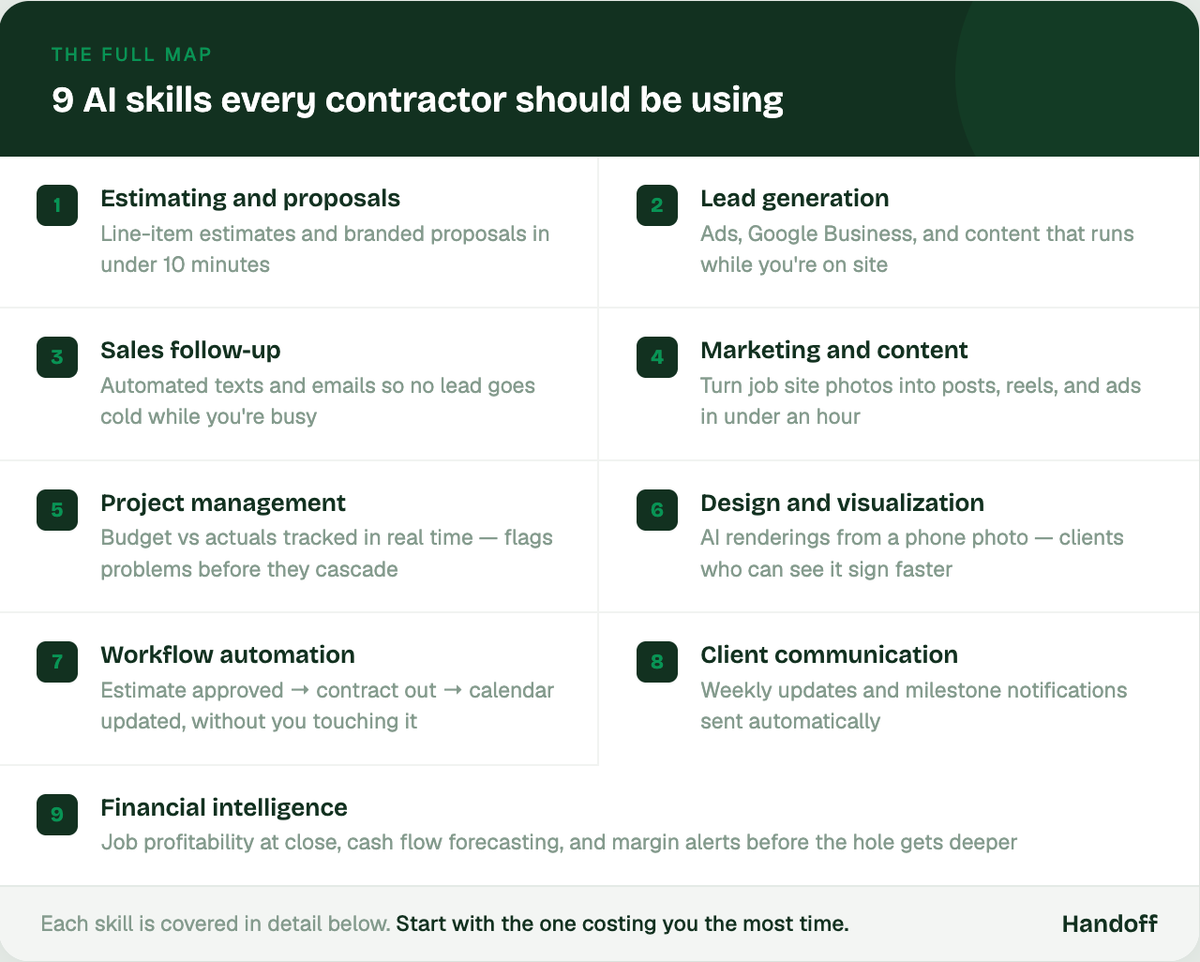
The nine skills below aren't theory. Each one is something you can start applying this week. Some will feel familiar. A few might surprise you. By the end, you'll know exactly which ones to tackle first based on where your business is leaking the most time and margin right now.
Some of these you've probably heard of. A few will surprise you. Let's get into it.
Watch the full breakdown here, then keep reading.
Skill 1: AI estimating and proposals
How long does it take you to put together a complete estimate right now? Two days? Three? For most GCs, it's somewhere in that range and a big chunk of that time is rewriting the same scope you've written dozens of times before.
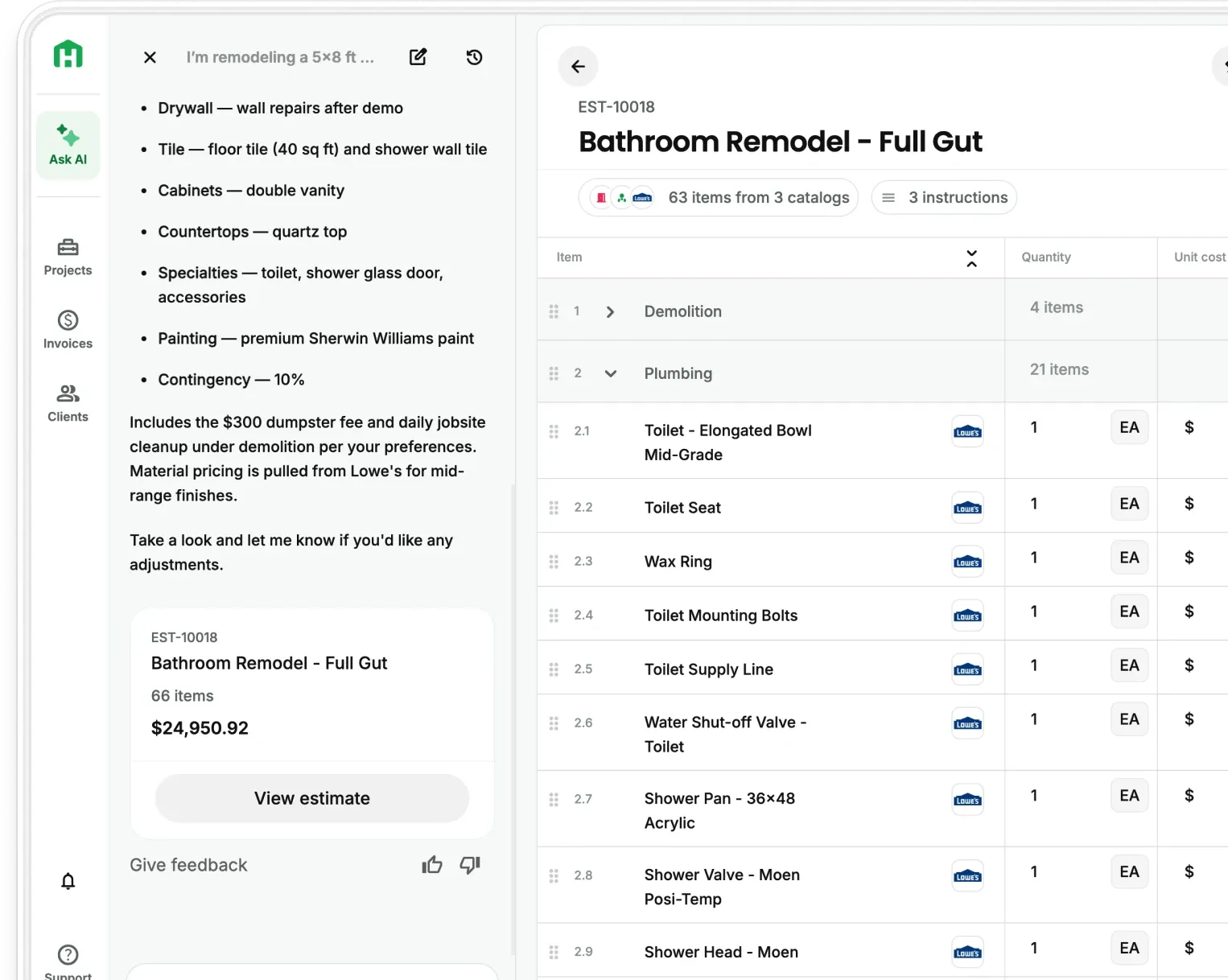
Tools like Handoff let you generate detailed scopes, exclusions, and pricing breakdowns in under 10 minutes. Line items, payment terms, branded proposals are ready to send before your competitor has even opened a spreadsheet.
Speed matters here beyond efficiency. The contractor who responds first usually gets the walkthrough. The contractor who gets the walkthrough usually wins the job. AI gives you that edge on every single bid, if you let it.
Skill 2: Lead generation
Raise your hand if you've ever paid for a lead that turned out to be completely worthless. That's all of us.
The old model of buying leads and hoping for the best is done. AI can now write your ads, post your Google Business Profile on a schedule, generate blog content from your project photos, and run your social media consistently without you touching it.
The contractors building steady pipelines right now aren't getting lucky. They trained AI on their brand voice and service area and built a system that runs while they're on the job site.
Skill 3: Sales follow-up
Here's a cold, hard truth: most GCs don't lose jobs because they're bad at sales. They lose jobs because they forgot to follow up.
Someone fills out your contact form on a Tuesday. You're on a job site. You mean to call them back. By Thursday, they've already talked to two other contractors. AI-enhanced CRM tools can text that lead within minutes of them reaching out, send a sequence of follow-up emails, and keep nurturing them until they're ready to book a walkthrough without you thinking about it.
A salesperson who never forgets, never gets busy, and never lets a lead go cold. That's what this skill gives you.
Skill 4: Marketing and content
How many before-and-after photos do you have on your phone right now from finished jobs? Probably dozens, maybe hundreds. And what are you doing with them?
For most contractors, the answer is nothing. They're sitting in your camera roll.
Every one of those photos is a blog post, a YouTube script, an Instagram reel, and an ad campaign waiting to happen. AI can turn a set of before-and-afters into all of that in under an hour. The contractors who document their work online consistently are the ones who show up when a homeowner searches for a remodeler in their area.
Invisible contractors don't grow. AI makes it effortless to stay visible — you just have to be consistent.
Skill 5: Project management
Tell me if this sounds familiar. A job starts clean. By week three, there's a small delay. The delay pushes a material order. The material order shifts a subcontractor schedule. By the time you catch it, you're two weeks behind and $5,000 over budget.
Project management tools track budget versus actuals in real time, flag schedule slippage before it cascades, and warn you when a job is trending toward a margin problem. This is a dashboard that tells you when something needs your attention before it becomes a crisis.
Handoff's AI Job Costing feature does exactly this: your approved estimate becomes the financial baseline, and actual costs update against it as the job runs. You know where you stand while there's still time to act.
Skill 6: Design and visualization
Homeowners buy with their eyes. Most of them genuinely cannot picture what a renovation will look like from a scope document or a verbal description. That uncertainty makes them hesitate, question the budget, and push back on price.
AI design tools let you take a photo of a client's existing kitchen, bathroom, or backyard and show them a rendering of what it could look like in seconds. Handoff does this too. You're not a designer and you don't need to be. The tool handles the rendering.
What you get is a client who can see the finished result before they sign. Clients who can see it sign faster, question the budget less, and refer you more. A rendering can turn "I'll think about it" into a yes.
Skill 7: Workflow automation
Picture this. Your estimate gets approved. The contract goes out automatically. The client signs. The job gets added to your calendar. When the job wraps up, a review request goes to the client. Every step, your CRM is updated without you touching a single button.
That's workflow automation. Tools like Zapier and Handoff connect your estimating, project management, scheduling, invoicing, and client communication and trigger actions automatically based on what's happening in the project.
This is how a two-person GC team starts operating like a ten-person business — not by working more hours, but by removing the manual handoffs that were eating those hours in the first place.
Skill 8: Client communication
What do clients want more than almost anything during a remodel? Updates. They want to know what's happening, when things will be done, and that someone is paying attention.
AI can send you weekly progress updates with photos, answer basic client questions automatically, and notify clients when milestones are hit without you composing a single message. Inside Handoff, you control exactly what the client sees and when. You put the update in once; it goes out professionally.
That consistent communication keeps clients calm, keeps them from calling you constantly, and leaves them with the impression that your operation runs like a premium service. Happy clients refer more, leave better reviews, and call you first for the next project.
Skill 9: Financial intelligence
How profitable were your last three jobs? Not the revenue but the actual margin, after labor, materials, subs, overhead, and paying yourself.
Most contractors find out how a job went at tax time. By then, there's nothing left to do about it.
Handoff’s financial tools calculate job profitability automatically at close, forecast cash flow 60 to 90 days out, and flag early when a job is trending over budget so you can make a correction before the hole gets deeper. The contractors who embrace this don't just make more money — they make smarter decisions about which jobs to take, how to price them, and where their operation is leaking.
This is what separates a real business from a cash flow crisis waiting to happen.
The four objections contractors have about AI — and why they don't hold up
Every time AI comes up with contractors, the same four objections surface.
- "It's too complicated." The tools built for contractors are designed to be as simple as texting. You don't need to understand how AI works. You just need to use it.
- "I'll figure it out when things slow down." Things never slow down. The contractors who built systems during the busy season are the ones pulling ahead right now.
- "My clients don't care about tech." Your clients care about speed, communication, and professionalism. AI delivers all three. They never see the machinery, they just think you have a full team managing the business.
- "This only makes sense for bigger companies." Small contractors benefit more, because AI gives you leverage you typically can't afford to hire. Especially early on.
Where to start this week
You don't need to implement all nine at once. Start with the one where your business is losing the most time or money right now.
For most contractors, that's estimating. If you're still rebuilding scopes from scratch in Word or ospreadsheets, that's the first thing to fix and the fastest win.
Other FAQs
What AI tools are general contractors actually using in 2026?
The most commonly used AI tools for GCs right now cover five areas: estimating and proposals, lead generation and follow-up, marketing content, project management, and financial tracking. Handoff handles estimating, proposals, project management, client communication, and job costing in one place. Tools like ChatGPT, Zapier, and AI CRMs handle writing, automation, and lead nurturing.
Will AI replace general contractors?
No. The craft — knowing how to manage a job site, build a relationship with a client, and get a project across the finish line — isn't going anywhere. What AI replaces is the inefficiency around the craft: the manual estimating, the forgotten follow-ups, the margin problems that show up too late to fix. The contractors who use it well end up doing more of the work they're good at.
How long does it take to get value from AI estimating software?
Most contractors using Handoff are turning out full estimates in under 10 minutes after their first few projects. The initial setup — connecting your pricing, services, and preferences — takes a few hours upfront. After that, the output requires minimal editing and the time savings are immediate.
Ready to win more jobs with less manual work? Try Handoff free →