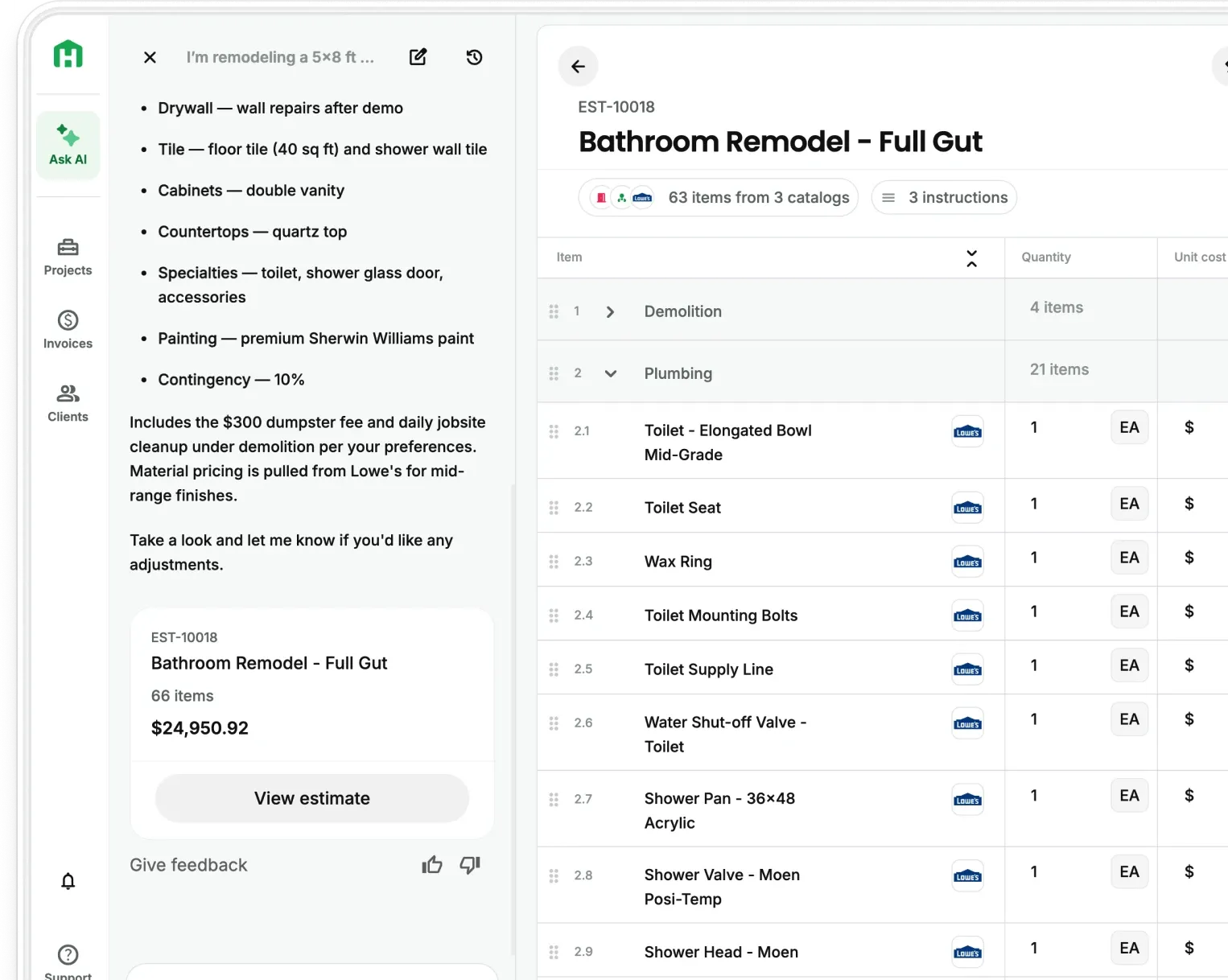
Built from Q2–Q3 2026 discovery calls.
Markup and margin are not the same number, and the gap between them is where a lot of remodelers quietly lose money. Markup is what you add on top of your costs. Margin is what you actually keep out of the final price. A 20% markup leaves you closer to a 17% margin, so if you've been setting one thinking it's the other, you're taking home less than you planned on every job. Here are the seven things that clear it up for good.
1. Markup vs margin: the plain-English difference
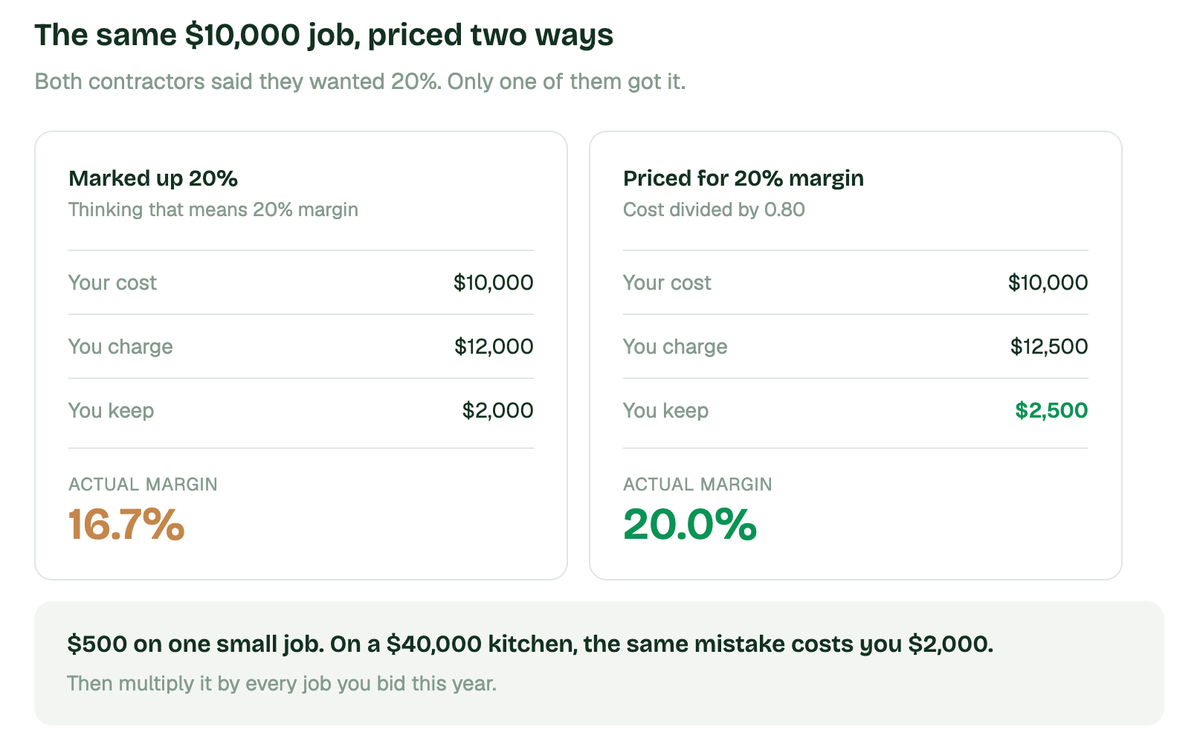
- Markup is added to your cost. Job costs $10,000, you mark it up 20%, you charge $12,000.
- Margin is measured against your price. That same $2,000 of profit on a $12,000 price is a 16.7% margin, not 20%.
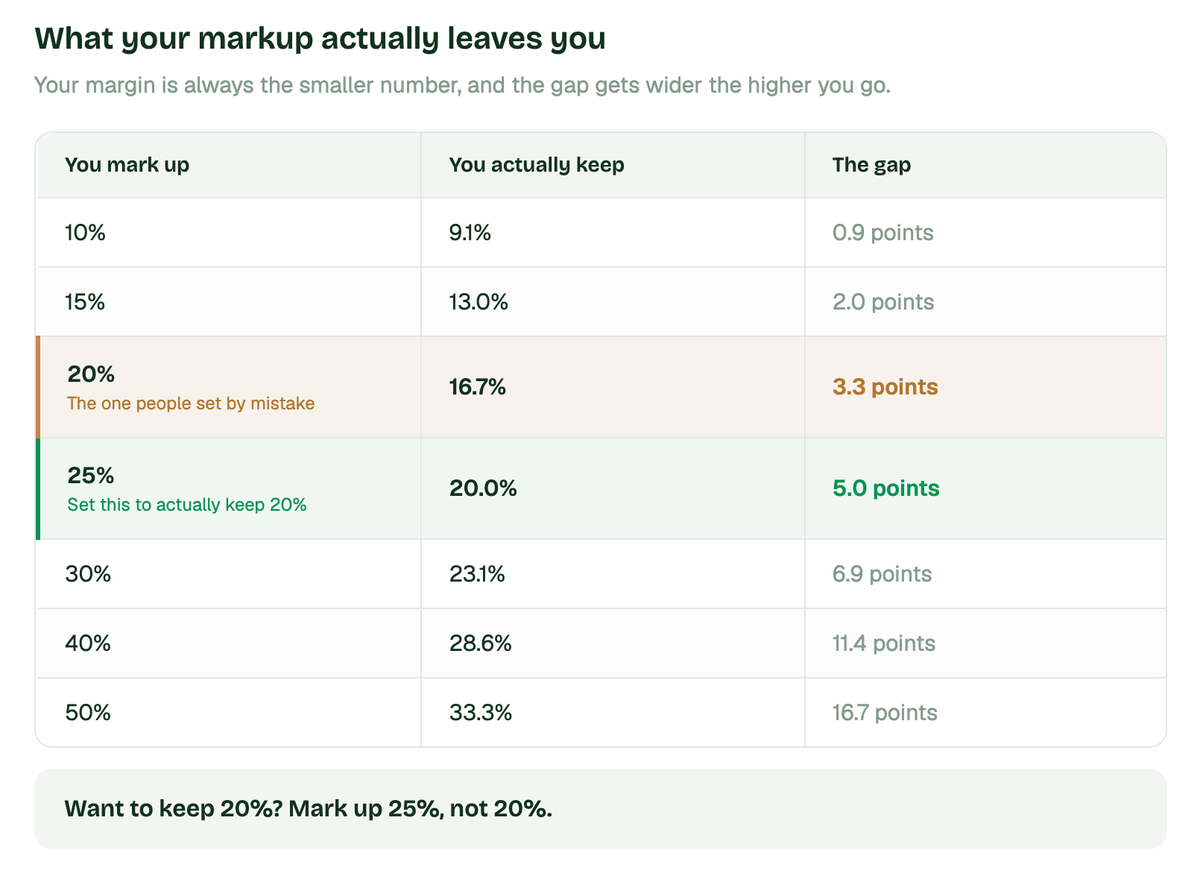
- The bigger the markup, the wider the gap. A 50% markup is only a 33% margin.
- Setting a 20% markup because you want a 20% margin means you come up short every single time.
This is the exact mix-up we hear most. What contractors punch in as markup is usually what they wish their profit margin was and the two rarely match. Getting this right is the difference between hoping you made money and knowing you did.
2. Why contractors confuse the two and lose money
- Most pricing tools ask for "markup," but owners think in "what I take home"
- On a $40,000 kitchen, a few points of confusion is real money off the top
- Nobody catches it until the job closes and the profit looks thin
- One remodeler admitted he was pricing at 45% when his work commanded 50% or above — money left on the table on every bid
The National Association of Home Builders has tracked how tight net margins already run in residential remodeling, which means small pricing mistakes hit the bottom line hard. If your jobs feel busy but your bank account doesn't, this is often why. Our guide to spotting money-losing estimates before they drain your wallet digs into the other leaks.
3. How to calculate markup and margin without a spreadsheet
- Markup % = profit ÷ cost. Made $2,000 on a $10,000 job? That's a 20% markup.
- Margin % = profit ÷ price. That same $2,000 on the $12,000 you charged is a 16.7% margin.
- To hit a target margin, work backwards from price: price = cost ÷ (1 − margin). Want 30% margin on a $10,000 cost? Charge $14,285.
- Quick gut check: your margin is always a smaller number than your markup. If they're equal, something's wrong.
Keep those straight and the pricing stops being a mystery. Your AI Teammate does this conversion on every line so you never run it in your head. See how AI estimating helps contractors price jobs more profitably.
4. What margin should a remodeling contractor aim for?
- Many small remodelers target a 15–20% net margin as a goal — actual industry averages run closer to 6–7% — higher on specialty or custom work
- Your number depends on overhead, risk, and how much of the work you self-perform
- The goal isn't the highest possible margin — it's a consistent one you actually protect
- A margin you set and then discount away on every job isn't your margin
Set the floor first, then let it hold across every estimate. Our pricing guide for remodeling jobs walks through how to land on the right target for your shop. Accurate margins protect your profit from the very first line of the bid.
5. Set your markup once and apply it to every estimate
- Lock your markup rules in one place instead of eyeballing each bid
- New estimator or new hire? The margin holds because it's built in, not remembered
- Separate labor and materials markups if your trades price differently
- Adjust per job when you need to negotiate, but always from a known starting point
Consistency is what turns pricing from a nightly guess into a system. Handoff applies your markup automatically on every estimate, so no bid ever goes out unprotected. If you're setting yours for the first time, start with how to set your first markup.
6. Markup is your negotiation lever, not a fixed wall
- When a client says the number's too high, you can knock the margin down on purpose — not by accident
- Because you know your true floor, you know exactly how far you can go before the job stops being worth it
- Discounting blind is how profitable-looking jobs turn into break-even ones
- A known margin lets you offer good-better-best options instead of just cutting the price
That control is the whole point of getting the number right. Contractors who know their floor close more jobs without giving away the profit — more on that in 5 common price objections and how to handle them.
7. Your bid is only as good as the costs under it
- A perfect margin on a lowballed cost still loses money
- Material prices move — metals, lumber, anything touched by tariffs — so stale costs sink good math
- Missed scope items get eaten straight out of your margin
- Pricing tied to live supplier data and local labor rates keeps the foundation honest
Margin math only works when the costs underneath it are real. Handoff prices materials from live supplier data and local rates, so your markup sits on numbers that haven't expired — the same reason AI-powered estimates land close to what contractors would price by hand.
Price every job like you know your number — because you will
Stop leaving margin on the table one confused percentage at a time:
- Start a free trial — no credit card needed
- Set your markup rules once so every estimate is protected
- Build a bid on a real job and watch the margin calculate itself
- Send it the same day, knowing exactly what you'll take home
Handoff does the conversion on every line so the number you set is the number you keep.
Other FAQs about margins and markups for residential construction
Is a 20% markup the same as a 20% margin?
No. A 20% markup on a $10,000 cost gives you a $12,000 price and a 16.7% margin. Markup is measured against your cost; margin is measured against your price, so margin is always the smaller number.
What's a healthy profit margin for a small remodeling business?
Most small remodelers aim for a 15–20% net margin as a target — actual industry averages run closer to 6–7% (NAHB, 2024) — with higher targets on custom or specialty work. The right number depends on your overhead and risk — a consistent margin you protect beats a high one you discount away.
How do I stop underpricing my jobs?
Set your markup rules once, apply them to every estimate automatically, and build bids on live material and labor costs instead of stale numbers. Underpricing is usually a systems gap, not an effort gap.