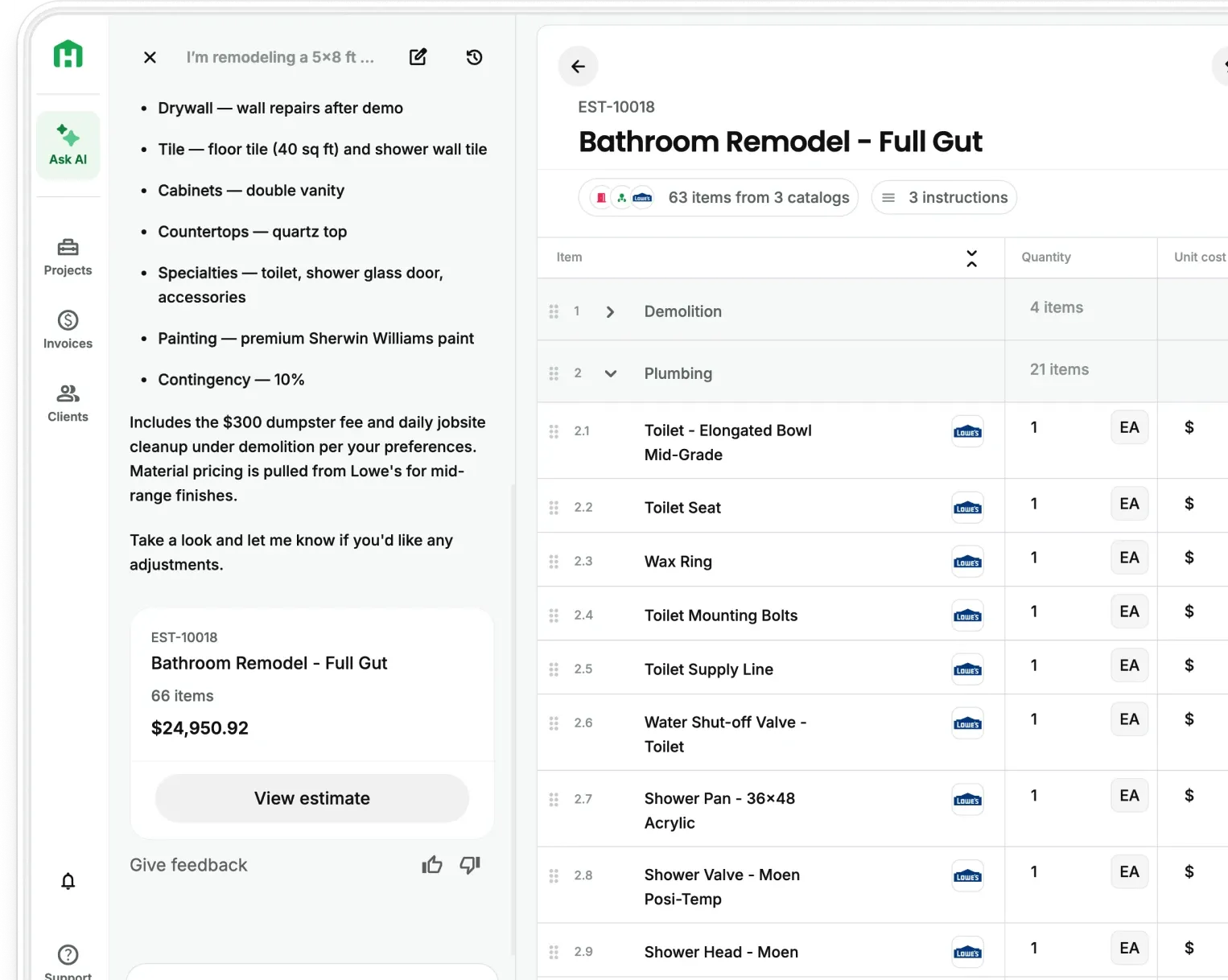
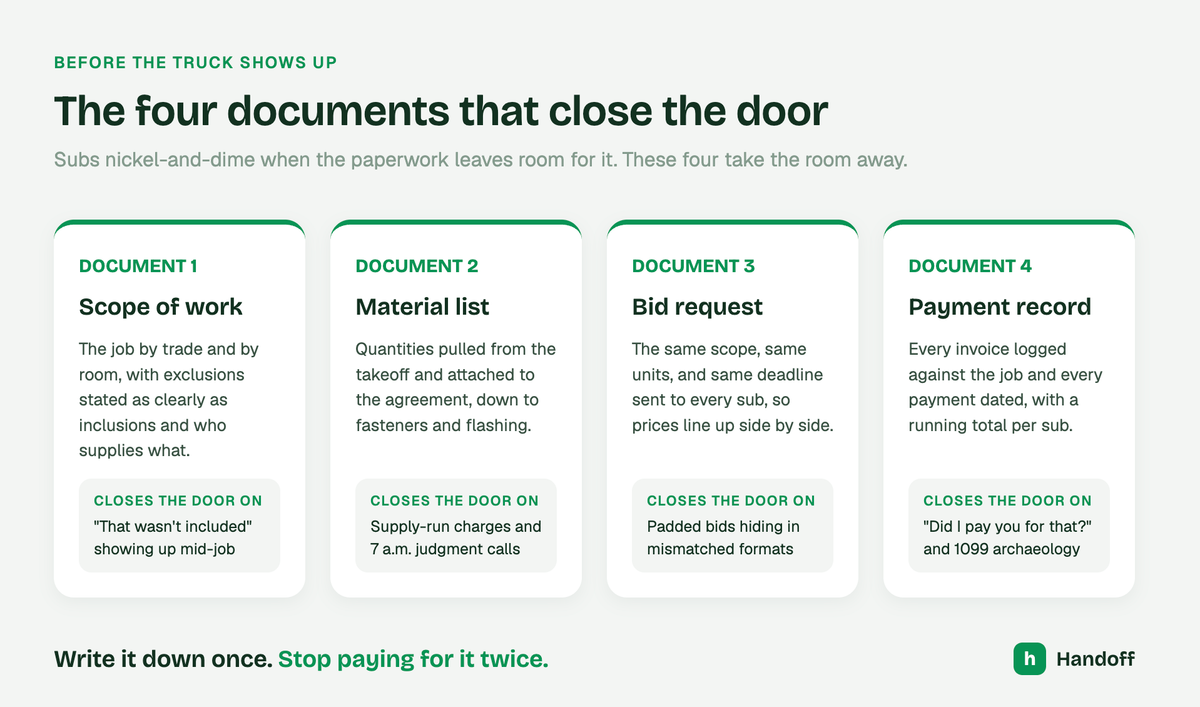
Subs nickel-and-dime you when the paperwork leaves room for it. Four documents close that door: a complete scope of work, a material list attached to the agreement, a structured bid request, and a running payment record. None of them require a lawyer or an office manager but they require the job to be written down before the truck shows up. Here's what each one does and how to put it together without adding a night of admin.
Why subcontractors nickel-and-dime general contractors
One GC told us the story every remodeler recognizes: the sub shows up, gets partway in, and announces he'll have to charge mobilization because one screw, one flashing detail, one thing wasn't on site or wasn't in the scope. When the scope is vague, every gray area becomes a billable conversation, and the sub isn't wrong to ask. The document was.
- A vague scope invites "that wasn't included" on every job
- A missing material list makes every supply run someone else's problem and billable to you
- Bids that arrive in different formats can't be compared, so you can't tell fair from padded
- Payments scattered across texts, checks, and three invoicing apps mean you can't prove what you've already covered
The National Association of Home Builders has long pushed written agreements as the baseline for working with trade partners, and the reason is simple economics: on a $25,000 job, a few "small" extras take a real bite out of the margin. Complete documents protect contractor margins from the first handshake.
4 documents that stop painful conversations with sub contractors
Document 1: a scope of work the sub can't argue with
- Spell out the work by trade and by room — "hang and finish drywall, level 5, garage and bonus room" beats "drywall as needed"
- State what's excluded as clearly as what's included, so the gray areas are decided before the bid, not after
- List who supplies what: your materials, his consumables, whose dumpster
- Attach the drawings or photos the scope came from, so there's one shared version of the job
Contractors who work from a written scope send it with every bid request and every agreement — the same document, start to finish. Your AI Teammate can turn an estimate into a scope of work in one step, so the writing-it-down part stops being the reason it doesn't happen.
Document 2: a material list attached to the agreement
A complete material list, attached to the sub agreement, ends the argument before it starts. Either the material is on the list and on site, or it's a legitimate extra — no judgment calls at 7 a.m.
- Pull quantities from the takeoff, not from memory — a plan-based takeoff counts what the drawings actually show
- Include the boring stuff: fasteners, adhesives, flashing, the items that trigger "supply run" charges
- Note delivery timing, because a sub standing around waiting for material will bill you for standing around
JLC has covered for years how material coordination separates profitable jobs from break-even ones. Handoff builds the material list from the same numbers as the estimate, so the list and the bid never disagree.
Document 3: a bid request that forces apples-to-apples pricing
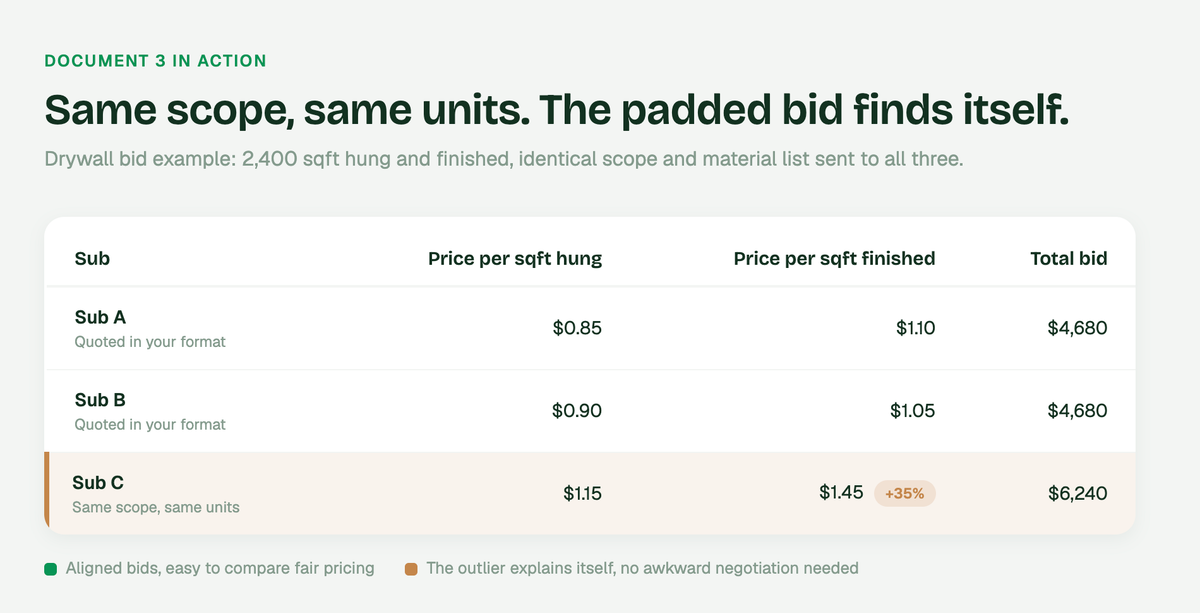
Send every sub the same package and ask for prices in the same structure. One remodeler we spoke with built his whole sub process around this: same scope, same units — price per square foot hung, price per square foot finished — so the numbers line up side by side.
- Send the identical scope and material list to every bidder
- Ask for unit pricing in your format, not their invoice template
- Set the deadline and the site-visit window in the request
- For trusted subs who won't quote fixed, agree on time and materials with a not-to-exceed cap tied to your budget line
When the bids come back in one structure, the padded one identifies itself. Contractors using this system stop overpaying without burning relationships because the numbers do the negotiating.
Document 4: a payment record that's ready for 1099 season
Sub invoices arrive by email, text, QuickBooks, and folded paper on a dashboard. If they don't land in one place, January becomes archaeology. One contractor described the loop exactly: print it, scan it, save it to the iPad, lose it on the desktop, rebuild it in a spreadsheet and hope no formula broke along the way.
- Log every sub invoice against the job it belongs to, the day it arrives
- Record payments against those invoices so "did I pay you for that?" has an answer with a date on it
- Keep a running annual total per sub — that number is your 1099, done
- Tie the costs to the project budget so sub spend shows up in your job costs while the job is live, not at tax time
For the filing rules themselves, QuickBooks keeps a current guide to 1099 requirements, and our own 1099 guide for general contractors covers the contractor side. Handoff keeps the record so tax season is a print job, not a project.
Put the four documents to work
You don't need new subs. You need the same four documents on every job:
- Start a free trial — no credit card needed
- Build an estimate for a real job, then generate the scope of work and material list from it
- Send the same package to every sub who's bidding
- Log invoices and payments against the job as they land
Nickel-and-diming isn't a subcontractor problem. It's a documentation problem, and documentation is exactly the work your AI Teammate is built to carry. Handoff writes it down so you don't pay for what already should have been.
Other FAQs about handling subcontractor conflicts
Should I pay subcontractors fixed price or time and materials?
Fixed price when the scope is clear and the sub will commit; time and materials with a written not-to-exceed cap when the work has real unknowns. The cap matters more than the method — it turns an open tab into a budget line.
What belongs in a subcontractor agreement for a small remodeling business?
Scope of work, material responsibilities, price and payment terms, schedule and notice expectations, insurance and license verification, and how changes get approved. Attach the scope and material list rather than summarizing them — the attachment is the protection.
Do I need to send a 1099 to every sub I pay?
Generally, yes for unincorporated subs you paid $600 or more in a year for services — that's the 1099-NEC. Corporations are usually exempt, but collect a W-9 from every sub before the first check so you're never guessing in January.