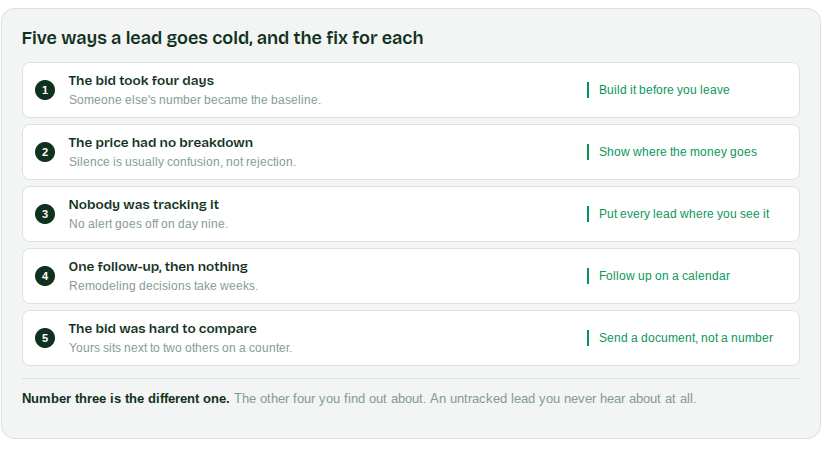
Most remodeling leads go cold because too much time passed or the price arrived without context or maybe nobody followed up after the first bid. Five specific things cause it, and four of them are fixable this week.
There are now more than 128,000 remodeling firms in the US, nearly double the number in 2000. The homeowner who called you called somebody else too.
Why do homeowners stop responding after a site visit?
You walked the job Tuesday. The homeowner was excited. You told them you would get them a number by the end of the week and you meant it. Then a wall opened up on your current job and Thursday disappeared.
Here’s what happened on their end while you were busy:
- Another contractor sent a number Wednesday morning
- That number became the baseline every other bid gets compared against
- The homeowner started picturing the project at that price
- Your bid arrived Friday as the second opinion, not the first
- By then they had already decided how much this should cost
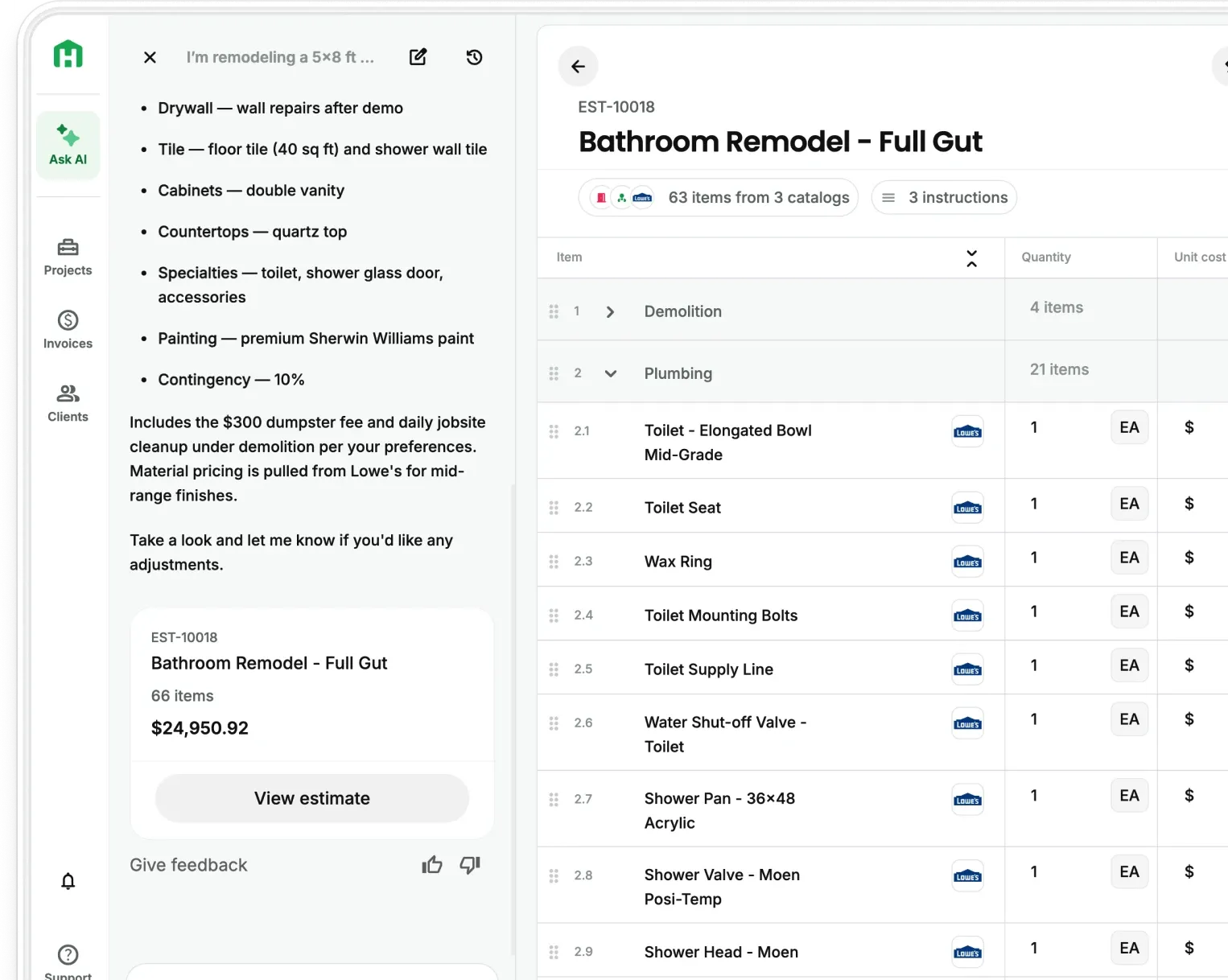
The first solid bid sets the anchor. Everything after it is judged against a number the homeowner has already accepted as normal. Building the estimate before you leave the driveway is the only reliable way to be first, which is what Instant AI Estimates are built for.
Same-day bids keep you in the conversation while the homeowner is still deciding what the project is worth.
Why a homeowner goes quiet after seeing the price
A homeowner who thinks your price is too high will often say so. A homeowner who doesn’t understand your price says nothing at all.
NAHB's remodeling market data shows managing customer cost expectations is the dominant challenge remodelers report in 2026. Material costs are part of it. Presentation is the rest.
What makes a price land badly:
- A single total with no breakdown, so there’s nothing to evaluate
- No explanation of what the contingency line covers or why it protects them
- Nothing showing which items are required and which are choices
- A number that arrived by text, with no context around it
When the homeowner can see where their money goes, the conversation stops being a negotiation and starts being a decision.
Clear pricing conversations protect your margin from the start.
Leads that go cold because nobody was tracking them
Nobody gets an alert when a lead goes quiet. There is no notification that says the Hendersons have been waiting nine days.
The typical residential remodeler completes 15 jobs over $10,000 a year with a median of five employees. At that size there’s no office manager watching the pipeline. You’re it, and you’re also on a roof.
So this happens:
- A lead gets outranked by an emergency on an active job
- Three weeks pass with no contact from either side
- Reaching out now feels awkward, so it slides another week
- You find out you lost it by driving past a different truck in the driveway
The loss is invisible until it’s permanent. That’s what makes this one different from the other four. Keeping every lead and job in one place is what turns a quiet lead into something you notice on day nine instead of day thirty.
How many times should you follow up on a remodeling bid?
Most contractors send the bid, send one check-in, and stop. The homeowner isn’t ignoring you. Remodeling decisions take weeks, spouses disagree, and life gets in the way.
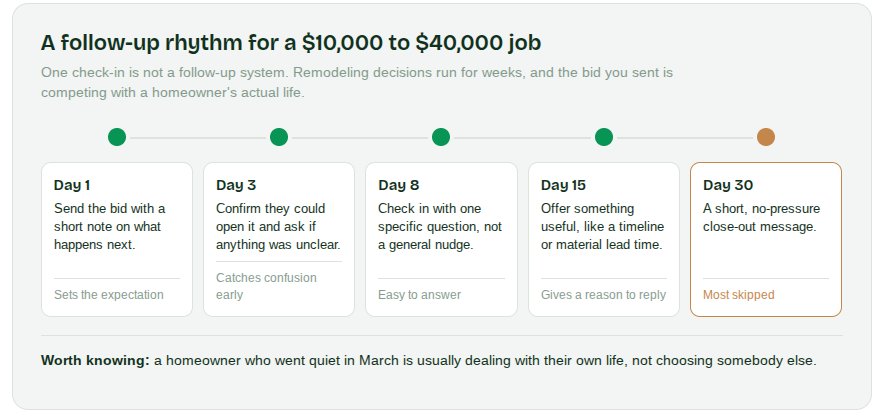
A workable rhythm for a $10,000 to $40,000 job:
- Day 1. Send the bid with a short note on what happens next.
- Day 3. Confirm they could open it and ask if anything was unclear.
- Day 8. Check in with one specific question, not a general nudge.
- Day 15. Offer something useful, like a timeline update or a material lead time.
- Day 30. A short, no-pressure close-out message.
Following up on a schedule wins jobs that were never actually lost.
What makes a bid easy for a homeowner to compare
Your bid isn’t being read on its own. It is sitting next to two others on a kitchen counter.
- A line-item breakdown beats a lump sum, because the homeowner can see what they are buying
- Scope written in plain language beats trade shorthand they have to decode
- A clear allowance for the unknowns reads as experience, not padding
- A polished document beats a texted number, even when the number is better
Homeowners can’t evaluate your framing. They can, however, evaluate whether you look like a business that’ll show up.
5 ways to keep a remodeling lead from going cold
- Build the estimate before you leave. Instant AI Estimates turn a walkthrough into an itemized number from the truck, so the four-day gap never opens.
- Send a document, not a number. A proposal that shows scope, line items, and allowances answers the questions that would otherwise become silence.
- Put every lead somewhere you can see it. Tracking your clients and jobs in one place means a quiet lead surfaces before it is gone.
- Follow up on a calendar, not a feeling. Decide the schedule once so the ninth day does not depend on you remembering.
Your AI Teammate handles the parts that fall apart when a job site goes sideways.
Getting started with your AI Teammate
- Pick the last five bids you sent and check how many got a second follow-up
- Build your next estimate before you leave the driveway instead of that night
- Send it as a line-item proposal rather than a texted number
- Put a follow-up schedule on the calendar the same day the bid goes out
- Start your free Handoff trial and run one lead through start to finish
Leads going cold is not a hustle problem. It is a timing problem. Handoff fixes the timing.
Other FAQs about residential construction leads
Is it worth calling a lead that went quiet two months ago?
Usually, yes. Homeowners often pause a project for reasons that have nothing to do with you, then feel awkward about the gap. A short message that names the project and asks whether they are still thinking about it costs you nothing and reopens more jobs than contractors expect.
Should you lower your price to save a lead that is going cold?
Dropping your number rarely fixes a cold lead, because price is usually not what stalled it. Ask what is holding them up first. If it genuinely is budget, adjust the scope instead of the margin so you are selling a smaller project rather than the same one for less.
How do you tell the difference between a slow homeowner and a lost job?
Ask a direct question that is easy to answer, like whether they are still planning to move forward this season. A homeowner who is still deciding will tell you. One who has hired somebody else usually will too, and knowing early is better than a pipeline full of leads that are already gone.