Construction material prices in July 2026
The gap between the headline and your receipts is the whole story this month.
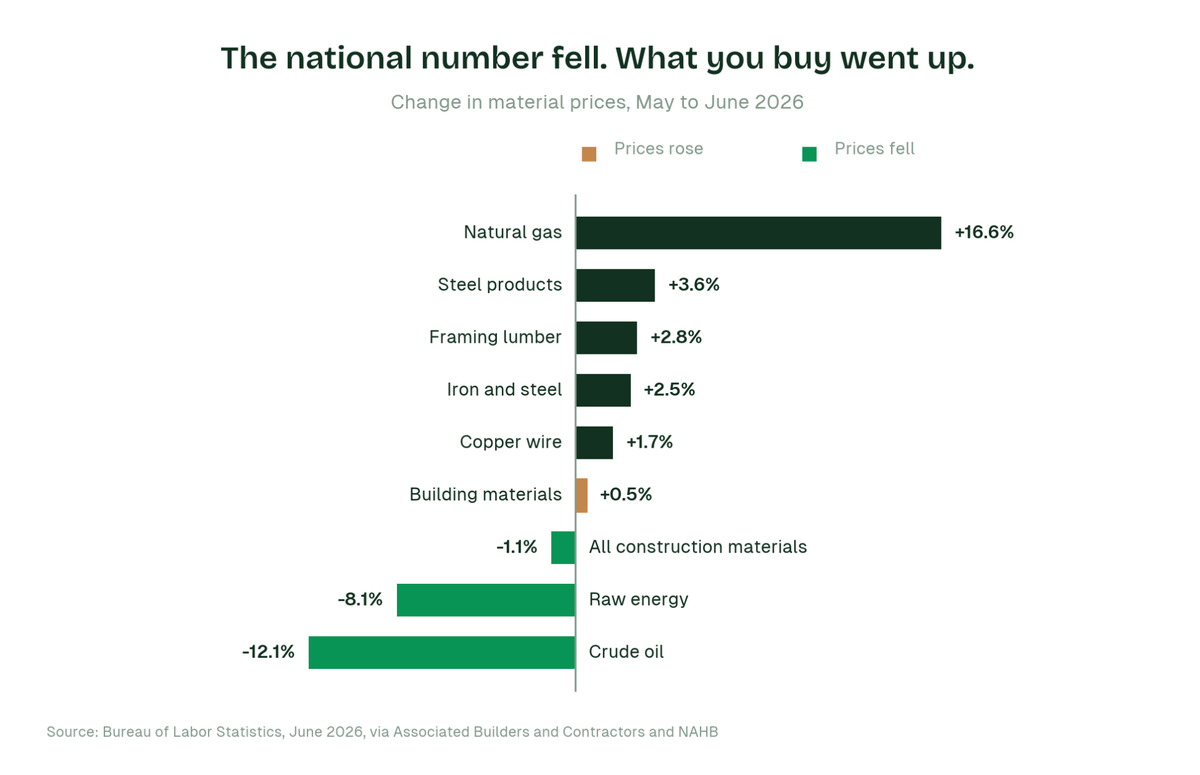
- Overall construction input prices fell 1.1% in June, according to Associated Builders and Contractors analysis of Bureau of Labor Statistics data
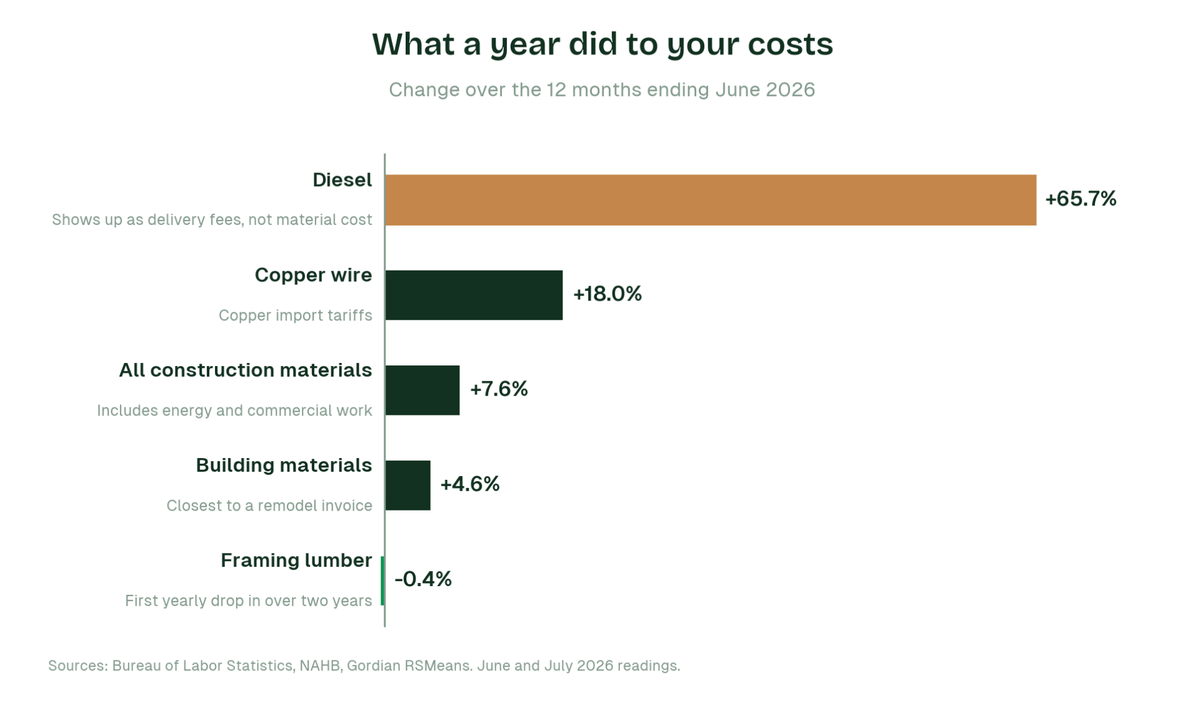
- Building materials specifically rose 0.5% and sit 4.6% above last year, per NAHB
- Overall input prices are still 7.6% higher than they were a year ago
- 74% of remodelers told NAHB their suppliers raised prices since March, with the average increase at 6.7%
That last number is the one to trust. It comes from remodelers reporting what they actually paid, not from an index weighted toward commercial and industrial inputs.
When the national number and your supply house disagree, your supply house is describing your business.
What went up and what came down this month
The aggregate fell because energy fell. Almost nothing a remodeler buys followed it down.
- Framing lumber: wholesale framing lumber moved from $547 to $558 per thousand board feet between July 10 and July 31, a 2.0% gain, according to Madison's Lumber Prices Index. Against the same week a year ago it is essentially flat, at $556. Both halves matter. The month-to-month move is sharp, and the year-over-year streak that ran for nine straight quarters has broken. Sawmill capacity is still down about 6% year over year, which is why the short-term swings stay violent even as the annual line flattens.
- Southern Yellow Pine specifically: delivered SYP prices rose $25 to $40 per thousand board feet in early to mid July, per trade desk reports, alongside similar gains in Hem-Fir and Douglas Fir. If you build decks, porches, or anything ground-contact treated, this is your line item and it is moving faster than the composite.
- Copper wire: up 1.7% for the month and roughly 18% from this time last year. Section 232 tariffs on copper sit underneath that. Panel upgrades and rewires are carrying it.
- Iron and steel: up 2.5% for the month, with steel mill products up 3.6%. This lands on fasteners, joist hangers, post bases, flashing, and every connector in a deck or framing package.
- Fasteners and millwork: the June producer price data showed nails up 1.9%, soft plywood up 0.9%, and general millwork up 1.4% for the month. These are the small lines nobody re-prices, and they add up across a framing package.
- Finish materials from overseas: lighting fixtures, plumbing fittings, cabinet hardware, and appliances carry Section 301 tariffs on Chinese imports ranging from 7.5% to 25%. These are kitchen and bath line items, and they rarely make the headlines because no index tracks them cleanly.
- Windows and doors: up 50% to 75% since 2020. This one is structural rather than cyclical. Energy code requirements, refrigerant transitions, and tariff exposure across multiple categories are all stacked on the same product. Do not expect this to revert.
- Diesel: up 65.7% from a year ago. This is the line most contractors miss, because it does not show up as a material cost. It shows up as a delivery fee, a fuel surcharge, and a longer drive to the one yard that has what you need.
- What actually fell: crude petroleum, down 12.1%, and unprocessed energy materials, down 8.1%. Natural gas went the other way at 16.6%.
A bid built on last quarter's material prices is quietly a discount you did not agree to give.
Why the lumber squeeze is a Southern problem right now
If you build in Texas, the Gulf, or the Southeast, the lumber number you are reading in the national press is understating what your yard is doing.
Four things are stacked on the same product at the same time.
- Southern mill capacity came out and is not coming back. West Fraser closed its Augusta, Georgia SYP mill at the end of 2025. Southern Parallel is shutting its Albertville, Alabama sawmill. No major new Southern Yellow Pine capacity is scheduled to come online to replace either one.
- The South ships by truck, and trucking got expensive. Truck rates are up 30% to 40% with rail delays approaching three weeks. Most Southern shipments have no rail alternative, so the freight increase lands on the delivered price with nothing to absorb it.
- SYP was priced above print. Producers passed freight through by asking $10 to $15 above published prices, after Southern Yellow Pine lagged the rest of the market through the spring. What looks like a spike is partly catch-up.
- The pipelines were already thin. Eastern SPF supply pipelines hit their leanest levels in 24 months and mill order files stretched to two and three weeks. That removed the discounts buyers had been getting in April and May, so the same order costs more even at an unchanged list price.
Put together, a deck or an addition framed in treated Southern pine is carrying cost pressure that a national average will not show you.
Why the oil drop did not help your material costs
Two things are pulling in opposite directions right now, and only one of them reached the shelf.
Energy fell, then reversed
The June decline in oil was real, but it happened inside the month and has already unwound. Renewed conflict in the Middle East pushed oil back up roughly 15%. Whatever relief that drop offered was gone before it worked through to delivered material prices, which lag the commodity by weeks.
Tariffs kept pushing the other way
Section 232 tariffs on steel, aluminum, and copper stayed in place through June, with lower rates applying to derivative products that contain those metals. Section 301 tariffs continue to hit imported finish materials separately. None of those rates moved in June. Every month they hold, more of the cost works through distributor inventory and into what you pay.
The result is an index that fell for reasons that do not touch a bathroom remodel, while the inputs that do kept climbing.
Knowing which number applies to your work is the difference between a bid that holds and a bid that eats your margin.
What rising material costs mean for your open bids
Think about the proposals you have out right now.
A bid you sent five weeks ago was priced on early June numbers. Framing has moved 2.8% since then, and the metal and electrical inside that same job moved more. If the client signs next week, you are building it at today's cost against last month's price. On a $38,000 addition with $14,000 in framing, hardware, and wire, a 3% swing is roughly $420 straight off your margin. That is not a catastrophe on one job. Across a season it is a vacation you do not take.
The harder version is the client who has been sitting on your proposal for two months and finally calls. Most contractors honor the old number because re-pricing means rebuilding the whole estimate at 9pm.
Same-day repricing turns an awkward conversation into a routine one.
How to protect your margin before September
Five moves, in order of how fast they pay off.
- Shorten your validity window on lumber and electrical scopes. Thirty days, not ninety. Write it on the proposal. Most homeowners accept it without comment because they have seen the same headlines you have.
- Re-price anything older than 30 days before you sign it. Not after. The conversation is easy before a contract and expensive after.
- Add a materials escalation clause with a named trigger. Tie it to a specific threshold, like any material moving more than 5% between signing and purchase. A vague clause gets argued about. A specific one gets accepted.
- Quote delivery separately from material. With diesel where it is, bundling the surcharge into your material line hides a cost that is moving faster than the material itself.
- Pull forward long-lead metal and electrical orders. Panels, wire, and connectors are carrying the steepest year-over-year increases and are the least likely to get cheaper this quarter.
Accurate estimates protect contractor margins from the start.
What to watch in August
Two dated items and one open question.
Canadian softwood duties are scheduled to drop. Preliminary antidumping and countervailing rates fell from a combined 35.2% to 25.9%, taking effect in August. The 10% Section 232 tariff stays, putting the total around 35.9%, which is roughly ten points below where it has been. These rates are preliminary and not final. Worth watching, not worth betting a bid on.
Oil is the swing factor. Energy is the largest single driver of the monthly aggregate right now. If the Middle East conflict escalates further, the July and August numbers will look considerably worse than June's.
August price data lands July 15. That release will show whether the lumber flattening is a turn or a pause, and whether the oil rebound has reached delivered material prices yet. We will break it down here the Monday after.
The open question is pass-through timing. Tariff costs reach the shelf on inventory turns, not on announcement dates. Some of what was imposed months ago is still working its way into what you pay this fall.
Bidding in a moving market
Material prices will keep moving. What you control is how fast your numbers catch up.
- Sign up at https://app.handoff.ai/sign-up/
- Build your estimate from a photo, a plan set, or a few lines of scope
- Let live pricing pull current material costs for your zip code
- Re-run any open bid in minutes when prices shift
- Send the updated proposal the same day the client calls
Watching material prices is not the hard part. Rebuilding every estimate by hand when they move is. Handoff removes the guesswork from pricing a job.
Common questions about material prices right now
How far out should I honor a bid in this market?
Thirty days is the safe default for anything lumber, electrical, or steel heavy. Sixty is reasonable for scopes dominated by labor and finish work that has been stable. Whatever you choose, put it in writing on the proposal rather than leaving it understood.
Should I lock in material prices or wait for them to come down?
Lock in what you can on jobs that are already sold, especially metal and electrical. Do not stockpile against jobs you have not signed. Buying ahead on speculation ties up cash that a two or three person shop needs available, and the carrying cost usually outruns the savings.
Is this as bad as the 2021 lumber spike?
No. That was a demand shock with prices multiplying in months. This is slower and broader, driven by trade policy and energy rather than a buying frenzy. The practical difference is that 2021 was impossible to plan around and this is not. Prices are moving in a direction you can see coming, which means a contractor who re-prices regularly stays ahead of it.
Sources
- Associated Builders and Contractors, June 2026 construction input prices analysis: https://www.abc.org/
- Bureau of Labor Statistics, Producer Price Index: https://www.bls.gov/ppi/
- NAHB Eye on Housing, building material prices June 2026: https://eyeonhousing.org/2026/07/building-material-prices-continue-to-rise-despite-energy-price-declines/
- NAHB Framing Lumber Prices: https://www.nahb.org/news-and-economics/housing-economics/national-statistics/framing-lumber-prices
- NAHB Building Materials and Trade Policy: https://www.nahb.org/Advocacy/Top-Priorities/Material-Costs
- NAHB Remodeling Market Index, Q2 2026: https://www.nahb.org/news-and-economics/press-releases/2026/07/remodeling-market-sentiment-remains-in-positive-territory-in-second-quarter
- Gordian RSMeans lumber price update, July 2026: https://www.gordian.com/resources/lumber-price-updates/
- ENR Q1 2026 Cost Report: https://www.enr.com/articles/62734-1q-2026-cost-report-tariffs-contributed-to-price-hikes-for-many-materials-in-2025
- Construction Dive, June 2026 construction input prices: https://www.constructiondive.com/news/construction-ppi-inputs-june-2026/825461/