Your electrician has been on your jobs for ten years. He was there when you had two clients and a borrowed truck. He came out on a Sunday once, for free, when a panel job went sideways and you had a homeowner with no power.
He also missed three scheduled days this spring. His pricing has drifted up while his crew has gotten younger. And you spent last Thursday redoing a trim-out that he shouldn't have left the way he left it.
You've known this for a while but you've done nothing about it, and you know why.
Why is this harder than it looks?
Anyone outside your business would say this is simple. But deep down, it's more than it seems.
He was there when it mattered: Loyalty earned in the lean years isn't something you throw away because of a bad quarter.
He knows how you work: A new sub doesn't know that you want the receptacles at eighteen inches or that you always walk the rough-in before drywall. That knowledge took a decade to build.
You might be the one who changed: Your jobs got bigger and your standards got tighter. He may be doing exactly what he always did, and it stopped fitting.
Your town is small: He knows other contractors. He knows your clients. This isn't a clean break in a big market.
At the end of the day, either way you owe the situation more thought than a text message.
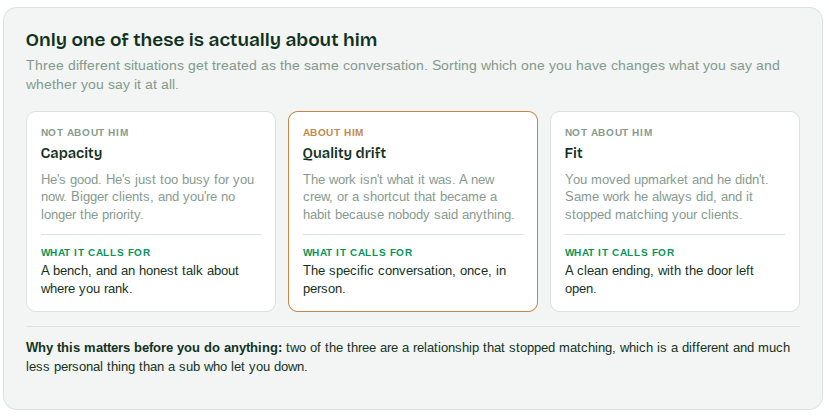
Figure out what’s your real problem
There are three versions of this, and they call for different responses.
The capacity problem: He's good, he's just too busy for you now. Bigger clients, more work, and you're no longer the priority you were. Nothing here is about quality or care.
The quality drift: The work isn't what it was. Sometimes that's a crew he hired. Sometimes it's a shortcut that became a habit because nobody said anything the first four times.
The fit problem: You moved upmarket and he didn't. His work is the same work it always was, and it's no longer the work your clients are paying for.
Only one of these is really about him. The other two are about a relationship that doesn't match anymore.
How to have the conversation
Most contractors skip straight from "I've been unhappy for a year" to "I stopped calling him." That's the version that ends badly and it's also the version that guarantees you never find out whether it was fixable.
Say it directly, once, in person.
Name the specific thing: Not "the work has slipped." The trim-out on the Kellers, and the three missed days in April.
Say what you need: Show up on the scheduled day, or call by 7am. Walk the rough-in with me before drywall.
Ask what's going on: You may find out he lost his best guy in February, or he's going through something, or he thinks your jobs got harder without the price changing.
Say what happens if nothing changes: Not as a threat. As information, so he can decide too.
Do this and one of two things happens. He fixes it, which happens more often than contractors expect from someone who's been with them ten years. Or he doesn't, and you stop wondering whether you gave it a fair shot.
How to build your bench
The reason you're stuck is that he's your only electrician. That's the actual problem, and it'll repeat with whoever comes next.
The typical remodeling firm runs about five employees.
Source: NAHB Eye on Housing, member census
At that size, your subs aren't a vendor list. They're your production capacity, and depending on one person per trade is a risk you're carrying whether you've named it or not.
Every trade you rely on should have two or three names, cultivated before you're desperate. That means giving a new sub one small job a year even when your main guy is available, getting bids from more than one even when you already know who you're hiring, and asking the subs you trust who they would call, since good tradespeople know good tradespeople.
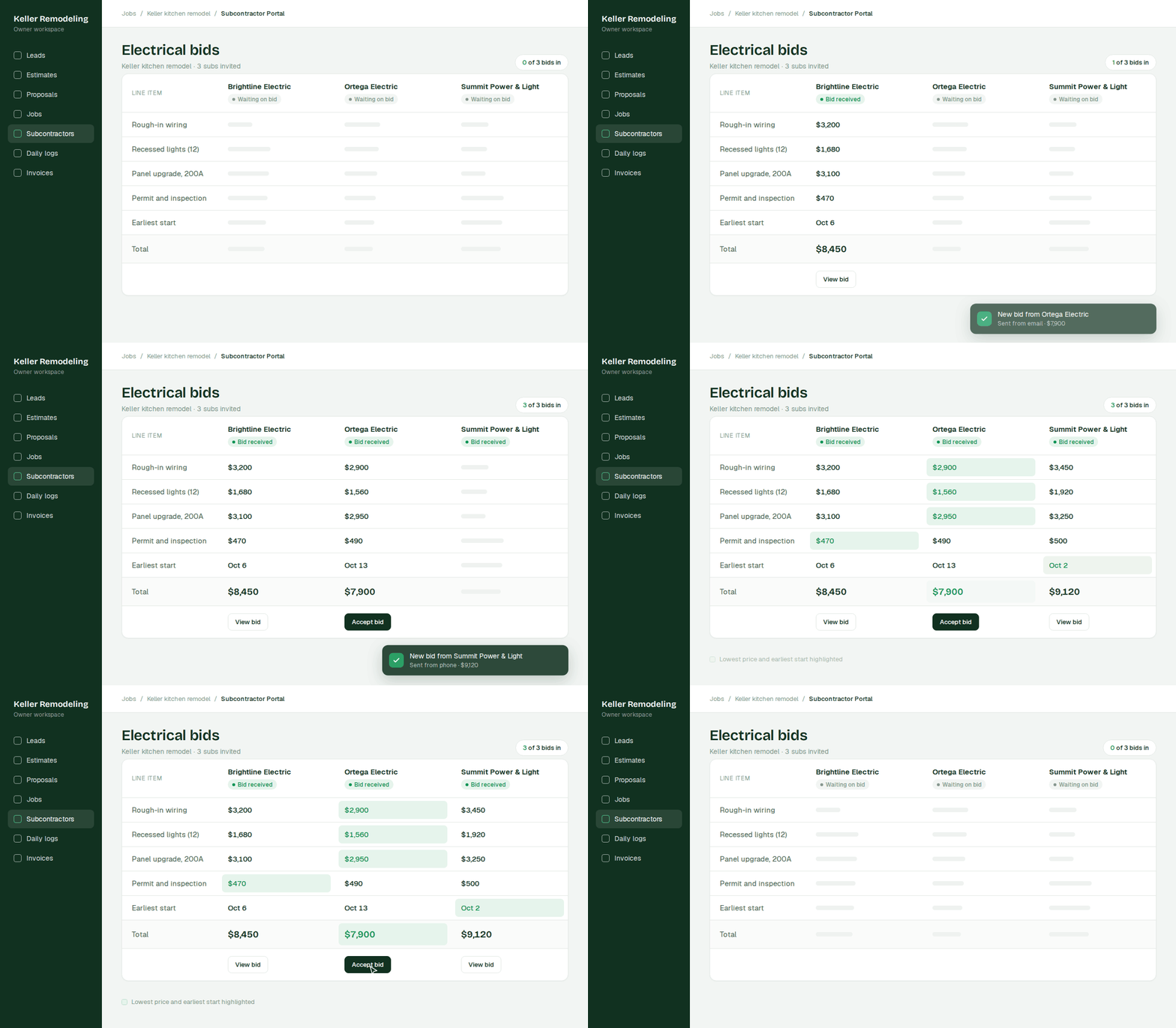
Pro Tip: Keep the bids and agreements attached to the job rather than in a text thread, so comparing them is actually possible.
The Subcontractor Portal on Scale is built for that. Bids come back where you can compare them side by side instead of as three different formats on your phone, and the agreed number stays attached to the project instead of to a conversation you half remember.
A bench isn't disloyalty. It's the thing that lets you make this decision on the merits instead of because you have no other option.
How to set up the new sub
Half the reason a replacement feels worse than the original is that the original had ten years of accumulated context and the new one has a phone call.
Write down what your long-time sub knows without being told:
- Your standard details and how you want things finished
- When you want to walk the work
- How you handle change orders and who approves them
- What your closeout expectations are
AI Documents can generate a written scope from the estimate so the new sub starts with something specific instead of your assumptions. AI Daily Logs turn photos into a dated record of how the work is actually going, which matters more with someone whose work you haven't seen a hundred times.
Give a new sub the context the old one earned, and the first job goes a lot better than it usually does.
How to end it professionally
Small markets have long memories, and how you end this is what people hear about.
Tell him directly: Not by going quiet. He's been on your jobs for a decade and he'll notice the phone stopped ringing, and the version he invents in the absence of a conversation will be worse than the truth.
Pay him quickly: Everything you owe. Don't let the last thing between you be an open invoice.
Leave the door open: If it's honest to do so. Capacity problems change. People come back with better crews. The sub you part with respectfully in March is available to you in two years. The one you ghosted is not.
What is this actually about?
You aren't being disloyal. But you're running a business that has to deliver for the homeowner whose kitchen is torn apart, and that obligation sits above your comfort.
He built his business the same way. He's probably had to make this call about someone else, too.
The kindest version of this is the direct one: a real conversation, a real chance to fix it, and a clean ending if it does not. That's more than most people get, and it's what ten years earns.
Want to see what your subs quoted without scrolling through your texts? Start free for 7 days and keep the bids with the job.
Other FAQs about subcontractors for residential construction
How many subs should you have in each trade?
Two or three you trust, even if one of them does most of your work. The point is not rotating work evenly. It's making sure that when your main sub is booked, sick, or slipping, you have a real option instead of a scramble.
Should you tell a sub why you stopped using them?
Yes, if you've worked together for any real length of time. A short, direct conversation costs you ten minutes and protects your reputation in a market where subs talk to each other. Going quiet saves the conversation and costs you the story he tells instead.
How do you vet a new sub before giving them a big job?
Start them on something small and low-risk, walk the work yourself, and ask the subs you already trust what they know about them. Nothing substitutes for seeing their work on your job. A small first project tells you more than any reference will.