You noticed it somewhere in your forties. The day after a demo day feels different than it used to. Stairs with a bundle of shingles, the third trip, not the first. Getting up off a subfloor.
It’s true. You can still outwork most people on your site. But you did the math one morning and realized the version of you doing this work at sixty isn't the same version doing it today, and the business you built assumes he is.
The biggest question here is about your business model, and you need to answer it while you've still got twenty good years to answer it in.
Why does this sneak up on you?
Because every year you can still do the work is a year the question can wait.
It's never urgent. Then a back goes out on a Tuesday, and you find out what happens to a business where the owner's body is the production capacity.
The median age of the construction labor force is 42.
Source: NAHB Eye on Housing, 2023 American Community Survey analysis
Half the trade is older than that. So if you're reading this and doing the math on your own knees, you're right on schedule, and you're in better shape than most because you're thinking about it before something forces you to.
The contractors who handle this well started when nothing hurting. That's the whole difference.
What are your three ways out?
There are really only three, and most shops end up as some combination.
- Hire production and become the owner: You stop swinging a hammer and start selling, estimating, and running jobs. Your income stops being tied to your hours. The cost is that you've got to get good at things you might not enjoy, and you've got to trust someone else's work with your name on it.
- Stay small and change what you sell: Move toward higher-margin, lower-labor work. More design and project management, less demolition. Sub out the heavy trades. The cost is a different kind of selling, and often a different kind of client.
- Build something you can sell or hand off: Make the business into an asset that has value without you in it. The cost is doing the documentation and systems work now, for a payoff you won't feel for years.
There's a fourth option, which is to keep going and hope. It's more common than the other three combined, but that’s got no plan attached.
Which parts of your week need your body?
Take a normal week and sort your hours into two piles.
The physical work: Demo, framing, carrying, installing, anything on your knees or over your head.
Everything else: Estimating, walkthroughs, client calls, ordering, scheduling, invoicing, chasing subs.
Most owner-operators are surprised by the split. A lot of what wears you out is the second pile, done badly, at night, after a full day of the first one.
The second pile is the part you can still do at seventy, and it decides whether the business makes money. If you're giving it your worst hours, you're underpricing the most valuable thing you do.
How do you shift the work before the labor? Use a construction estimating software.
You don't have to put the tools down next month. You do, however, have to stop doing the office work in the leftover hours, because that's what makes the transition feel impossible.
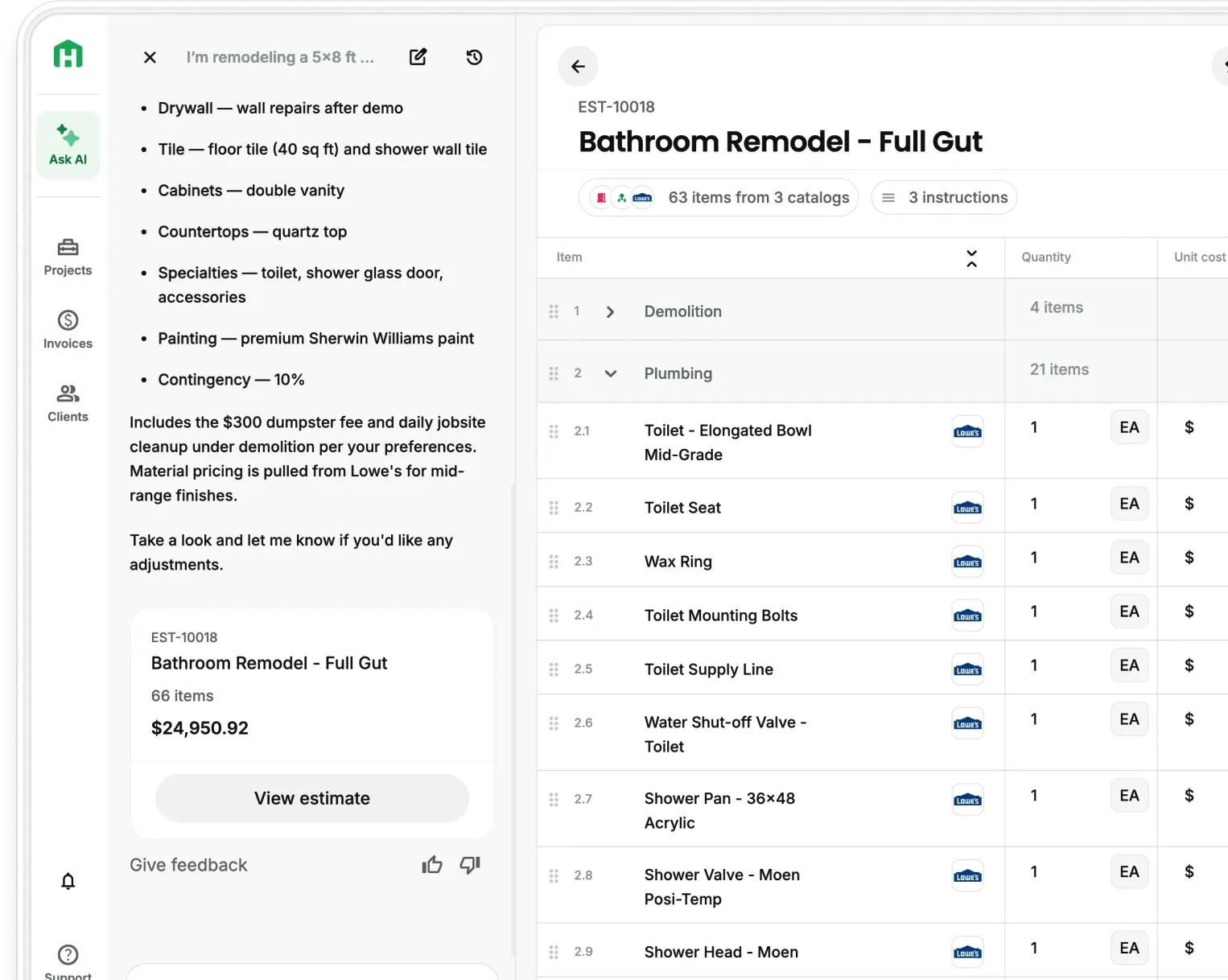
Get the estimate off your evenings: Building it during the walkthrough instead of at the kitchen table gives you back the hours you'd need to take on more of the owner role. That's the whole reason to run construction estimating software built around AI rather than a spreadsheet: Instant AI Estimates and AI Site Walkthroughs let your AI Teammate do the writing while you're still in the driveway.
Get the job out of your head: A lead can't run a day without knowing the scope, the schedule, and what the client's already been told. A contractor job tracking app holds all of that where your crew can reach it, which is the difference between delegating a task and delegating a job.
Take on work that doesn't need your back: Bidding from plans opens up jobs you can win without being on site all day. AI Takeoffs on the Scale plan handle the measuring side of that.
Build the sub bench before you need it: The contractors who transition well have three reliable subs in every trade, cultivated over years. The ones who struggle have one guy for everything and no leverage. Keeping bids and agreements in a Subcontractor Portal on Scale makes that bench something you can manage instead of a list in your head.

You’re not retiring. You’re moving the center of gravity of your business from your body to your judgment, one piece at a time, over a few years.
Who should you talk to about this?
If you've got a spouse or a partner, they've already thought about it. Probably more than you have.
Bring it up on purpose, at a time you both picked. Not as a crisis. As a five-year question: what does this business look like when the physical work is somebody else's job, and what would have to be true to get there?
That conversation's a lot easier at forty-five than it is after an injury, and it's one of the few business decisions where two people thinking about it beats one person deciding.
What are you actually building? What are you leaving behind?
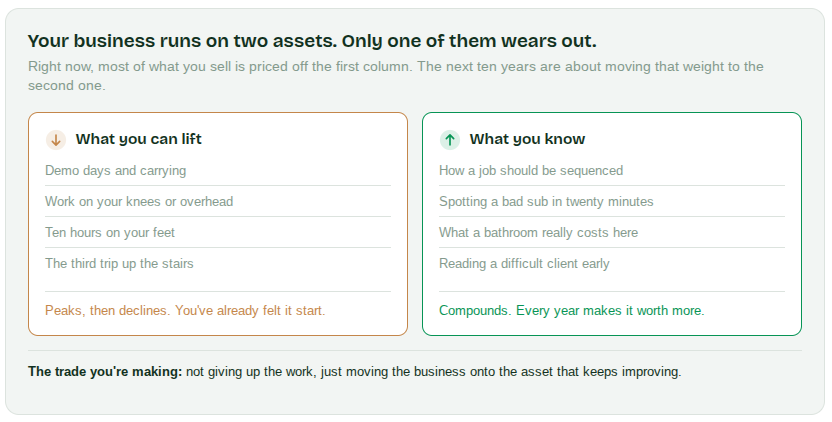
You know how a job should be sequenced. You can spot a bad sub in twenty minutes. You know what a bathroom actually costs in your market, and you know when a homeowner's going to be difficult before they are.
The trade you're making over the next decade is making the business depend on the part of you that keeps improving instead of the part that doesn't.
You've got time to do this on purpose. That's the whole point of starting while nothing hurts.
Want the office work off your evenings? Start free for 7 days and build your next estimate before you leave the driveway.
Other FAQs about planning past the tools in residential construction
How long does it take to get off the tools?
Plan on years, not months, and that's normal. Most owner-operators do it in stages: first the office work moves out of the evenings, then a lead starts running days without you, then you stop being on every job. Trying to do it in one jump is how contractors end up back on the tools within six months.
Can you still run a small shop without doing the physical work yourself?
Yes, and plenty do. It usually means selling a slightly different mix of work, leaning harder on subs, and charging for the project management you were previously giving away. It also means your contractors business software has to hold the estimate, the schedule, the budget, and the client communication, because those four things can't live in your head if you're not on site every day. The shops that struggle are the ones that keep pricing jobs as though the owner's labor is free.
How trustworthy is construction estimating software?
It depends entirely on where the numbers come from. A tool pulling live pricing from your actual supplier in your zip code is trustworthy in a way that a national average never will be. The way to find out is to build a job you've already bid, compare it line by line to the number you sent, and do that three or four times before you trust it on a bid you can't check. Any tool worth using shows you where every number came from, so you can verify a line in a second instead of taking it on faith.
Is it worth hiring someone if you can barely cover your own pay?
Not yet, and that's the honest answer. The step before hiring is getting the paperwork off your nights so you can bid more work with the same body. More volume at the same margin is what makes the first hire affordable, so the order matters.