Tony DiSilvestro finishes the bid before he leaves the client's driveway. He doesn't always send it right away. "I don't want to act like I'm doing it so quick that I'm not paying attention to details," he says. But the work is done: the estimate built, priced for his market, sitting in his truck while the homeowner assumes it'll take a week.
After 30 years of building, Tony has one rule he repeats from every stage he speaks on: "I make money when I write my estimate. It’s not when I finish the job.”
The job box
- Contractor: Tony DiSilvestro, Ynot Build
- Market: Virginia Beach, Virginia
- Experience: 30 years building, from remodels to ICF concrete custom homes, "anything from the dirt to the roof"
- Volume: 25 jobs running at once, 75 to 100 jobs a year across remodels, custom homes, and commercial
- Also: founder of 30+ companies, author of The Business Scaling Blueprint, business coach for 25 years
Where margin actually dies
Tony learned numbers in the restaurant business, where he ran eight locations at once with a P&L for each. "We're in the penny business there. In construction, you're in the dollar business," he says. That training shows up in how he watches a job: he knows what a foot of paper towel costs, so he notices the 2x4 on the ground with nails still in it.
Ask him where contractors lose money and he doesn't start with big line items. He starts with the runs to the supply store. "The biggest killer in construction for margin is the big-box runs," he says. The caulk, the Simpson brackets, the boxes of nails, the blue tape on a 3,000-square-foot house. The consumables that never make it into the estimate but always make it onto the receipt.
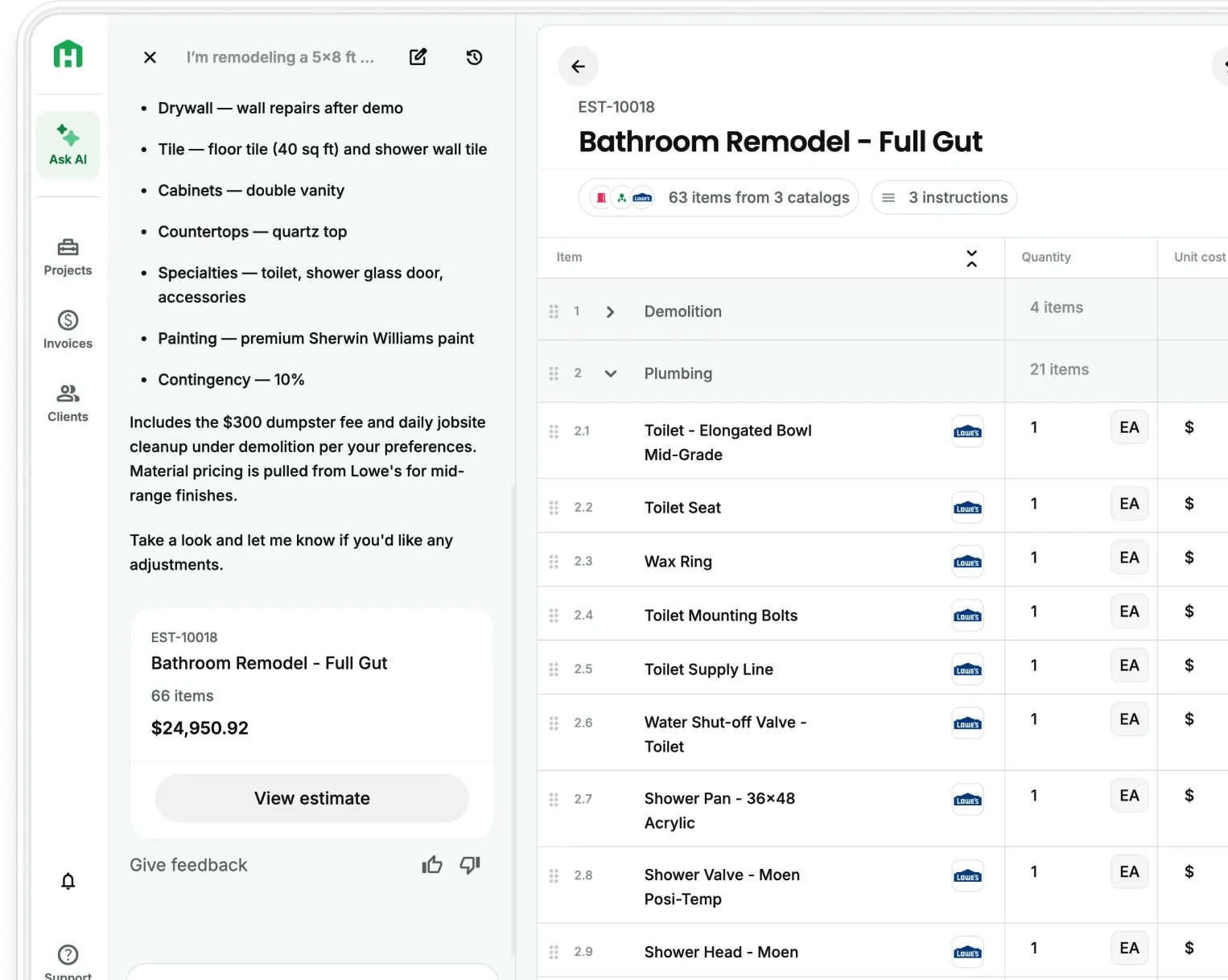
The first thing he noticed in Handoff was exactly that. Every consumable line, in the estimate, priced. ""The very first time I used Handoff, I realized I don't have to worry about those supply runs anymore."
The second killer is stale pricing. "The price of PVC has gone up 30% in the last two weeks. Those bids you did two months ago are not going to be good enough today," he says. Handoff's pricing updates with his market, so the estimate reflects what the material costs now, not what it cost when the lead came in.
The negotiation play: market-specific pricing on Handoff
An hour before recording the conversation this story comes from, Tony got a sub's bid on a decking job: $22,000 for labor. His Handoff estimate had the same labor at $15,000.
He didn't accept the bid, and he didn't just reject it either. "I'm going back to my contractor and saying, hey, I had $15,000 in labor on this bid. What can you do for me? Or explain to me why there's a difference," he says. And if that conversation needs a bad guy: "You can blame Handoff. This is the standard for our area of Virginia Beach. This is the going cost for labor. Can you justify why you're $7,000 more?"
Sometimes the sub has a real answer, custom framing or a roof condition the estimate didn't capture, and Tony takes that straight back to the client as a documented change instead of eaten margin. Either way, the estimate's labor line has become his benchmark: a local, current number that keeps every sub conversation honest. He still adds a 3% buffer to every bid. Thirty years teaches you that too.
The delegation problem, solved without a hire
Tony coaches contractors through scaling, and he says the wall they all hit is the same one: trust. "One of the biggest problems with entrepreneurs is they have a huge trust issue. They don't trust anybody, so delegation becomes a huge issue."
His fix is blunt: "Handoff is the delegation tool. That's what it is. It's just like having an employee for me. I'm delegating my estimate to them."
It's spreading through his team the same way. His project managers now run their own estimates, and one recently built her first Gantt chart in the platform. For a company running 25 simultaneous jobs on roughly 20% overhead, every task that moves off Tony's desk without a new salary attached is margin kept.
Steal this play
Three habits from Tony's playbook that work at any size:
- Divide, don't multiply. If you want 25% margin, don't multiply your cost by 1.25. Divide by 0.75. On a $50,000 job that difference is four to five points of margin, and Tony says most of the 400 contractors in the room when he asks this question are giving those points away on every job.
- Audit every receipt against the estimate. A $500 supply-store receipt comes back to the office, Tony's question is: where's that $500 in the estimate? If it isn't there, the estimating process has a hole to fix before the next bid.
- Run every job as its own P&L. Allocate overhead, fuel, insurance, and marketing across your active jobs, and check the margin you bid against the margin you finished with. "If you can do it efficiently with one job, now you're ready to scale. If you don't know your numbers, you shouldn't be talking scaling."
The verdict from a guy who's seen everything
Tony has founded more than 30 companies and evaluates software the way he evaluates subs: quickly and without sentiment. "Handoff is one of the easiest tools I've ever used," he says. "They called me, and within an hour I did an estimate right on the phone."
His advice for contractors circling AI but not sure where to start: begin where the money is made. "Start with the estimating, because it's the purest piece of your construction business. If there was anything I was going to invest in AI right now, it would be Handoff and the estimating tool."
Want your estimate done before you leave the driveway? Start your free trial and price your next job while you're still on site.
Other FAQs about how Handoff makes the difference between winning and losing jobs
What's the difference between markup and margin for contractors?
Markup is a percentage added on top of cost; margin is the percentage of the final price that's profit. A 25% markup only yields about 21% margin, so contractors who quote "25%" by multiplying cost by 1.25 give away four to five points on every job. To hit a true 25% margin, divide cost by 0.75 instead.
How do contractors use AI estimates to negotiate with subcontractors?
By treating the estimate's labor lines as a local benchmark. When a sub's bid comes in above the estimate, contractors like Tony ask the sub to justify the gap against current going rates for the area. Legitimate differences become documented change conversations with the client; padding gets negotiated out before the job starts.
Does AI estimating catch small materials like fasteners and caulk?
Yes, and those consumables are where margin quietly leaks. Handoff builds estimates that include the small stuff, the caulk, brackets, fasteners, and tape that rarely make it into a manual estimate but always show up on supply-store receipts mid-job.