The job is done. The homeowner loves it. They told you so, standing in their new kitchen, and they meant it. But that was five weeks ago and the final invoice is still open.
You've sent two polite follow-ups. You're drafting a third in your head at 6am, trying to find a version that doesn't sound like you're accusing them of anything, because you're not, and you still want the referral. Meanwhile you've already paid your tile guy, your plumber, and your own crew out of a job that hasn't fully paid you. So how do you reconcile this without pulling your hair out?
Are last final payments just memory problems?
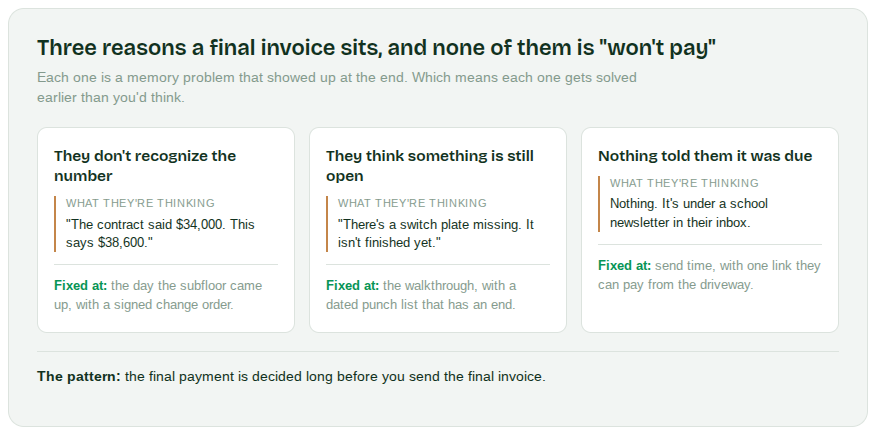
When a homeowner sits on a final invoice, the reason is usually one of these three:
- They don't recognize the number. The contract said $34,000. The final invoice says $38,600. You know exactly where the extra came from, because you lived it: the subfloor, the panel upgrade, the tile they upgraded in week three. They half-remember agreeing to some of it, in a hallway, while you had a saw running.
- They think something is still open. There's a switch plate missing and a touch-up on the door casing. To you, the job is done and those are punch items. To them, the job isn't done, so paying in full feels premature.
- Nothing told them it was due. It's in their email somewhere, under a school newsletter and an insurance thing. They’re not avoiding you. They forgot, the way you forget things that aren't sitting in front of you.
All three are memory and documentation problems that showed up at the end. Which means the fix is almost never at the end.
The final payment is decided at signing
A homeowner who watched the number move isn’t surprised by it. On the flip side, a homeowner who is surprised by it slows down, and a slow homeowner looks exactly like a difficult one, even when they're just confused.
Two things make that concrete on a small shop:
- Bill in pieces, not at the end. If your only invoice is the last one, then every disagreement in the entire project arrives at once, at the moment you have the least leverage and the most fatigue. Progress billing spreads that out. It also tells you early whether this homeowner pays on time, while you still have work left to adjust to that information.
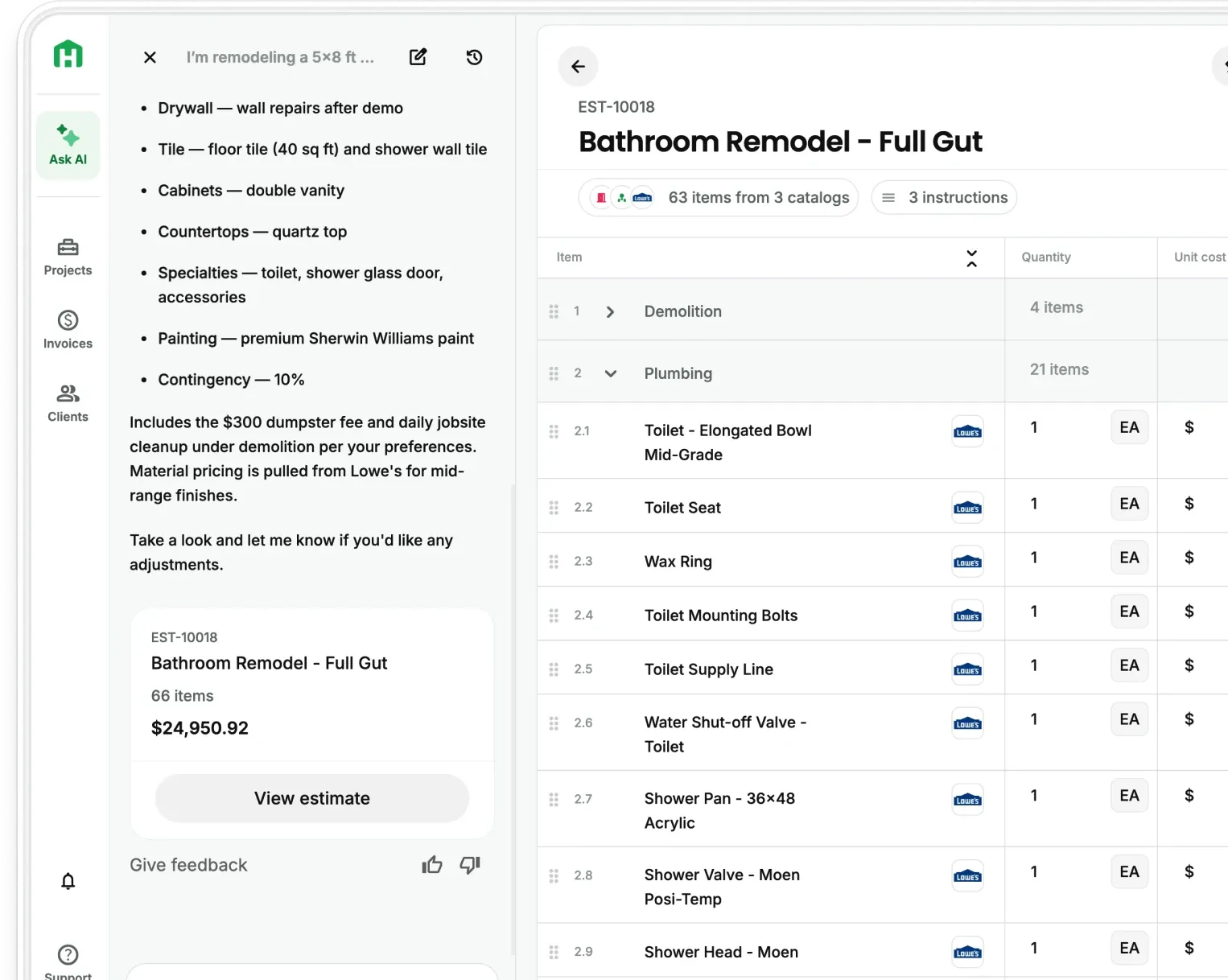
- Show the number as it moves. AI Budget Tracking on the Pro plan keeps your approved estimate as a live budget, with receipts and actual costs landing against it as the job runs. That's built for your margin, not for the client, but it's the same underlying discipline: when the real number is visible during the job, the final number is never a reveal.
Know your own number before you ask for theirs
A lot of contractors don't know what the job actually made until weeks after it closes. Receipts are in the truck. Sub invoices are in email. Crew hours were on a legal pad, then in a text, then in somebody's memory. So when the homeowner pushes back on $2,400, you're negotiating without knowing whether $2,400 is your entire profit on the job or a rounding error.
That's a bad place to make a decision from. You either hold firm on something you should have let go, or you eat something you couldn't afford, and you don't find out which until later.
Getting the number closed while the job is still running fixes it:
- Time Tracking on Pro and Scale puts crew hours against the project as they happen, so labor cost hits the budget instead of arriving at payroll. On Scale, subs and vendors can clock in through the Subcontractor Portal without taking a paid seat.
- The Subcontractor Portal on Scale lets subs upload their invoices in the same place they bid, so their costs come into the project budget instead of your inbox.
- Receipts go in as you get them rather than in a shoebox reconciliation later.
When you know your real margin on the day you send the final invoice, the conversation changes. You're not defending a number you're unsure about. You know exactly what you can give and what you can't.
The follow-up that actually works in residential construction
When the invoice is out and nothing is happening, the instinct is to write a longer message. More explanation, more apology, more hedging.
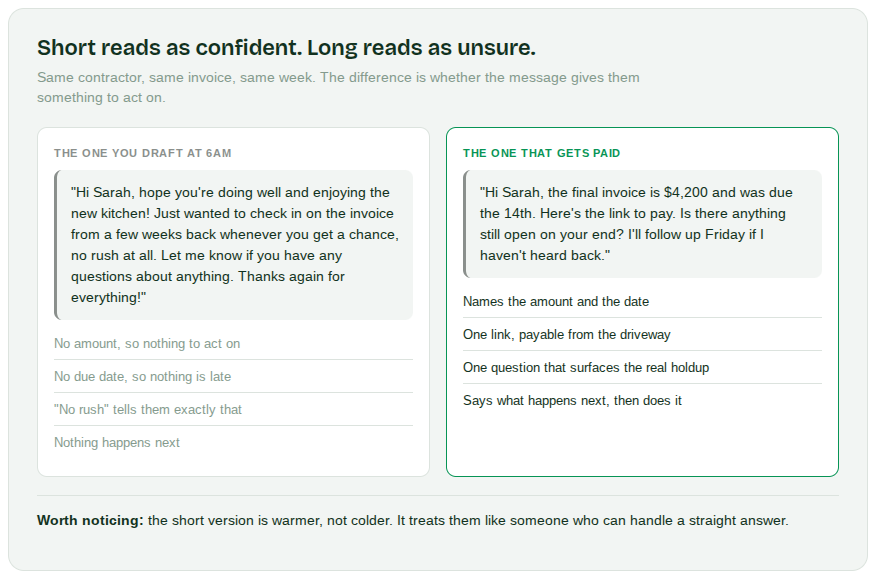
Do the opposite. Long messages read as uncertainty, and uncertainty invites negotiation.
What works is short, specific, and easy to act on:
- Name the amount and the date. "The final invoice is $4,200 and was due the 14th." Not "just wanted to check in on the invoice."
- Give them one link. Not an attachment they have to find. If they can pay from their phone in the driveway, they will.
- Ask one question. "Is there anything still open on your end?" This one does real work: it either surfaces the punch item they were quietly waiting on, or it removes the excuse.
- Say what happens next. "I'll follow up Friday if I haven't heard back." Then follow up Friday.
Invoicing handles the mechanics of the link and the record. The Client Portal gives them one place to see the job, the documents, and what's owed, so "let me find that email" stops being a reason.
Pick up the phone before you get angry
Somewhere around week three, most contractors go quiet. Emails stop, resentment starts, and the next contact is colder than the last.
Call instead. Not to confront. To ask.
Nine times out of ten you learn something in ninety seconds that six emails would not have surfaced. They're waiting on a loan disbursement. They thought their spouse paid it. They're still bothered by the grout line in the corner and didn't want to bring it up because everything else went so well.
A homeowner will sometimes hold a whole final payment over a small thing they feel awkward mentioning. You cannot fix what you don't know about, and email is where discomfort goes to hide.
When it's genuinely a problem
Sometimes the money isn't there, or the person has decided not to pay.
Your options here are state-specific. Lien rights, notice requirements, and collection timelines vary enough that anything I told you here would be wrong somewhere. Talk to an attorney licensed where you work, and do it before you're at ninety days, because most of those remedies have deadlines that started running the day you finished.
What we’d say is this: the documentation that protects your margin during the job is the same documentation that supports you in that conversation. Signed change orders, dated logs, itemized costs. If you build the habit for the ordinary jobs, you have it for the rare hard one.
The version worth aiming for
The goal is to build the job so the last payment is unremarkable.
The homeowner has watched the number move all along. Every change is signed and dated. They've been billed in pieces, so the final draw is the smallest one, not the scariest. You know your real margin before you ask. And when the invoice goes out, it arrives with one link and one clear number.
That's a job that closes itself.
Want the number to be current when you send the last invoice? Start your free trial and run one project with the budget tracked as it happens.
Other FAQs contractors ask about final payments
How long should you wait before following up on a final invoice?
Follow up the day after it's due, not a week later. A prompt, matter-of-fact reminder reads as normal business practice. Waiting two weeks makes the first follow-up feel like a confrontation, for both of you.
Should the final payment be a large share of the job?
Smaller is better. If your last draw is 30% of a $40,000 job, you're carrying $12,000 of risk into the least predictable part of the project. Progress billing keeps the final number small enough that nobody feels the weight of it.
What if the homeowner is holding payment over punch list items?
Get the list in writing, put dates on each item, and confirm what happens when they're done. Most punch disputes are actually about not knowing when it ends. A dated list with a completion date turns an open-ended standoff into a schedule.