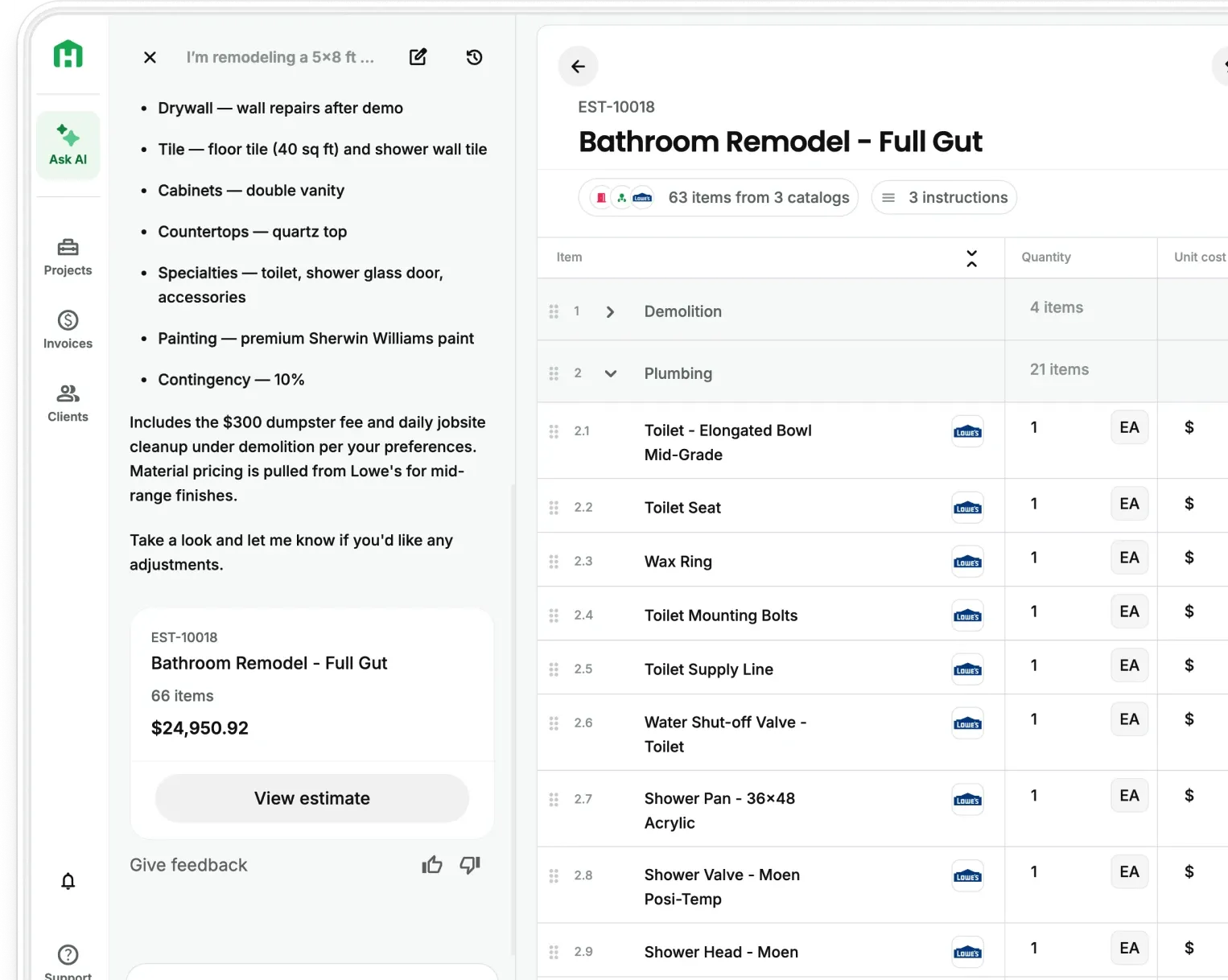
Before a remodeler signs up for AI estimating software, the same nine questions come up almost every time: will it work for my jobs, which plan do I need, what happens to my data, can it track my crew, and a handful more. Here are straight answers to all nine — no demo required, no dodging the ones where the honest answer is "not yet." If you're weighing whether construction estimating software fits a two-person shop, this is the list to read first.
Which plan do I need, and what counts as an AI interaction?
One contractor thought his plan gave him 50 full jobs and found out it was 50 AI interactions which is a real gap worth clearing up before you sign.
- An interaction is a request to the AI, not a whole project. Building one estimate uses several.
- Low-volume shops bidding a handful of jobs a month fit a lighter plan. Daily users need room to run.
- Plan-set takeoffs sit on the top tier; lighter estimating and proposals sit lower.
- Match the plan to how often you actually bid, not to the longest feature list.
Check the current plan breakdown and pricing before you decide. Handoff is built for contractors doing $500K to $3M a year, so there's a tier that fits without overpaying.
What happens to my data if I switch software?
Contractors who've been burned by a five-CRM history ask this first, and they're right to. SCORE has long advised small businesses to confirm data portability before committing to any platform.
- Your clients, projects, pricing, and history come with you. Migration is part of onboarding, not a DIY project.
- You can run your current tool and a new one side by side for a trial before moving anything for real.
- Ask any vendor the exit question too: if you ever leave, can you take your data out? A straight answer there tells you who to trust.
Your AI Teammate is meant to be the place everything finally lives in one spot, not another silo you have to escape later. Handoff keeps your business data yours.
Will AI takeoffs work for my type of jobs?
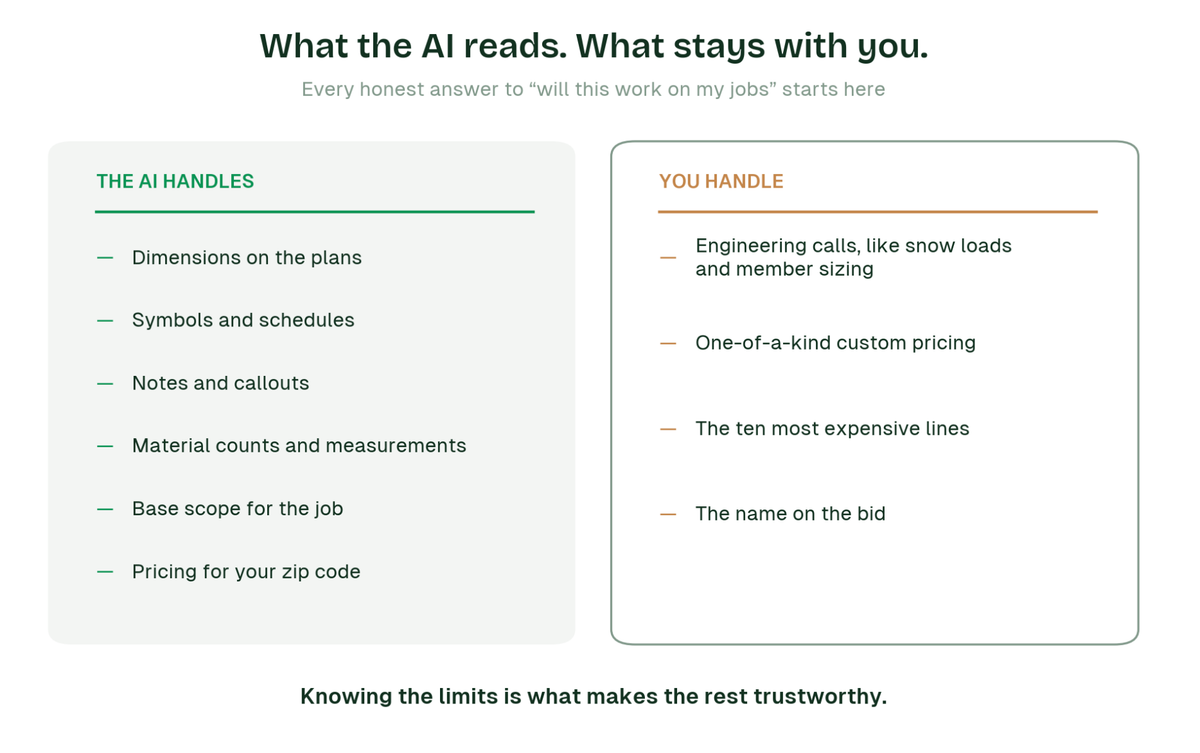
- If it's drawn or written on the plans — dimensions, symbols, schedules, notes — AI reads it and carries it into the takeoff.
- Engineering calls that aren't on the prints, like snow loads or member sizing, stay with your engineer. Good software doesn't pretend to stamp drawings.
- One-of-a-kind custom work still needs your pricing. AI gets the measurements and base scope fast; your specialty numbers come from you.
- Residential plans up to 5,000 sqft are the sweet spot, which covers nearly every kitchen, bath, addition, deck, and custom home a small remodeler bids.
Knowing the limits is what makes the rest trustworthy. See the full breakdown in what AI can and can't read on your plans.
Can it track my crew's hours?
Several contractors asked for geofenced clock-in — auto clock-in when a crew member hits the site, auto clock-out when they leave — to stop paying for early clocks and long lunches. Right now, dedicated time tracking isn't a Handoff feature. But not for long…
- If automated time tracking is a must-have today, you'll still need a standalone tool for it.
- It's on the roadmap because enough contractors have asked. You can track what's shipping on the public roadmap.
- What Handoff does capture is crew and material notes inside daily logs, tied to the project.
We'd rather tell you plainly than oversell it. That's the same reason the estimates you do get are ones you can trust.
How do I stop subs from nickel-and-diming me?
- A complete scope of work, so "that wasn't included" stops being a daily conversation.
- A material list attached to the agreement, so the one-screw mobilization charge has nowhere to hide.
- A bid request in one format, so three sub quotes actually compare.
- A running payment record per sub, so 1099 season is a print job.
The National Association of Home Builders treats written agreements as the baseline with trade partners for exactly this reason. Full playbook here: four documents that stop subs from nickel-and-diming you. Complete paperwork protects your margin from the first handshake.
Who answers my phone while I'm on the tools?
The number one complaint homeowners have about contractors is not getting called back. Handoff can help.
- Lead forms that create a project automatically mean the lead is captured even when you can't pick up.
- Automated follow-up by text and email keeps a warm lead from going cold on a Tuesday.
- A shared schedule stops the double-booking that happens when it all lives in your head.
Fast, automatic capture means more bids submitted per week without you chained to the phone. See how leads flow in through connected workflows.
Can I give clients options without redoing the whole estimate?
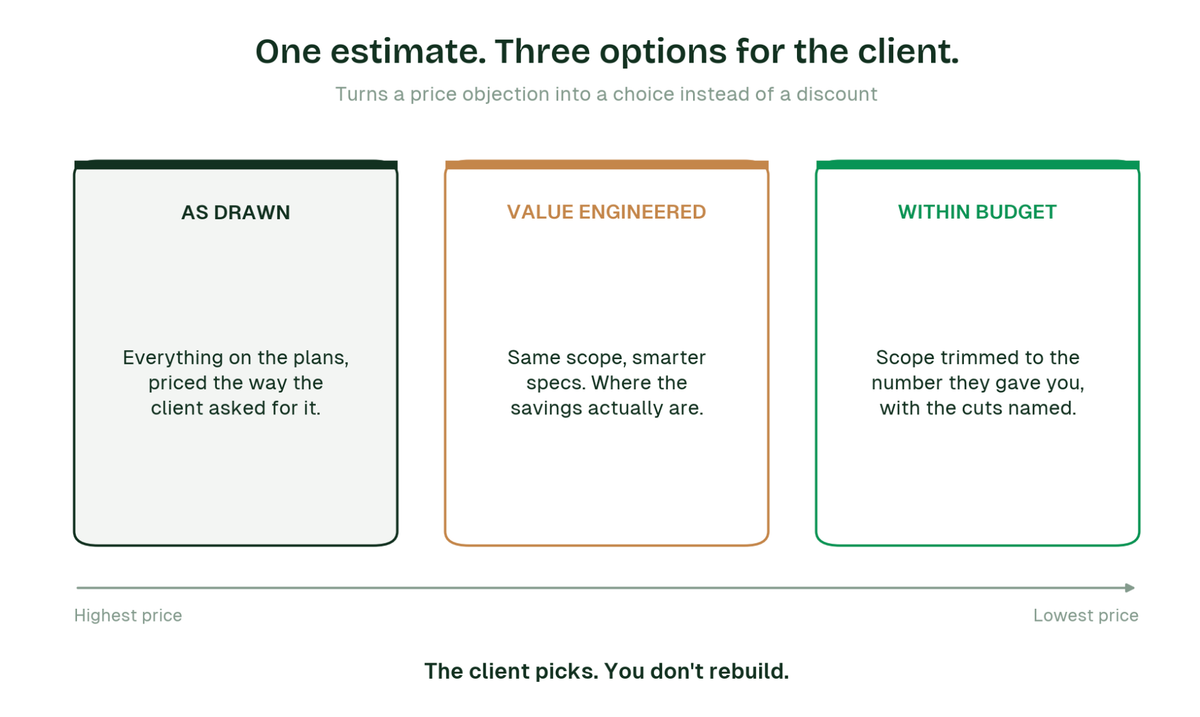
Clients almost always ask to add the pocket door or price a nicer finish. Redoing the estimate three times kills the momentum. One remodeler runs every proposal as a three-column choice: as-drawn, value-engineered, and within-budget.
- Options turn a price objection into an upsell conversation instead of a discount.
- Generating variants from one estimate keeps your numbers consistent across all three.
- The client picks; you don't rebuild.
Contractors who present options close more jobs without lowering their base price. Your AI Teammate builds the proposal once and lets the client choose from it.
I have more work than crews — can software fix that?
Software won't hire for you, but it changes what your crew can carry. The hardest problem some remodelers face isn't leads. It's labor. No app hires a framer. What software does is take the office load off the owner so more of the day goes to the work only people can do.
- Every hour not spent estimating at night is an hour back for running jobs and finding crew.
- Systematized bids and follow-ups mean you can take on more without a bigger office team.
- Harvard’s Joint Center for Housing Studies tracks remodeling demand at over $500 billion a year — which means the constraint for most small shops is capacity, not work.
Handoff won't swing a hammer, but it frees the owner who's swinging too many.
Is the AI accurate enough to trust on a real bid?
- It's trained on real residential projects and priced to your location, not a national average.
- It flags its own assumptions and any plan clashes, so your review takes minutes.
- The bid still carries your name, so you confirm the ten most expensive lines before it goes out.
G2 reviews from residential contractors consistently call out how close the numbers land to their own. Accurate estimates protect your margin from the start.
Get your own answers, on your own jobs
The fastest way to settle these nine questions is to run one of your own bids through it:
- Start a free trial — no credit card needed
- Build an estimate for a job you've already priced, so you can compare
- Load your catalogs and rates in the second onboarding session
- Send a real proposal and see how it lands with a client
Buying software shouldn't take a leap of faith. Handoff answers these questions the same way it runs your estimates — straight, and on your terms.
Other FAQs people ask us
Do I need to be tech-savvy to use AI estimating software?
No. The contractors who get the most out of it are comfortable with a phone and photos, not spreadsheets or CRMs. If you can text a picture and talk into your phone, you can build an estimate.
How long does it take to get set up?
Most remodelers build their first real estimate the same day they sign up. A second onboarding session is where you load your pricing, catalogs, and templates so future estimates come out in your format automatically.
Can I try it before I pay?
Yes. A free trial lets you build estimates on your own jobs before committing, and you can run it alongside whatever you use now so nothing breaks mid-project.