Your most valuable asset isn't in the truck. It's your time, and manual estimating spends it faster than anything else in your business. We broke this down in a recent video, and this post walks through the same math so you can run it against your own numbers. The short version: between non-billable takeoff hours, fatigue errors, and bids that go out too slow, the old way costs a small contracting business tens of thousands of dollars a year. Automating the estimate is how you get it back.
Where your time actually goes on a manual estimate
Every manual estimate is really three jobs stacked on top of each other. First comes the takeoff: measuring rooms, counting outlets and fixtures, tallying linear feet of trim off the plans. It's tedious work that's easy to get wrong, and one slipped measurement can throw the whole bid.
Then comes pricing. You're digging through old price sheets, calling suppliers for current costs, and chasing sub quotes through phone tag and text chains. Finally you assemble everything into a proposal you hope looks professional enough to stand out.
By the time it's done, you've sunk hours or days into a bid you might not win. That's time you didn't spend on a job site, in front of a new client, or home at a decent hour.
The math on non-billable estimating hours
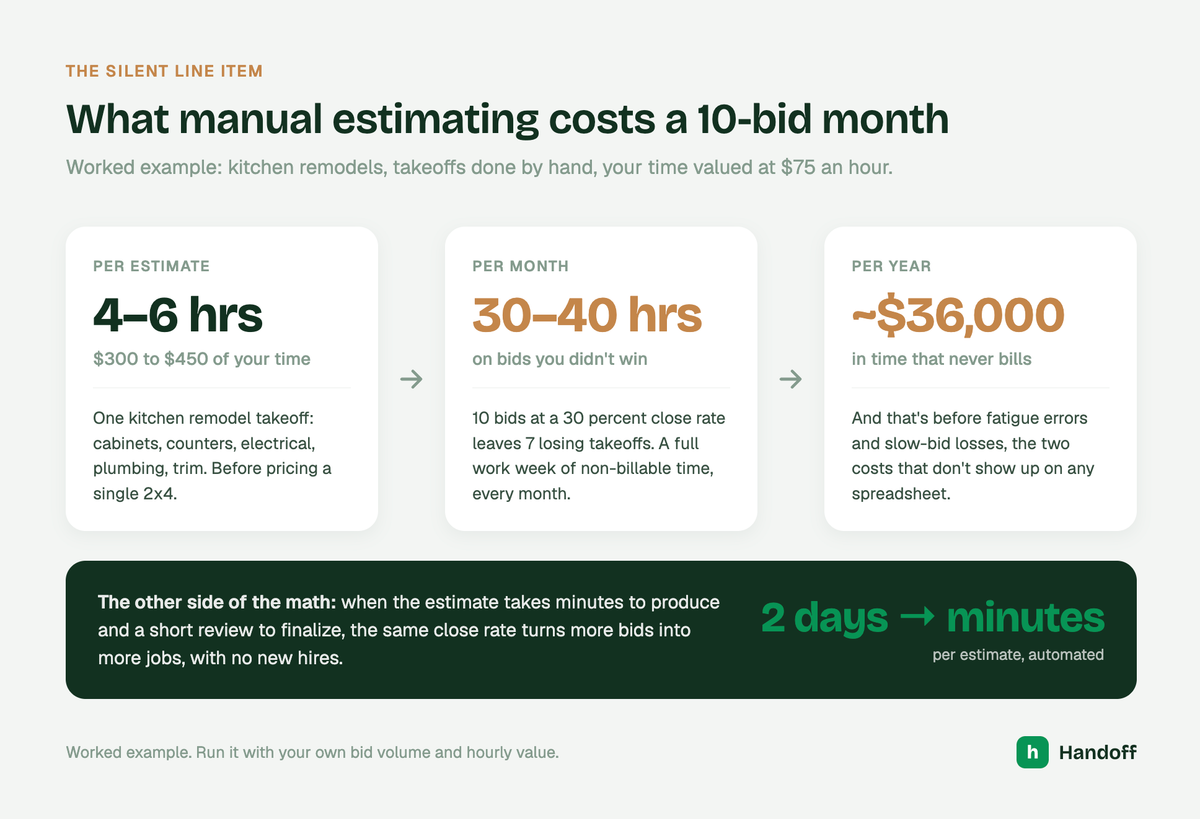
Put real numbers to it with a typical kitchen remodel. The takeoff alone runs 4 to 6 hours: cabinets, countertops, electrical, plumbing fixtures, trim. If you value your time at $75 an hour, that's $300 to $450 in labor before you've priced a single 2x4 or written a word of the proposal.
Now scale it across the business. Bidding 10 jobs a month at a 30 percent close rate means 30 to 40 hours a month spent on takeoffs for jobs you didn’t win. That’s a full non-billable work week, every month, or roughly $36,000 a year in time that never turns into revenue. Run the same math with your own bid volume and hourly value. The number is usually worse than you expect.
Errors and slow bids cost more than the hours
The hours are only the visible cost. Manual takeoffs done at night, after a full day on site, are where scope items get missed: the HVAC relocation on sheet 17, the structural beam, the bathroom that never made it from the walkthrough notes into the estimate. On a $50,000 kitchen remodel, a missed scope item worth 10 percent of the job means eating $5,000 or pricing yourself out of contention.
Speed cuts the same way. Homeowners today compare response times the way they compare prices, and if your estimate takes three days while another contractor’s lands in a couple of hours, the faster bid looks more professional even at the same number. Plenty of good contractors lose jobs on turnaround alone. Fast estimates lead to more bids submitted per week, and more bids at the same close rate is the simplest growth math in the business.
What changes when you automate construction estimates
Automating the estimate doesn't mean handing your judgment to software. It means the counting, pricing lookups, and document assembly stop being your job.
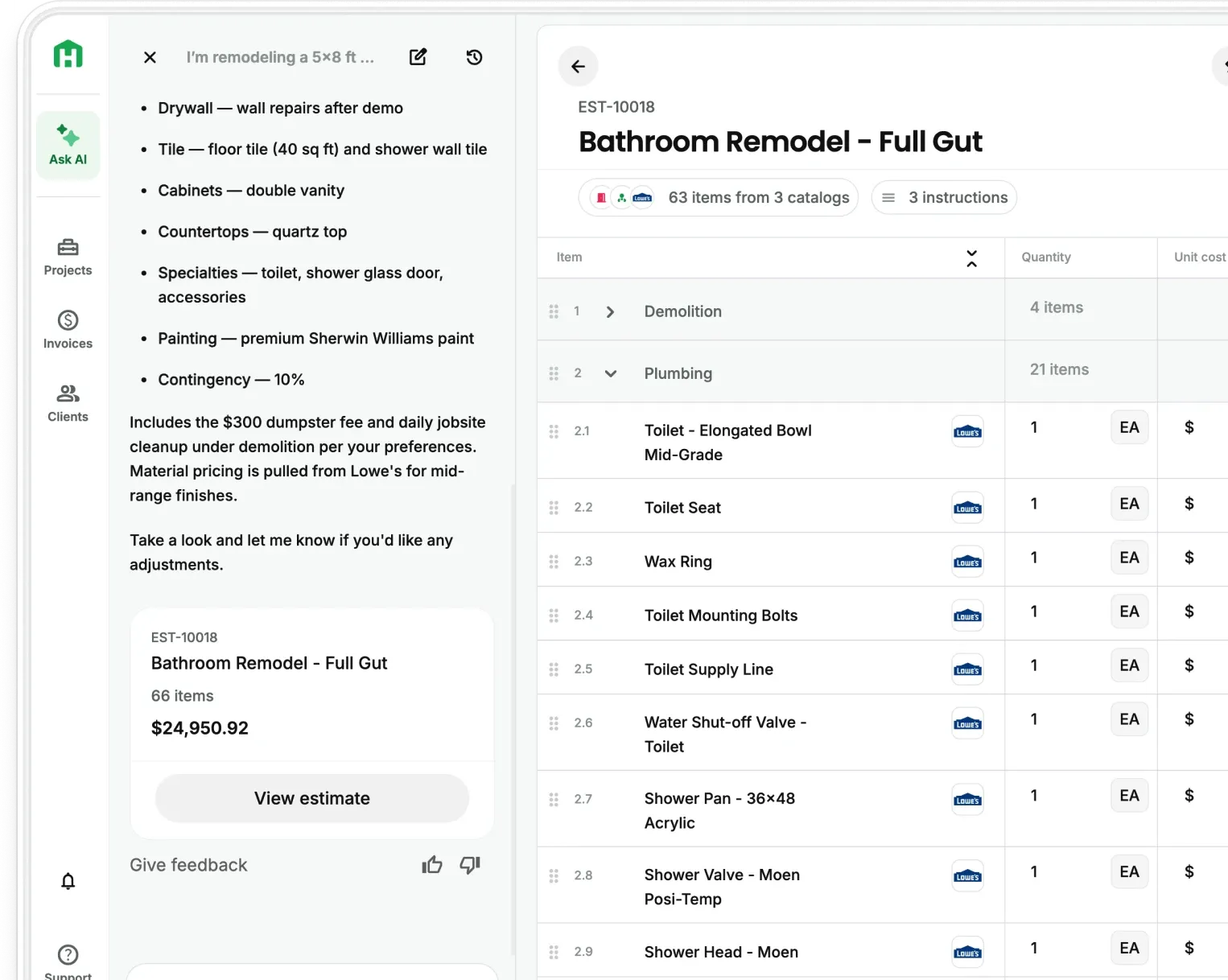
Upload the plans, or walk the site taking photos and talking through the scope into the app. Your AI Teammate reads the documents, counts the symbols and quantities, and comes back with a detailed estimate covering scope, materials, labor, and markup. You connect your own pricing and templates so the numbers reflect your suppliers and your margins, then generate a client-ready proposal without wrestling Word, Excel, and your photo reel into agreement.
The estimate that took two days now takes minutes to produce and a short review to finalize. Same close rate, several times the bid volume, no new hires. That's the whole trade.
Case Study: Two contractors who made the switch
Tim O'Keefe runs Keller Construction Group in Chicago, handling kitchen remodels through full additions. His manual process ate 2 to 4 hours per estimate, and he knew it was capping how many jobs he could bid. He ran his first AI estimate from the couch as a skeptic's test, and it took 20 minutes start to finish. He went from four proposals in eight hours to twelve in the same window, sent over 40 proposals in a single month, and started sending proposals before leaving the job site. The automated follow-ups mattered just as much, because forgetting to chase prospects had been one of his biggest silent revenue leaks.
Matthew Dodge of Lasting Impressions in Pennsylvania has been quoting from walkthroughs for years, and even seasoned pros miss things. On one high-stakes renovation, an entire bathroom never made it from his mental notes into the estimate, a $2,500 scope gap that would have come straight out of his margin. Because he'd started photo-based AI estimating, the AI flagged the missing bathroom when it processed his site photos. The estimate caught what memory dropped.
What to look for in AI estimating software
Not every AI tool is built for a working contractor. Before you commit, check for:
- Both plan-based and photo-based estimating, since not every job comes with a plan set
- Editable pricing logic, so you control margins instead of the software
- Trade-level detail rather than generic lump sums
- Proposals that look professional to a homeowner with minimal editing
- Follow-up and invoice automation, so leads and payments don’t depend on your memory
- Workflows that finish on site, not "send it to the office later"
The test that settles it: run a job you've already bid through the tool and compare the AI's numbers against your manual ones. The output will tell you more than any feature list.
Get the estimating hours back this week
The contractors pulling ahead right now aren't working longer. They've stopped spending their evenings counting fixtures. Here's the fastest way to see the difference on your own numbers:
- Sign up for Handoff free, no credit card needed
- Run a recent job through it, from plans or from site photos and a spoken scope
- Compare the estimate against the one you built by hand, line by line
- Send your next real bid the same day the client asks for it
Slow bids and missed scope aren't a work ethic problem. They're a workflow problem, and Handoff fixes the workflow.
Other FAQs about automating construction estimates
Is AI estimating accurate enough to bid from?
Yes, with your review. AI doesn't get tired at 9pm or skip a page, which removes the fatigue errors manual takeoffs are prone to, and it flags its assumptions so you know exactly what to verify. The bid still carries your name, so the final check stays yours.
Does AI estimating replace the contractor's judgment?
No. It replaces the counting, the pricing lookups, and the document formatting. Scope decisions, pricing strategy, and the final number stay with you, which is exactly where they belong.
Does AI estimating work on small remodels and fix and flips?
Small jobs benefit most, because remodels are where missed scope items happen most often. A photo walkthrough with a spoken scope can produce an editable, professional estimate in minutes, fast enough to send before you've left the driveway.