Buildertrend Gives You Tools. Handoff Gives You the Takeoff.
There's a pattern in construction software: the bigger the platform, the more features get added, and the less any single feature gets the attention it deserves.
That's Buildertrend takeoffs in a sentence. Buildertrend is a powerful project management platform used by thousands of home builders and remodelers. But its takeoff feature is exactly what you'd expect from a platform tool: functional, manual, and built to serve the platform rather than the estimating workflow.
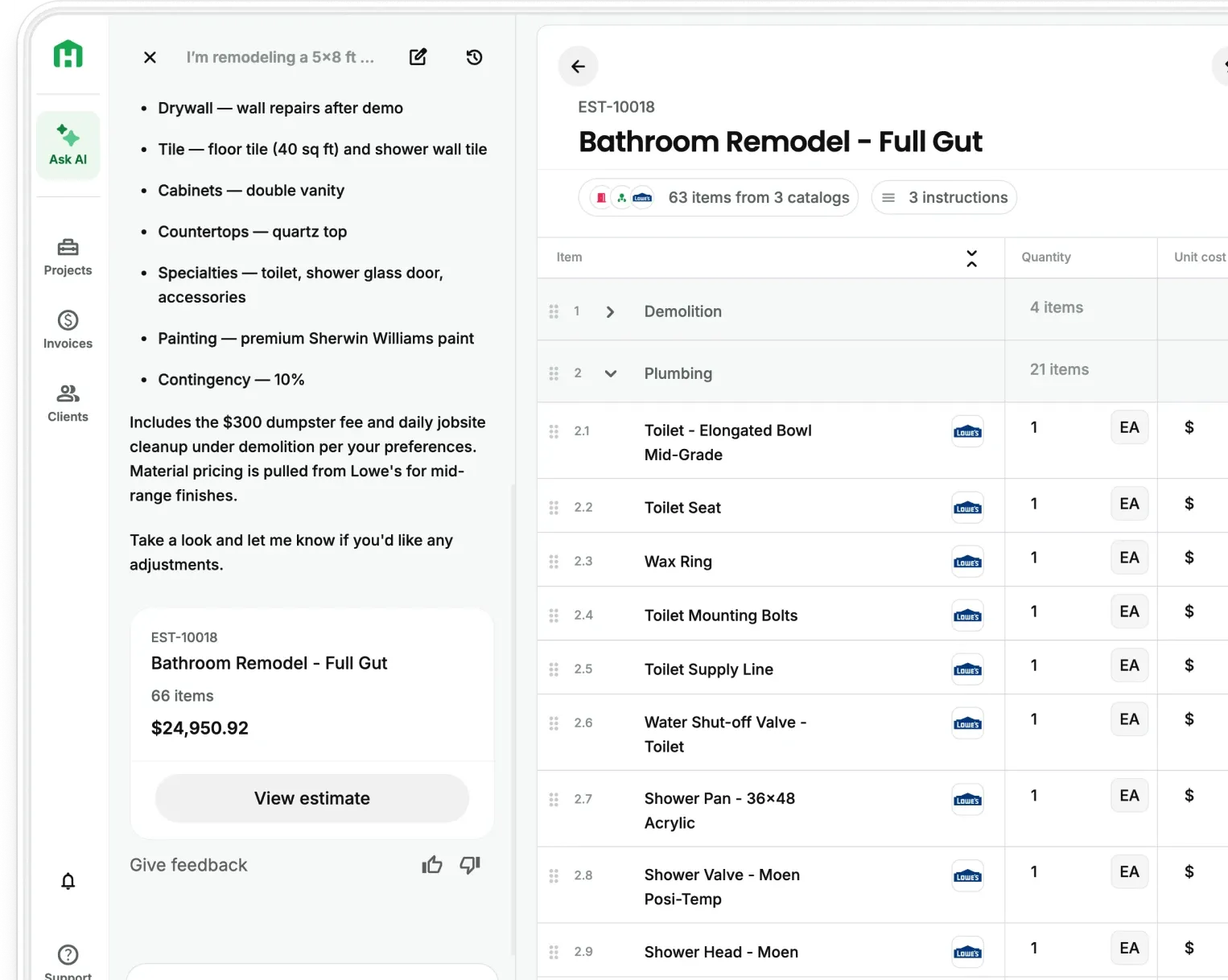
Handoff AI Takeoffs is the opposite. It was built to do one thing, take residential construction plans and turn them into a complete, verifiable takeoff, and it does it autonomously.
Here's how they compare.
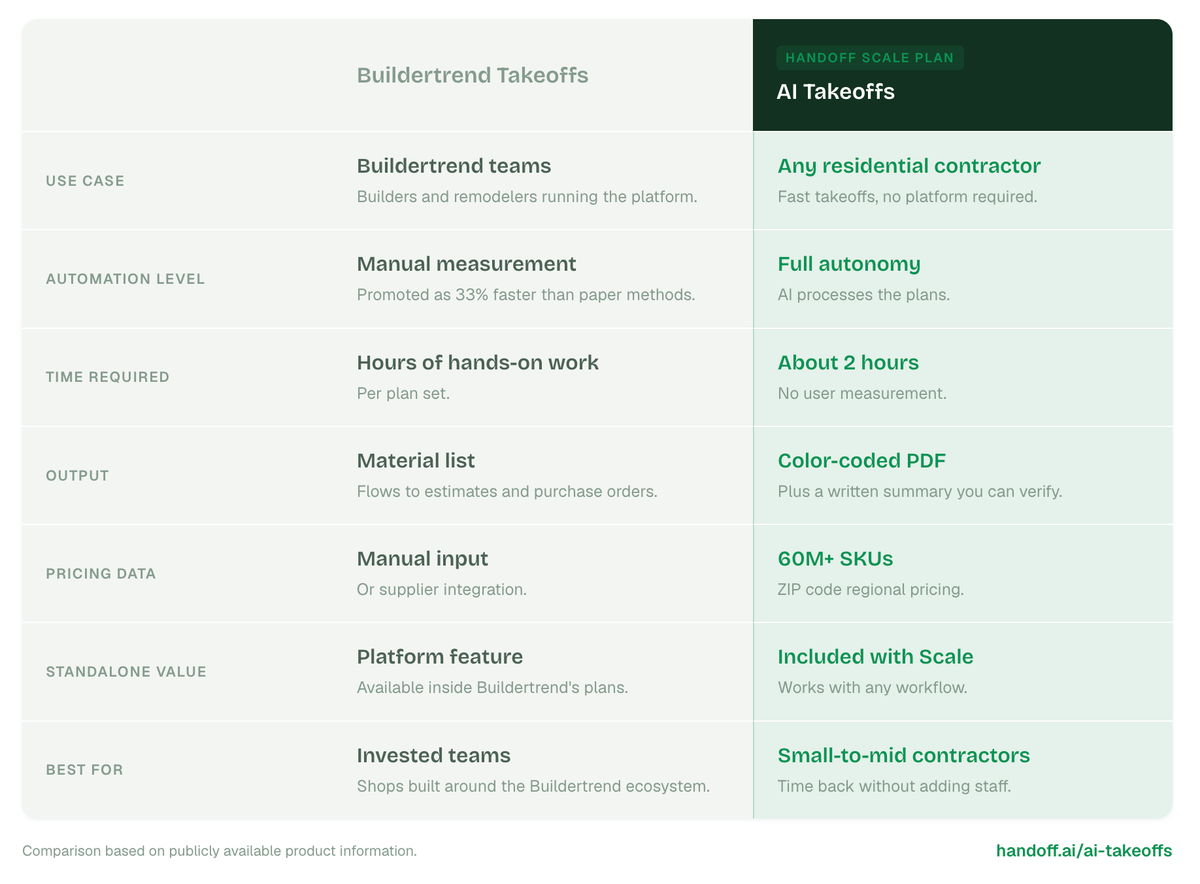
Buildertrend takeoffs vs Handoff AI Takeoffs comparison
Buildertrend Takeoffs: What It Is
Buildertrend's takeoff module lets you upload blueprint PDFs into the platform, then use on-screen measurement tools to manually calculate material quantities. Once you've done the measuring, it generates a material list that connects directly to your estimates and purchase orders.
For teams already running Buildertrend across their projects, it's a logical place to handle takeoffs. Everything stays in one system, and the data flows downstream to procurement.
Buildertrend's own site makes the pitch plainly: takeoffs 33% faster than manual or paper-based methods. Take that claim at face value and notice what it tells you. The ceiling of this approach is measuring faster. Someone on your team still sits down with the plans and measures everything. The software digitizes that process. It doesn't replace it.
When Buildertrend Takeoffs Make Sense
If you're running a mid-to-large residential construction company with a full Buildertrend implementation, a dedicated estimating team, and complex project flows that need tight integration between takeoff, procurement, and scheduling then Buildertrend's takeoff module makes sense. You're already paying for the platform.
It's a reasonable choice when you have the team to support it.
The Gap: What Manual Still Costs You
For small-to-mid contractors, the remodelers and GCs doing 5 to 30 jobs a year, manual takeoff is a margin problem disguised as a workflow problem.
Think about what it actually costs:
- 8 to 16 hours of skilled labor per takeoff, or your own evenings if you don't have staff
- Outsourced takeoff services typically run $700 to $1,000 per plan set, with a 1 to 2 week wait
- Slow turnaround means slower bids, which means losing jobs to faster competitors
- Measurement errors mean scope gaps, which means losing margin mid-project
Measuring 33% faster shrinks the first number. It doesn't even touch the other three.
Handoff AI Takeoffs: Fully automated and connected to the entire project
Handoff AI is not a feature inside a larger platform. It's a purpose-built AI system trained specifically on residential construction plans.
You upload your residential plans up to 5,000 sqft and in under 2 hours, the AI delivers:
- A color-coded visual takeoff PDF with every area, length, and item measured and marked
- A written summary that flags assumptions, missing details, and plan clashes for you to verify
- Quantities that flow into an estimate priced against 60M+ SKUs from Home Depot, Lowe's, and other major suppliers
- ZIP-code level regional pricing so you get actual costs in your market, not national averages
No measuring. No calibration. No estimating staff required. And because every number is marked on the plans, you can check the work before you bid, which is more than any outsourced takeoff service gives you.
Handoff was trained on 100,000+ completed residential estimates, so it understands construction scopes the way an experienced estimator would. It processes plans up to 5,000 sqft, which covers the vast majority of residential remodel and new construction projects.
When it makes sense to use Handoff AI Takeoffs
If you're a contractor who doesn't have a dedicated estimator — or who has one but wants to dramatically cut the time spent on takeoffs — Handoff is the right call.
Handoff wins on:
- Speed: Under 2 hours vs. hours of manual work
- Cost: A fraction of what outsourced takeoff services charge ($300–500/set)
- Accuracy: Trained on 100,000+ real residential estimates
- Independence: Works without needing a full platform subscription
The ROI math is simple. If you're spending 4 hours doing a takeoff in Buildertrend, and Handoff does it in 2 hours with zero effort on your end — you're freeing up time that goes directly into more bids, more site visits, and more closed jobs.
The Cost Angle: What Manual Takeoff Actually Costs
Outsourced takeoff services typically charge $700 to $1,000 per plan set and take one to two weeks to turn around. A dedicated cost estimator runs a median of $77,070 a year in salary, according to the Bureau of Labor Statistics. And if you're doing the takeoffs yourself, every hour you spend measuring is an hour you're not selling.
Handoff AI undercuts all three while delivering a faster result you can verify. For small-to-mid contractors, it's not even a close comparison.
Done waiting on takeoffs? Try Handoff. Upload your residential plans and get a complete, priced takeoff in under 2 hours.
Other FAQs about the difference between Buildertrend takeoffs and Handoff’s AI Takeoffs
Is Handoff a good Buildertrend alternative for small contractors?
For takeoffs and estimating, yes. Buildertrend is a broad project management platform where the measuring and scope-building stay manual, while Handoff’s AI runs the takeoff autonomously and prices the estimate with regional data. Small contractors without dedicated estimating staff get the most from the difference, since Handoff replaces the work instead of organizing it.
Do I need takeoff software if I already outsource my takeoffs?
Outsourcing solves the labor but not the wait or the blind spot: plan sets sit in a queue for one to two weeks, cost $700 to $1,000 each, and come back as numbers you can't check. AI takeoffs return in about two hours as a color-coded PDF you can verify line by line. You keep the hands-off workflow and drop the wait, the per-set fee, and the guesswork.
How does AI estimating compare to using Buildertrend or JobTread?
Buildertrend requires you to build estimate line items manually — the platform organizes and tracks the estimate once it exists, but the scope-building is still on you. JobTread has added AI-assisted estimating via MCP integration with ChatGPT and Claude, which can draft estimates from text prompts — but it requires external tool setup outside the platform. Neither supports generating a scope from site photos, walkthrough video, or uploaded documents. Handoff generates the estimate structure directly from your input — no third-party AI wiring required to get an estimate at all. If you do want to work from your own AI assistant, Handoff has its own MCP server so Claude or ChatGPT can create the project and build the estimate directly in your account — that's an optional entry point on top of native generation, not a requirement like it is on JobTread.