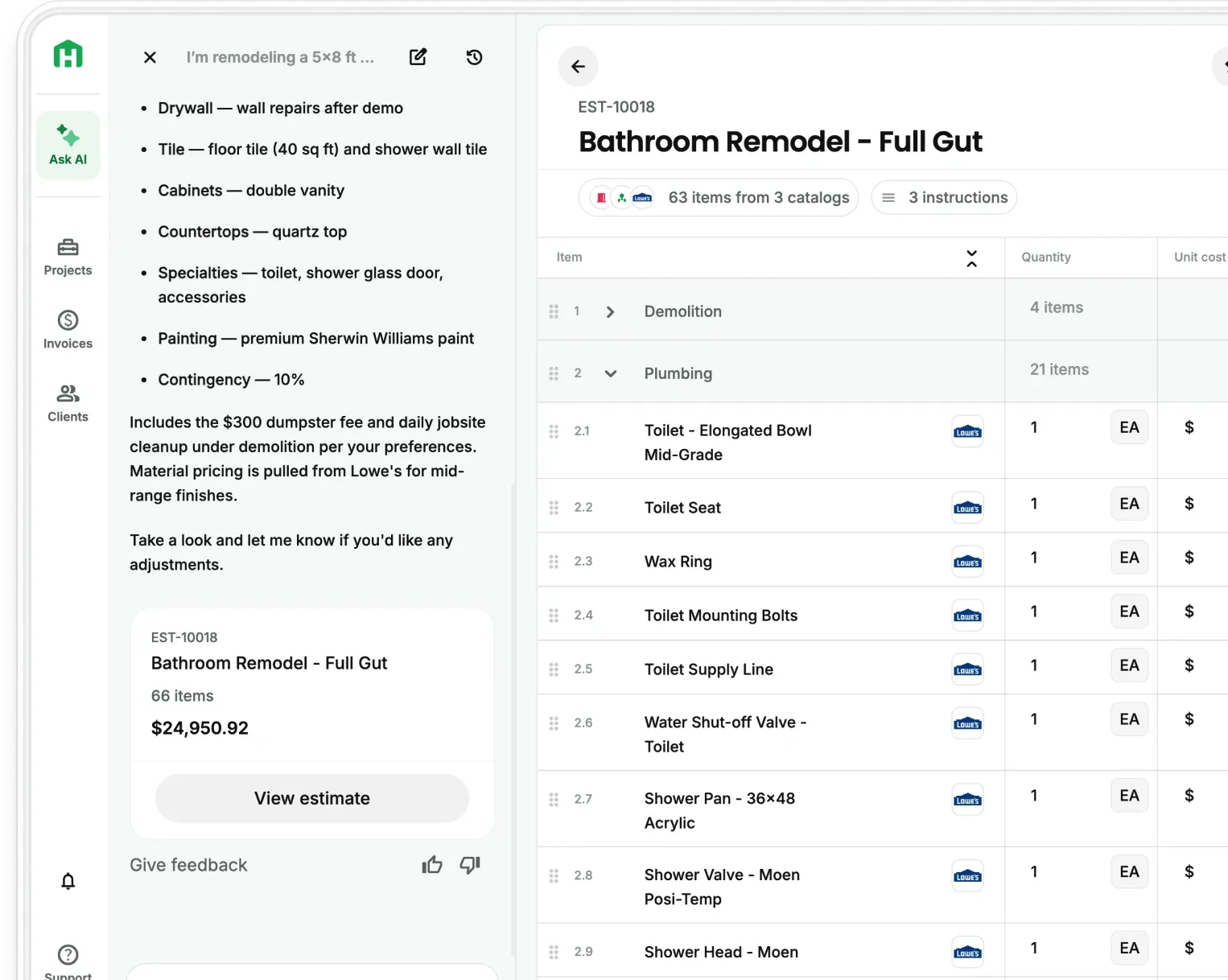
The Kennedy Center is in the headlines last week, and not for a performance. Whistleblowers handed Congress an 83-page stack of internal documents, emails, and photos alleging the renovation was rushed, corners were cut, and the people in charge said they would deal with the lawsuits later.
Here's the detail every contractor should sit with. The story didn't blow up because of rusting columns or a torn-out bathroom floor. It blew up because former project managers had documents and photos to back up every claim. When work gets questioned, the side with the paper trail writes the story.
You're never going to be a national headline. But the same pattern plays out at residential scale every week: a job moves fast, the record lives in text threads and memory, something gets disputed, and the blame lands on whoever can't prove otherwise. That's usually the contractor. The good news is that the tradeoff behind all of this, speed versus a clean record, is exactly the tradeoff AI has started to erase.
What the Kennedy Center story means for residential contractors
You didn't rush that renovation, and your jobs are kitchens and additions, not concert halls. But the lesson still applies, because the cost of poorly documented work shows up the same way at every scale:
- Callbacks that pull your crew back to a job you already closed out
- Change order disputes where it's your memory against the homeowner's
- Insurance claims that go sideways because the records weren't clean
- A reputation hit in a local market where one bad story travels fast
One disputed job with a thin paper trail can undo years of good work. Contractors who keep clean records settle disputes in a conversation instead of a crisis.
AI tools for contractors that build the paper trail while you work
The reason AI changes this equation is simple. The documentation stops being a separate chore you do after the real work. It becomes a byproduct of the work itself. And you do great work. So get great documentation.
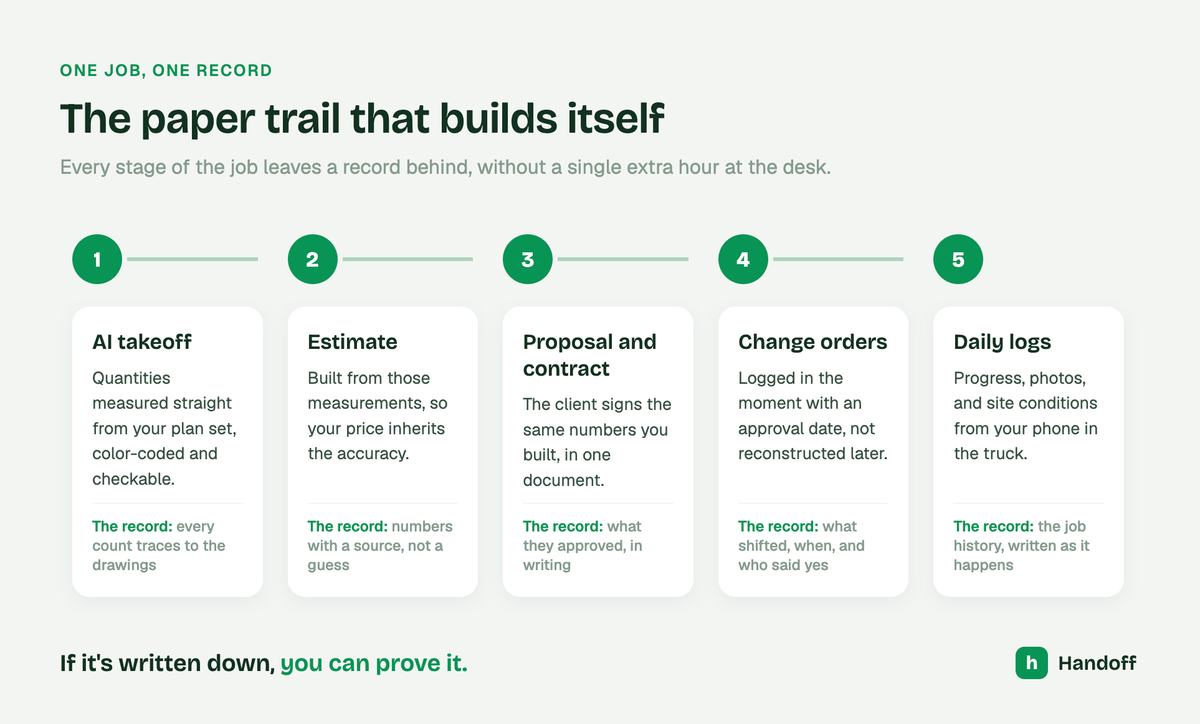
- AI takeoffs measure quantities straight from your plan set, so your numbers trace back to the drawings instead of a guess. A complete, color-coded takeoff comes back in about 2 hours, and every count is checkable against the plans.
- Estimates built from those measurements carry forward into your proposal and contract, so what you quoted and what you're building are the same document, not two versions of a memory.
- Change orders logged in the moment create a timestamped record of what shifted, when, and who approved it. No reconstruction after the fact.
- Daily logs capture progress, photos, and site conditions from your phone in the truck, so the job history writes itself while the job runs.
None of this slows you down. It's the opposite: the same AI that documents the job is the reason your bid went out the same day instead of Thursday. Your AI Teammate handles the record-keeping layer so speed and proof stop being a tradeoff.
How to automate construction tasks without losing an accurate paper trail
If you only fix one documentation gap, fix the one at the front. Most disputes trace back to time between what the client thought they approved and what got built, and that happens at the time of your estimate.
When your takeoff comes from actual plan measurements, your estimate inherits that accuracy. When the estimate flows into the proposal and the proposal into the scope of work, every phase of the job points back to a number the client signed. A client who can see exactly what they approved has very little room to claim they approved something else.
Judges, adjusters, and homeowners all reason the same way: if it's written down, it probably happened. Accurate estimates protect contractor margins from the first day of the job.
Here’s a helpful link to see what documents help you avoid disputes.
Three questions to ask before your next job starts
Run your current setup through these. Answer honestly.
- If a client questioned any phase of your last job, could you pull the documentation in 24 hours?
- Do your subs know what they're accountable for, in writing, before work starts?
- Does your estimating process create a record, or does it create ambiguity?
If any answer is "probably not," that's a gap in your system, and it's the same gap that turned a rushed renovation into a congressional letter. Contractors who close it look like they run a tight operation, because they do.
How to get your jobs documented without adding desk time
The contractors who come out ahead in a skeptical market aren't the ones doing better work. They're the ones who can prove they did good work. Here's how to start:
- Sign up for Handoff free
- Upload a plan set and let AI Takeoffs build your first measured, traceable takeoff
- Turn it into an estimate and proposal, so your numbers and your contract match from day one
- Log changes and daily progress from your phone as the job runs
- Track your budget and margins and adjust before the project is over
Rushed work isn't what gets contractors in trouble. Unproven work is. Handoff keeps the proof building itself, from the first takeoff to the final payment.
Other FAQs about documentation and AI tools for contractors
What records should a contractor keep on every residential job?
At minimum: the takeoff and estimate the price came from, the signed proposal and contract, every change order with an approval date, daily logs with photos, and material receipts tied to the job. If those live in one system instead of five, you can produce any of them in minutes.
Do clients trust AI-generated estimates?
Clients trust estimates they can understand and verify. An itemized estimate built from actual plan measurements reads as more professional than a per-square-foot guess, whoever did the measuring. What builds trust is the transparency, and AI makes that level of detail practical for a small crew.