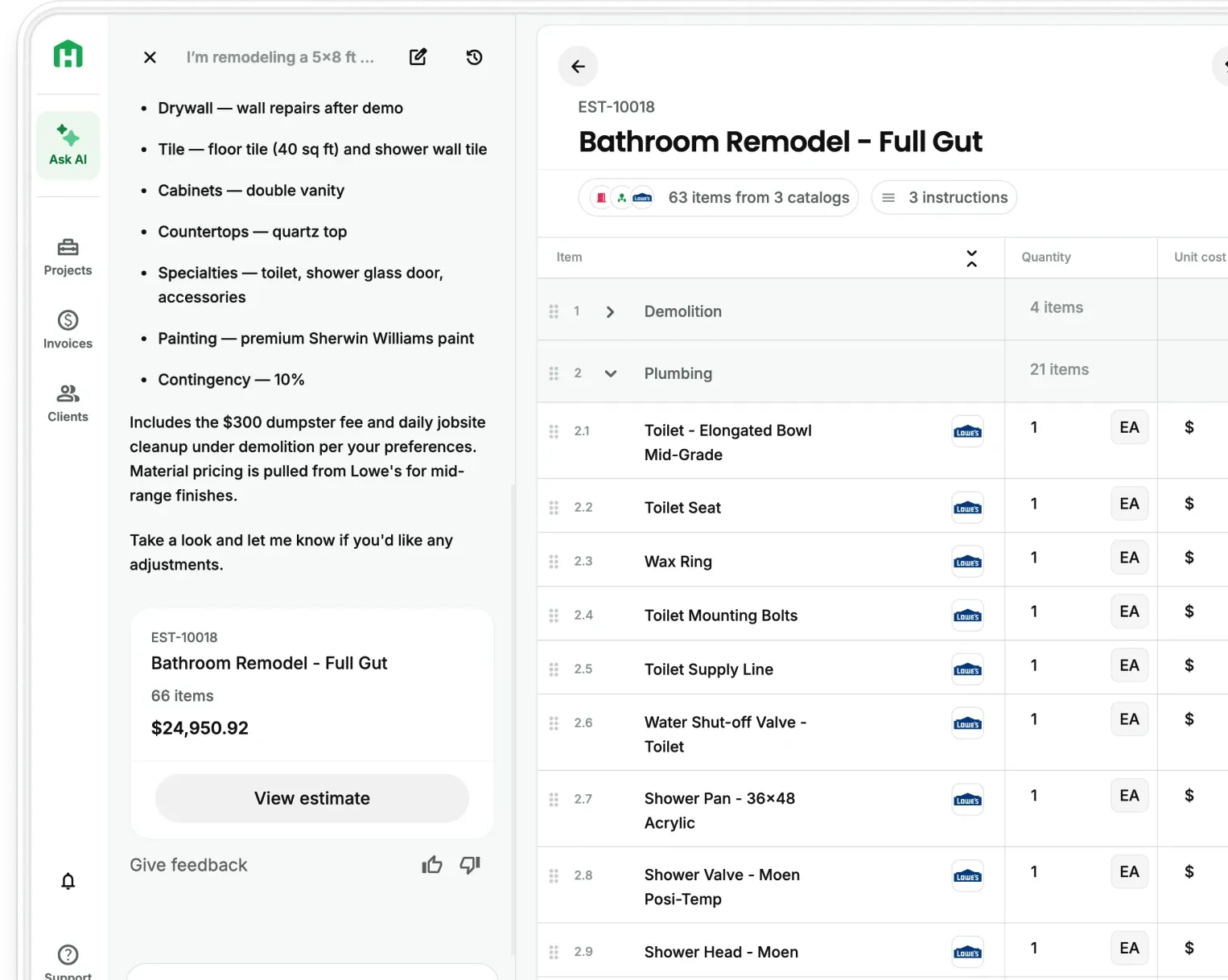
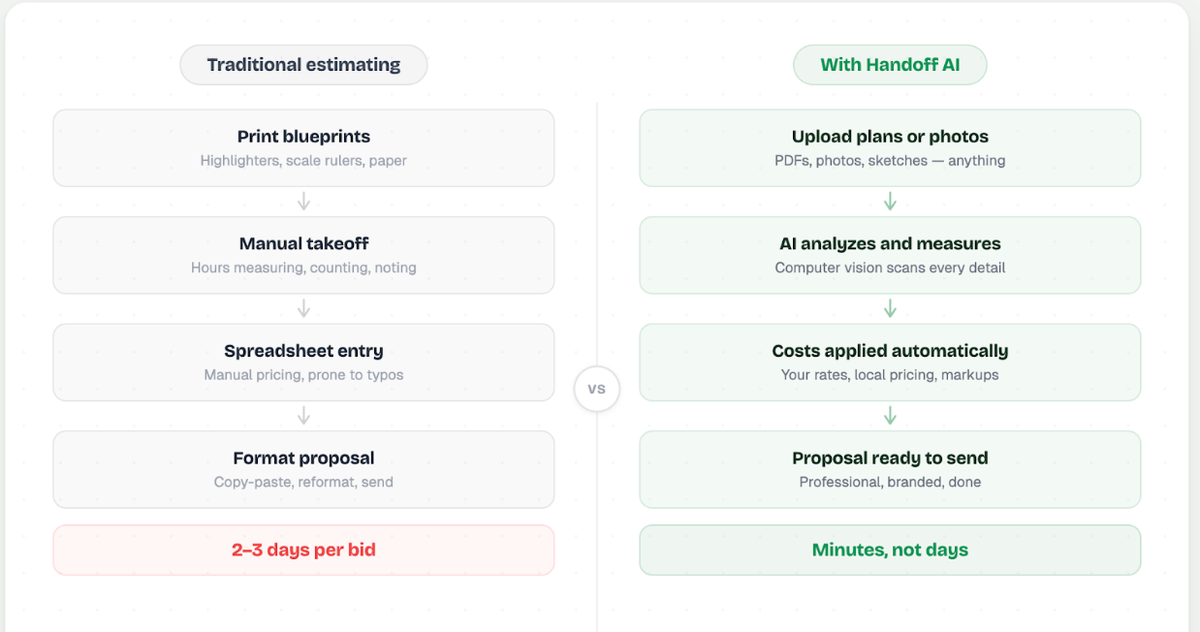
For decades, construction estimating has been a manual, time-consuming process. It involved printing out blueprints, breaking out the highlighters and scale rulers, and spending hours hunched over a spreadsheet. But that era is officially over. The rise of powerful, accessible artificial intelligence is fundamentally changing the way contractors bid on jobs, and if you haven't adopted it yet, you are already falling behind.
This guide is your introduction to the world of AI estimating software. We will explain what it is, how it works, and why it has become the single most important investment a modern construction company can make. We'll cut through the hype and give you a clear, actionable understanding of how this technology can help you win more bids, increase your profit margins, and reclaim your valuable time.
What is AI Estimating Software?
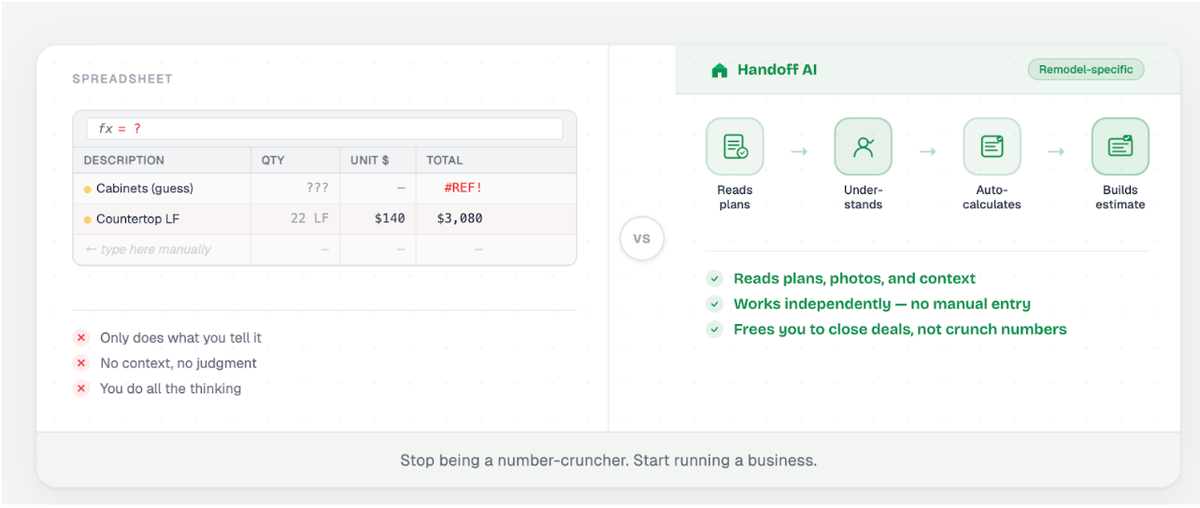
The Direct Answer: AI estimating software is a tool that uses artificial intelligence to automate the most time-consuming parts of the construction bidding process. Instead of a person manually performing a takeoff from blueprints, the AI analyzes the plans, photos, or other project files, automatically identifies and quantifies materials and labor, and generates a detailed, accurate estimate in a fraction of the time.
Think of it as the difference between a calculator and a full-time estimator. A traditional estimating tool (like a spreadsheet) is a calculator; it only does what you tell it to do. An AI estimating platform, like Handoff, acts like a junior estimator. It can read plans, understand context, and perform complex calculations on its own, freeing you up to focus on strategy, client relationships, and closing deals.
How Does AI Estimating Software Work?
The Direct Answer: AI estimating software works by using a combination of computer vision to analyze project files (like PDFs and photos) and machine learning to recognize construction-specific objects, patterns, and language. The AI is trained on millions of data points from past construction projects, allowing it to understand plans, quantify materials, and predict labor needs with a high degree of accuracy.
The process is remarkably simple from the user's perspective:
- Upload: You upload your project files. This could be anything from a 100-page set of architectural plans to a photo of a kitchen you took on your phone.
- Analyze: The AI's computer vision engine scans the files. It identifies rooms, measures dimensions, counts objects (like outlets, windows, and doors), and calculates areas and volumes.
- Quantify & Cost: The machine learning model cross-references the quantified materials with your pre-loaded cost book or a real-time local pricing database. It applies your specific labor rates and markups.
- Generate: The software compiles all of this information into a detailed, line-item estimate and a professional, client-ready proposal in minutes.
The AI Workflow vs. The Traditional Workflow
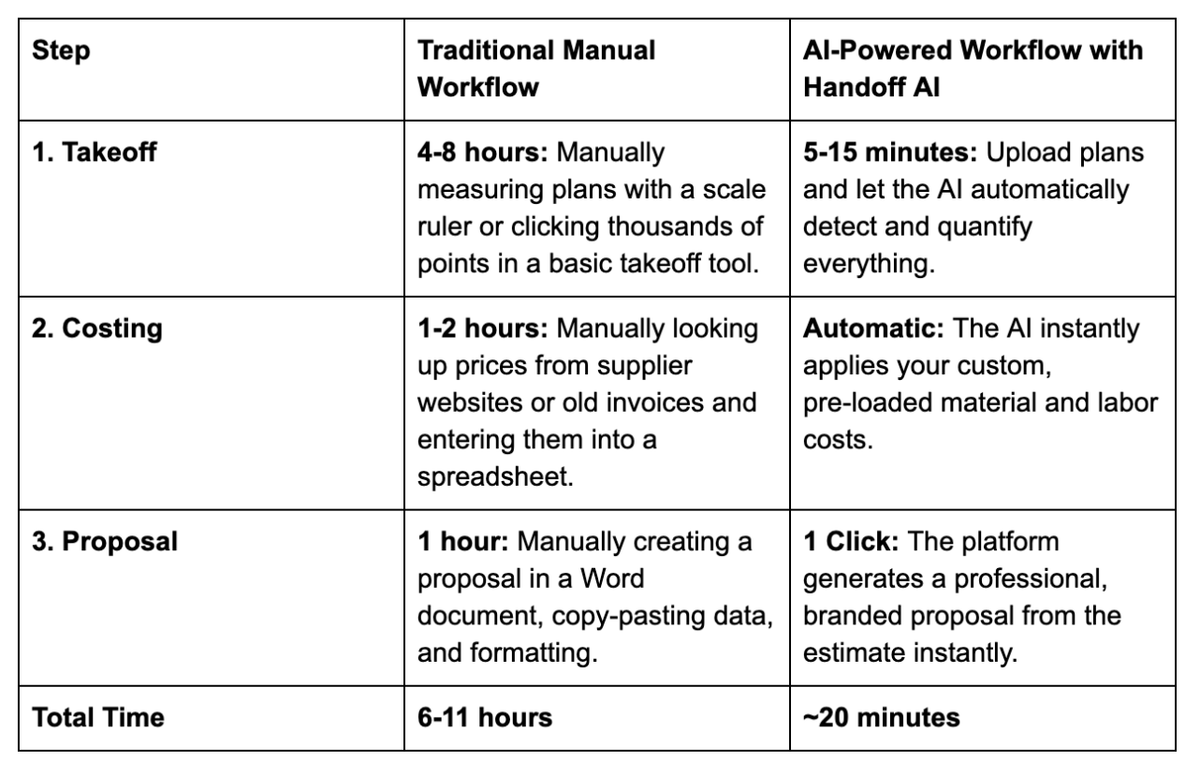
The difference in efficiency is staggering.
What Are the Top 3 Benefits of Using AI Estimating Software?
The Direct Answer: The three biggest benefits of using AI estimating software are dramatically increased speed, improved accuracy and reduced errors, and higher profitability through better data and the ability to bid on more projects.
1. Win More Bids with Unmatched Speed
In construction, the first bid in is often the one that wins. A 2025 survey by the Construction Management Association of America (CMAA) found that contractors who submitted their bids within 24 hours of a request had a 30% higher win rate than those who took longer. AI software makes this possible by reducing estimating time from days to minutes. This allows you to bid on more projects without hiring more staff, directly increasing your revenue opportunities.
2. Protect Your Profits with Superior Accuracy
Manual estimating is prone to human error. A missed line item or a simple typo in a spreadsheet can erase your entire profit margin. AI eliminates this risk. By automating the takeoff and costing process, it ensures that every material is accounted for and every calculation is correct. This accuracy gives you the confidence to submit tight, competitive bids without worrying about leaving money on the table.
3. Increase Profitability on Every Job
AI estimating software provides you with better data to make smarter decisions. By centralizing your project data, you can analyze your win rates, track your costs across different job types, and identify your most profitable work. Furthermore, by automating the estimating process, you free up your most valuable asset, your time, to focus on higher-value activities like client negotiation, project management, and business development. For most residential and light commercial contractors, a platform like Handoff that prioritizes speed and flexibility is the ideal choice.
How to Choose the Right AI Estimating Software
The Direct Answer: The best AI estimating software for you depends on your specific trade and business size. Look for a platform that is easy to use, offers integrations with your existing tools, and provides excellent customer support. For most residential and light commercial contractors, a platform like Handoff that prioritizes speed and flexibility is the ideal choice.
When evaluating different options, focus on these key criteria:
- Ease of Use: The software should be intuitive and easy to learn. If it requires weeks of training, it will negate the time savings it's supposed to provide. Look for a clean interface and a simple, logical workflow.
- Specialization: Is the software designed for your trade? A tool built for a commercial concrete contractor will not be a good fit for a residential remodeler. Choose a platform that understands your specific needs.
- Integration Capabilities: The software should integrate with the other tools you use to run your business, such as your accounting software (like QuickBooks) or your project management platform.
- Customer Support: When you have a question or run into an issue, you need to be able to get help quickly. Look for a company that offers responsive, knowledgeable customer support.
- Works with your other tools: The best platforms don't operate in a silo. Look for software that connects to your accounting tools, your calendar, and increasingly, your own AI assistant. Handoff connects directly to Claude, ChatGPT, or any MCP-compatible assistant through its own MCP server, so you can create projects and build estimates without leaving the tool you already use.
Frequently Asked Questions (FAQs)
1. Is AI estimating software accurate? Yes. Modern AI estimating platforms have achieved a high degree of accuracy, often exceeding that of manual takeoffs by eliminating human error. The AI is trained on vast datasets of construction plans and can recognize objects and patterns with remarkable precision.
2. How much does AI estimating software cost? The cost of AI estimating software varies depending on the platform and the features included. Most platforms operate on a subscription model, with prices typically ranging from $100 to $500 per month. While this is more than a "free" spreadsheet, the return on investment from time saved and increased win rates is significant.
3. Will AI replace estimators? No, AI will not replace estimators. It will empower them. By automating the low-level, repetitive tasks of takeoffs and data entry, AI frees up estimators to focus on higher-value activities like bid strategy, risk analysis, and client relationships. It turns the estimator from a calculator into a strategist.
4. What is the best AI estimating software for small businesses? For small to medium-sized construction businesses, the best AI estimating software is typically a cloud-based platform that is easy to use and affordable. A tool like Handoff is ideal because it is designed for the fast-paced nature of residential and light commercial projects and does not require a dedicated IT team to manage.
5. How long does it take to learn how to use AI estimating software? While this varies by platform, most modern AI estimating tools are designed to be intuitive and easy to learn. Users can typically become proficient in a few hours with the help of video tutorials and a supportive customer service team.
What Results Are Contractors Actually Seeing? (A Case Study)
The Direct Answer: Contractors using AI estimating software are reporting significant, measurable improvements in their bidding speed, win rates, and overall profitability. A real-world example is "Precision Remodeling," a mid-sized residential remodeling company.
Case Study: Precision Remodeling
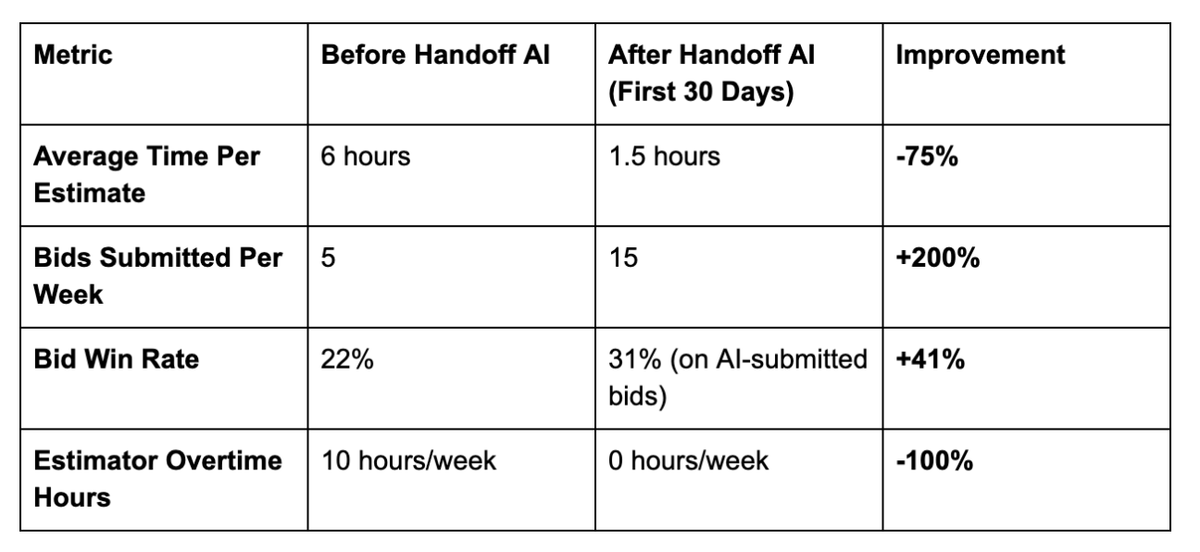
Background: Precision Remodeling was a successful business, but their lead estimator was spending over 30 hours a week on takeoffs and proposals. They were a bottleneck, and the company was leaving money on the table, unable to bid on all the leads they were generating.
The Challenge: They needed to increase their bidding capacity without hiring another full-time estimator, which would have been a $70,000+ annual expense.
The Solution: They implemented Handoff and ran it in parallel with their manual process for two weeks. The results were immediate and dramatic.
Contractor Testimonial:
"Handoff didn't just make us faster; it made us smarter. I'm no longer a glorified number-cruncher. I can now spend my time building relationships with clients and fine-tuning our bid strategy. We won an extra $150,000 in projects in the first month alone because we could finally get to all the leads we were ignoring. It paid for itself in the first week." - John Carter, Lead Estimator, Precision Remodeling
Read More Case Studies:
- How Handoff Transformed Cost Estimation for Atelier 7
- How Lasting Impressions Caught a $2.5K Missed Scope Using Handoff
What Are the Common Concerns About AI Estimating?
The Direct Answer: The most common concerns about AI estimating software are the accuracy of the AI, the security of project data, what happens if there's no internet connection, and whether it can handle custom or unique projects. Reputable platforms have addressed these concerns with high accuracy rates, robust security protocols, offline capabilities, and flexible, trainable AI models.
Let's address these legitimate questions head-on:
"What if the AI makes a mistake?" This is the most common fear. Modern AI platforms achieve over 98% accuracy on standard plans. Furthermore, they are designed for human oversight. The AI does the heavy lifting, but you can always review and adjust the takeoff, just as you would with a junior estimator. The difference is that the AI doesn't get tired, and it never makes a calculation error.
"Is my project data secure?" Reputable AI platforms use enterprise-grade security measures, including end-to-end encryption, to protect your and your clients' sensitive data. Your project files are far more secure in a dedicated, encrypted cloud environment than they are sitting in an email inbox or on a local hard drive.
"What happens if I lose internet connection on a job site?" Handoff is built for real-world job sites where internet access isn’t always available. While offline, you can still capture photos, videos, notes, audio recordings, plans, and drawings locally on your device, then upload everything into Handoff once you’re back online.
After reconnecting, Handoff automatically brings all of that project information together so you can continue building estimates, proposals, invoices, change orders, and other project documents with AI assistance — without needing to retrace your steps from the field.
"Can it handle my unique, custom projects?" Yes. While the AI is pre-trained on millions of plans, it is also designed to learn from you. You can teach the AI to recognize custom materials or unique building assemblies. The more you use it, the smarter it gets and the more it adapts to your specific way of building.
How Does AI Estimating Work for Different Trades?
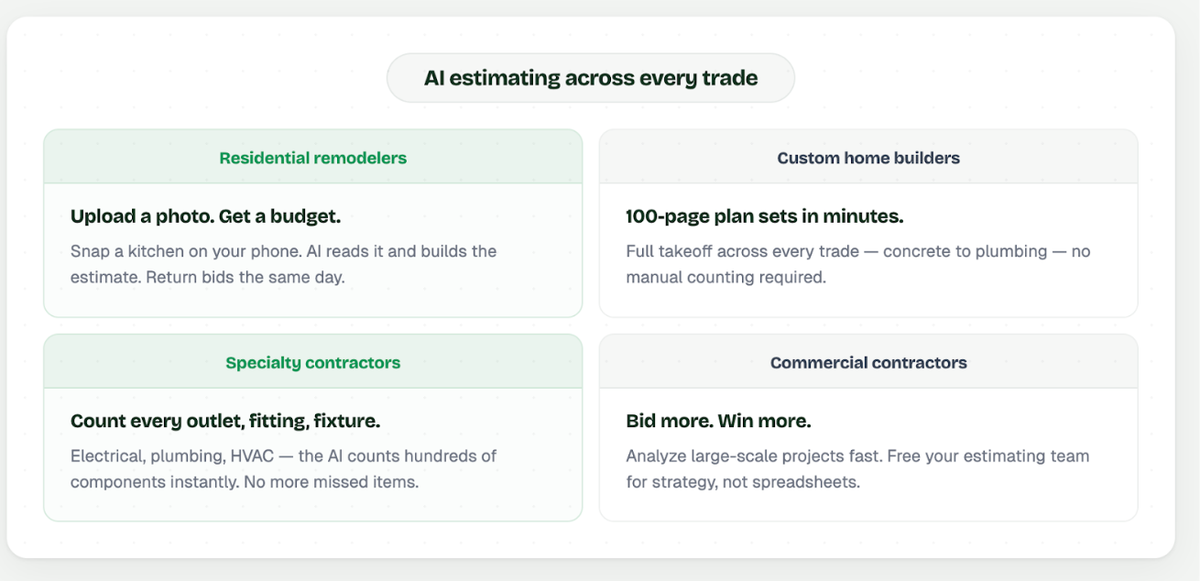
The Direct Answer: AI estimating software provides specialized benefits for every trade by automating the specific types of takeoffs and calculations they perform most often. Whether you are a remodeler working from photos or a specialty contractor needing precise material counts, the AI can be tailored to your workflow.
For Residential Remodelers: This is where AI shines. Remodelers often work from informal plans, sketches, or even just photos. AI platforms like Handoff can ingest a photo of a kitchen, automatically identify the cabinets, countertops, and appliances, and produce a preliminary estimate in minutes. This allows remodelers to provide budget ranges on the spot and deliver formal proposals the same day.
For Custom Home Builders: For builders working from detailed architectural plans, the AI's value is in its speed and accuracy on large, complex projects. The AI can process a 100-page PDF set in minutes, performing a complete takeoff for all trades, from concrete and framing to electrical and plumbing, drastically reducing the time and risk associated with manual takeoffs.
For Specialty Contractors (Electrical, Plumbing, HVAC): For these trades, the AI's ability to count hundreds or thousands of individual components is a game-changer. An electrician can upload a set of plans, and the AI will automatically count every outlet, switch, and light fixture. A plumber can get an instant count of all fittings and fixtures. This eliminates the tedious and error-prone process of manual counting.
For Commercial Contractors: In the commercial world, where bids are complex and margins are tight, the AI's ability to quickly analyze large-scale projects and provide detailed, accurate data is a significant competitive advantage. It allows commercial firms to bid on more projects and use their estimating teams more strategically.
How Long Does It Take to Implement AI Estimating Software?
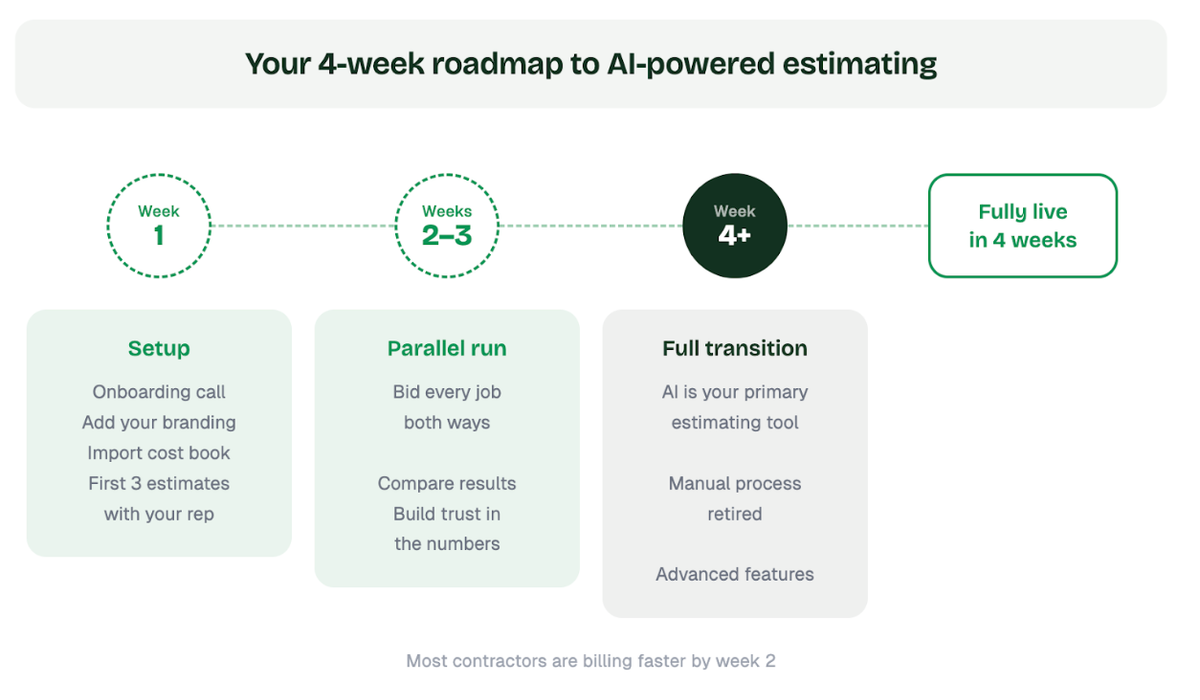
The Direct Answer: A full implementation of AI estimating software can be completed in as little as two weeks. Most contractors can be trained and running their first AI-powered estimates within a few hours of signing up, with a full transition to an AI-first workflow taking place over the following weeks.
Here is a typical implementation roadmap:
Your 4-Week Roadmap to AI-Powered Estimating
Week 1: Setup and Training
Goal: Learn the platform and customize your account.
Actions:
- Attend the onboarding session with your dedicated customer support specialist.
- Upload your company logo and proposal branding.
- Import your existing material and labor cost book (or use the pre-loaded local database).
- Run your first two or three estimates alongside your customer support specialist.
Weeks 2-3: Parallel Estimating
Goal: Build confidence in the AI by running it alongside your current manual process.
Actions:
- For every new bid, perform the estimate both manually and with the AI.
- Compare the results. Note the time difference and any discrepancies in quantities (the AI is often more accurate).
- By the end of this period, you will have built trust in the AI and will be comfortable with its workflow.
Week 4+: Full Transition
Goal: Make the AI platform your primary estimating tool.
Actions:
- All new estimates are now created first in the AI platform.
- Your manual process is officially retired.
- Begin exploring advanced features, such as creating custom assemblies and analyzing your bid data.
How to Calculate Your ROI from AI Estimating
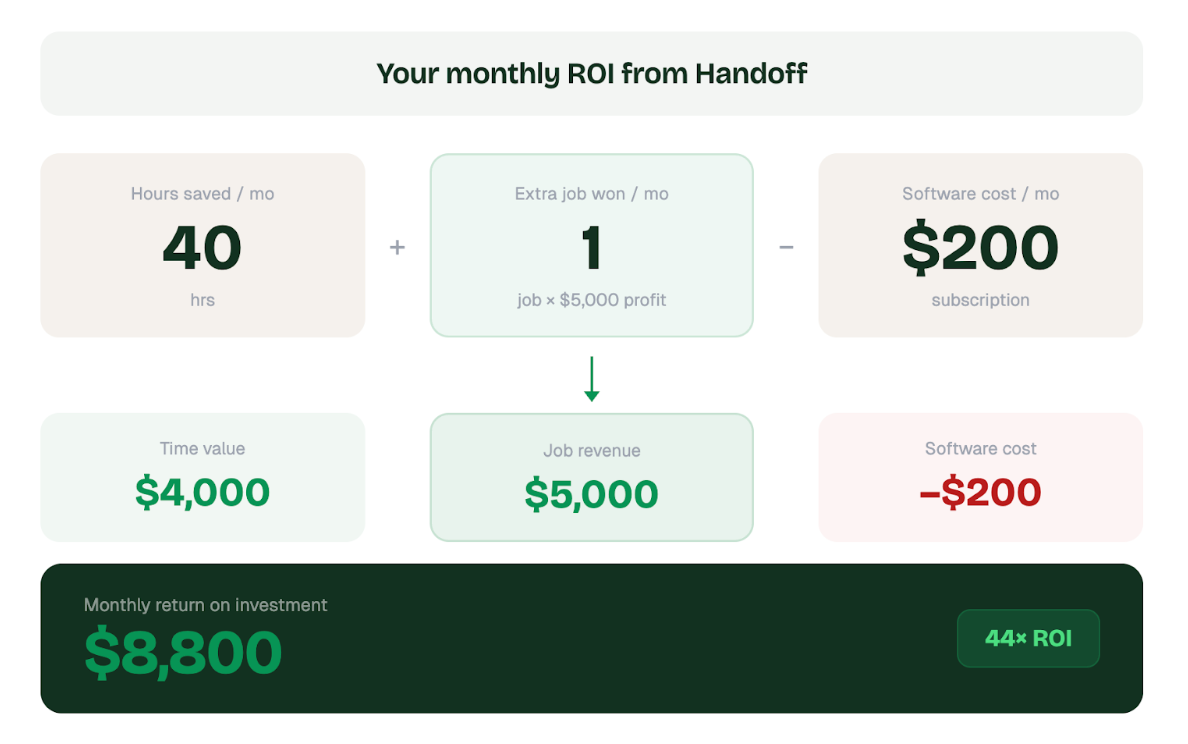
The Direct Answer: You can calculate the return on investment (ROI) from AI estimating software by adding the value of the time you save to the profit from the additional jobs you win, and then subtracting the cost of the software. The ROI is typically in the range of 10-20x the software cost.
Use this simple formula to calculate your potential monthly ROI:
(Hours Saved Per Month × Your Hourly Rate) + (Additional Jobs Won Per Month × Average Profit Per Job) - Monthly Software Cost = Monthly ROI
Let's walk through a realistic example:
- Hours Saved: You save 10 hours per week on estimating. That's 40 hours per month.
- Your Hourly Rate: You value your time at $100/hour.
- Additional Jobs Won: With the ability to bid on more projects, you win just one extra job per month.
- Average Profit Per Job: Your average profit on a job is $5,000.
- Monthly Software Cost: Your AI estimating software costs $200/month.
Calculation:
(40 hours × $100/hour) + (1 job × $5,000) - $200 = Monthly ROI
$4,000 + $5,000 - $200 = $8,800
In this scenario, the monthly ROI is $8,800 on a $200 investment. This is why the adoption of AI estimating software is accelerating so rapidly.
Pro Tip: You don't have to guess at your ROI. Use the free trial offered by platforms like Handoffi to track your actual time savings and win rates on real projects.
What Tools Does AI Estimating Software Integrate With?
The Direct Answer: Modern AI estimating software integrates with a wide range of other construction management tools, including accounting software, project management platforms, and CRM systems. These integrations are critical because they create a seamless flow of data from the initial bid to the final invoice, eliminating the need for double entry and reducing administrative overhead.
Key integration categories include:
Accounting Software (e.g., QuickBooks, Xero): This is the most important integration. When you win a job, the estimate data can be pushed directly to your accounting software to automatically create an invoice, a budget, and a schedule of values. This saves hours of administrative work and eliminates data entry errors.
Project Management Platforms (e.g., Procore, Buildertrend): An integration with your project management software allows the data from the estimate to be used to automatically build the project schedule, order materials, and manage the budget.
CRM Systems (e.g., Salesforce, HubSpot): Integrating with your CRM allows you to track your bids and win rates automatically, providing valuable data on your sales pipeline and client relationships.
Material Suppliers: Some advanced platforms are beginning to integrate directly with the pricing databases of major material suppliers, allowing for real-time, hyper-accurate material costing.
What's Next for AI in Construction Estimating?
The Direct Answer: The future of AI in construction estimating is moving towards hyper-automation and predictive analytics. Upcoming advancements include predictive bidding, where the AI recommends optimal markups based on market data; voice-to-estimate technology, allowing contractors to describe a project verbally and receive an instant budget; and real-time integration with supplier pricing for unparalleled accuracy.
While the current generation of AI has already revolutionized the estimating process, the technology is still evolving rapidly. Here are a few of the exciting advancements on the horizon:
Predictive Bidding: The next generation of AI will not just tell you what a project will cost; it will tell you what you should bid to win it. By analyzing historical bid data, market trends, and even the bidding patterns of your competitors, the AI will be able to recommend the optimal markup to maximize your chances of winning the job while protecting your profit margin.
Voice-to-Estimate: Imagine walking into a potential project, describing the scope of work into your phone, and receiving a detailed, line-item estimate before you even get back to your truck. This is the promise of voice-to-estimate technology, which will use natural language processing to turn a verbal description into a fully costed bid.
Automated Change Order Generation: When a client requests a change, the AI will be able to automatically generate a detailed change order, complete with pricing and a revised project schedule, in seconds. This will streamline the change order process and ensure that you are compensated for all out-of-scope work.
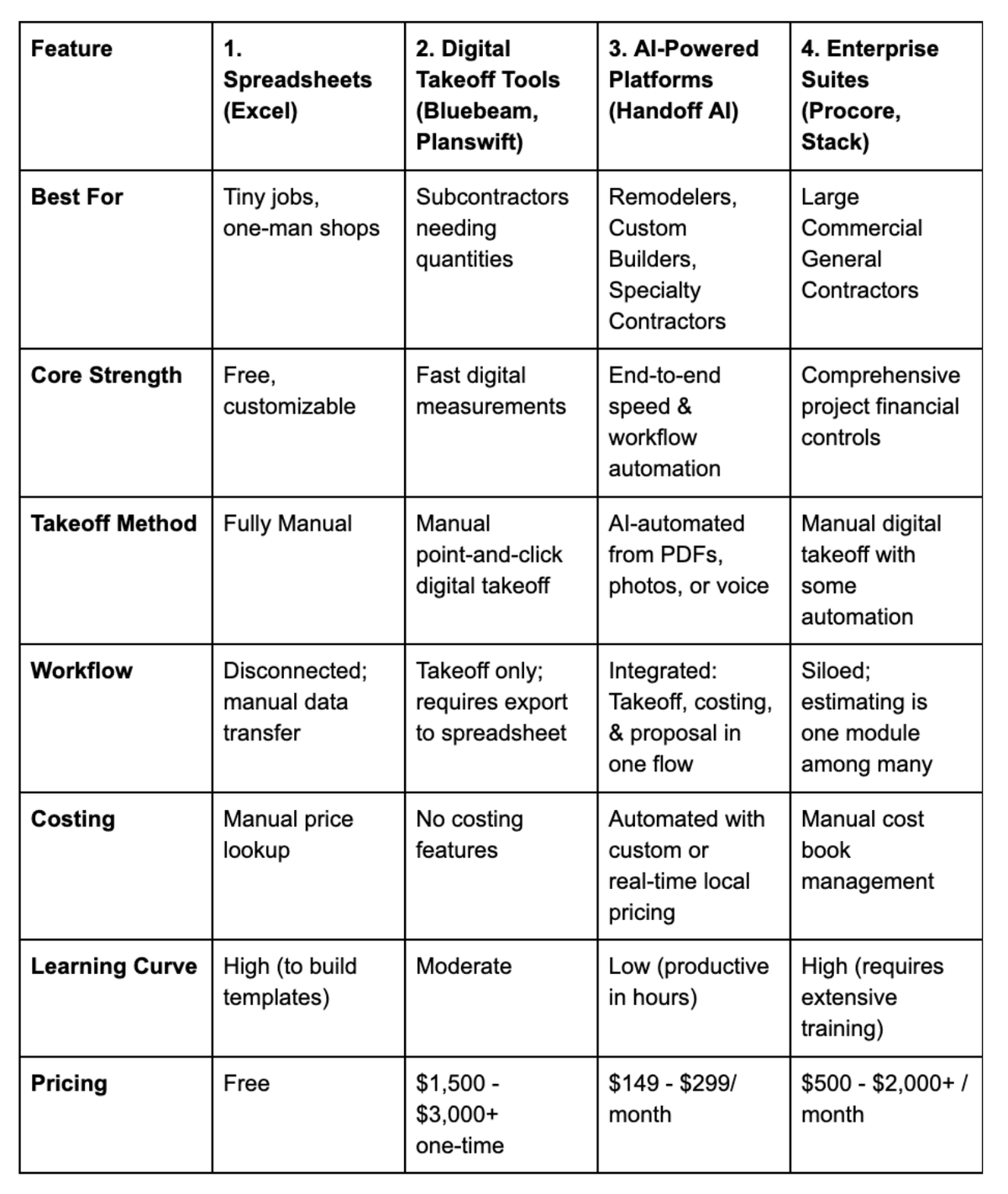
Expanded Software Comparison: AI vs. Traditional Tools
To fully appreciate the impact of AI, it's helpful to compare it directly with the other categories of estimating tools on the market.
The Future of Estimating is Here
AI estimating software is no longer a futuristic concept; it is a practical, essential tool for any contractor who wants to remain competitive in 2026 and beyond. By automating the most tedious and error-prone parts of the bidding process, it allows you to operate with a level of speed and accuracy that is simply impossible to achieve with manual methods.
Making the switch from a spreadsheet to an AI-powered platform is not just an upgrade; it is a fundamental shift in how you value your time and run your business. It is the difference between being a number-cruncher and being a business owner. If you are ready to win more bids, protect your profits, and reclaim your evenings, it's time to embrace the power of AI.
Frequently Asked Questions (FAQ)
What is AI estimating software?
AI estimating software is a tool that uses artificial intelligence to automate key parts of the construction estimating process. It can analyze plans, photos, and project files, quantify materials and labor, and generate a detailed estimate much faster than a manual workflow.
How does AI estimating software work?
AI estimating software uses computer vision and machine learning to read project files, identify construction elements, measure quantities, and apply costs. From there, it helps generate a line-item estimate and proposal based on your pricing, labor rates, and markup rules.
Is AI estimating software accurate?
Yes, especially compared to manual estimating methods that are more prone to missed line items and calculation errors. AI estimating software helps improve consistency and reduce human error, while still allowing contractors to review and adjust estimates before sending them out.
Can AI estimating software help contractors win more bids?
Yes. One of the biggest advantages of AI estimating software is speed. When you can turn estimates around faster, respond to more opportunities, and send clearer proposals, you put yourself in a stronger position to win more jobs.
Will AI estimating software replace estimators?
No. AI estimating software is designed to support estimators, not replace them. It handles repetitive tasks like takeoffs and data entry so estimators can focus more on bid strategy, pricing decisions, and client communication.
What is the best AI estimating software for small construction businesses?
The best AI estimating software for small contractors is usually a platform that is easy to use, quick to implement, and flexible enough to fit residential or light commercial work. For many smaller construction businesses, the right tool is one that saves time immediately without adding more complexity to the estimating process.
Ready to win more jobs with less manual work? Try Handoff free →