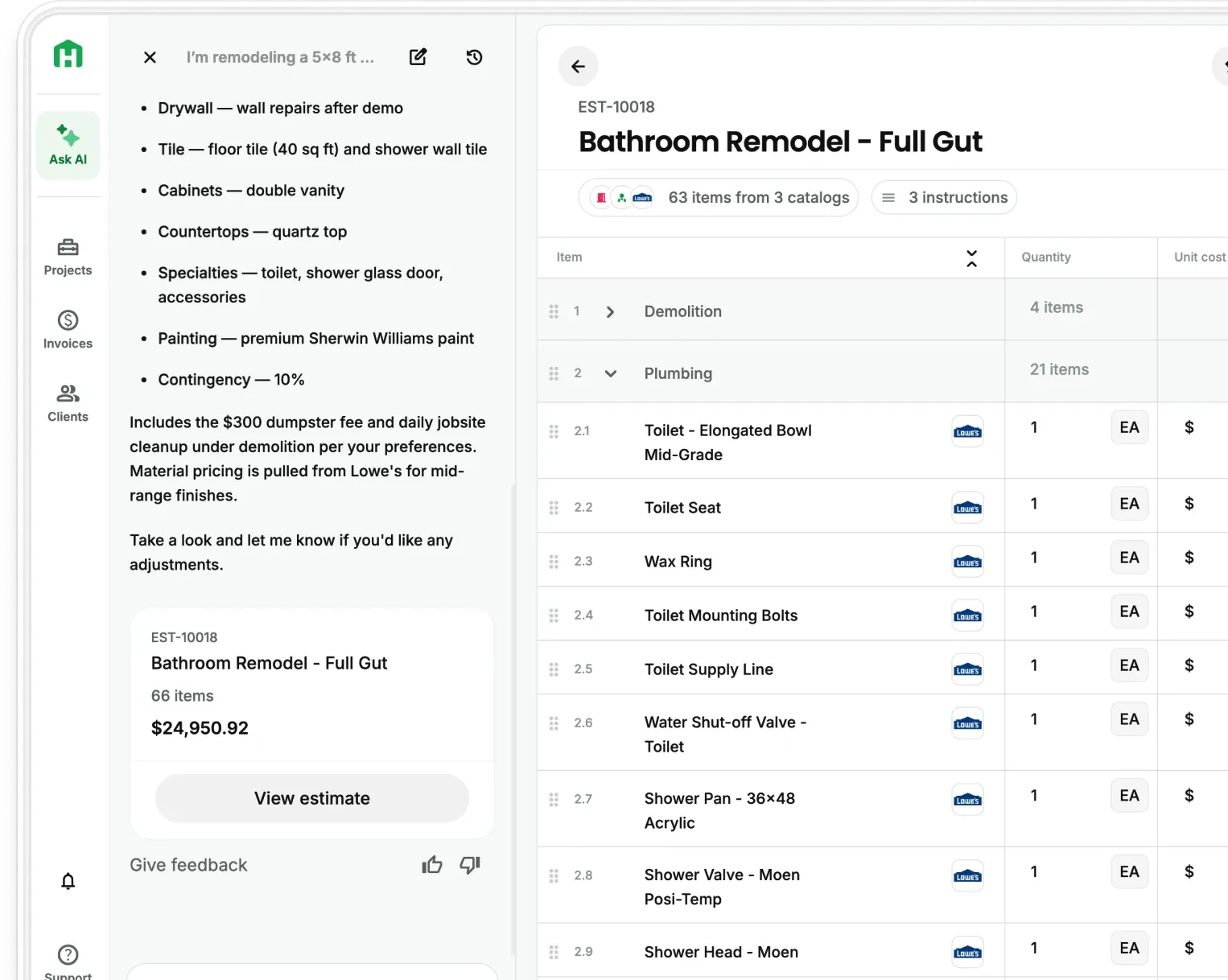
A callback is when a client asks you to come back and fix something after the job is finished. Handle it by deciding three things before you drive over: whether it's your work, whether it's inside your warranty period, and whether the relationship is worth more than the hour. Most callbacks are small, and most are worth doing without a fight.
The ones that hurt are the ones with no policy behind them.
What counts as a callback vs a change order
Contractors lose money on this distinction more than any other, because the conversation happens in a doorway with no paperwork in sight.
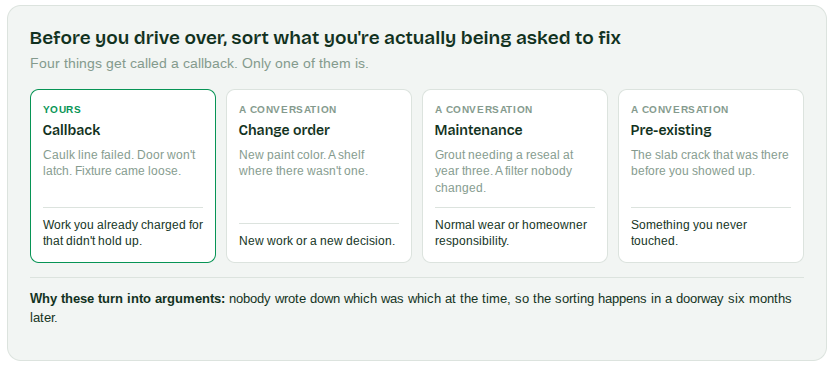
A callback is work you already charged for that didn't hold up. The caulk line failed, the door won't latch, a fixture came loose. A change order is new work or a new decision. A maintenance item is normal wear or homeowner responsibility. A pre-existing condition is something you didn't touch.
Only the first one is yours. The other three are conversations, and the reason they turn into arguments is that nobody wrote down which was which at the time.
Clear scope documentation protects your margin long after the job is finished.
Warranty vs. State: How long a contractor is responsible for their work
Your warranty is what you promised in writing. A one-year workmanship warranty is common in residential remodeling, and it's the number you control.
Your legal exposure is set by state law, and it runs longer than your warranty almost everywhere. Statutes of limitation and repose vary widely from state to state, which means a general answer would be wrong somewhere. This is where you should ask an attorney licensed where you work, once, so you actually know your number instead of guessing.
For the workmanship standard itself, the NAHB Residential Construction Performance Guidelines are the reference most of the industry uses. They cover more than 340 guidelines across 13 construction categories and describe how a home should perform during the warranty period.
Referencing them in your contract gives you a third-party standard to point at instead of a debate about opinions.
Should you charge for a callback?
Pro Remodeler has argued for years that a remodeler's warranty is a relationship tool rather than a cost center. One columnist described tearing out a custom tile shower eight years after the job, well past the warranty period, because a recurring problem could not be solved any other way.
That's an extreme case, but it makes the point. The math on a callback is rarely just the labor.
Three ways to handle it, and when each fits:
- Fix it free and say nothing. Right when it's small, fast, and clearly your work. Twenty minutes buys goodwill worth more than the twenty minutes.
- Fix it free and name it. "That's outside what we covered, but I'll take care of it." You get the goodwill and the client learns where the line is, which protects you on the next three requests.
- Quote it. Right when it's new work, a maintenance item, or a pattern that's repeating. Send it as a small estimate so it looks like business, not a grudge.
The mistake is doing option one silently every time. That teaches a homeowner the list has no boundary, and it teaches you to resent someone who never knew they crossed a line. Contractors who define their warranty in writing spend less time negotiating it in a driveway.
Why do callbacks happen on remodeling jobs?
The pattern is consistent.
- Rushed closeout. The last 5% gets done in return trips, and return-trip work gets less attention than the work that had a full day.
- Nobody documented the final condition. Six months later there's no record of what the space looked like when you handed it over.
- Expectations were never set. The homeowner didn’t know grout needs sealing or that a solid wood door moves with humidity.
- A sub cut a corner and nobody caught it. You’re the one who gets the call, not them.
- Materials failed, not workmanship. A manufacturer defect isn’t your error, but it’s still your phone ringing.
A callback is not automatically an accusation, and treating every one as a fight costs you more than the repairs would have.
Photo documentation at closeout turns a memory argument into a five-minute answer.
How to reduce callbacks on your next job
You’re probably already building it right. Most callback reduction is about documentation and expectations, not skill.
- Photograph the finished condition. Every room, before you hand over the keys. Daily logs with photos give you a dated record without a separate filing habit.
- Hand over a maintenance sheet. What needs sealing, what moves seasonally, what's normal in the first year. Ten minutes of writing prevents a category of calls entirely.
- Put your warranty in the contract, in plain language. What's covered, for how long, and how to reach you.
- Close the punch list with a signature. A dated list the client signed makes the difference between "we finished" and "we agreed we finished."
- Give them one place to find everything. A client portal means the warranty terms and job documents are still there in month nine, instead of buried in a text thread.
Your AI Teammate builds the documentation as part of the job rather than as an evening task, which is why it actually gets done.
What a callback costs you over time
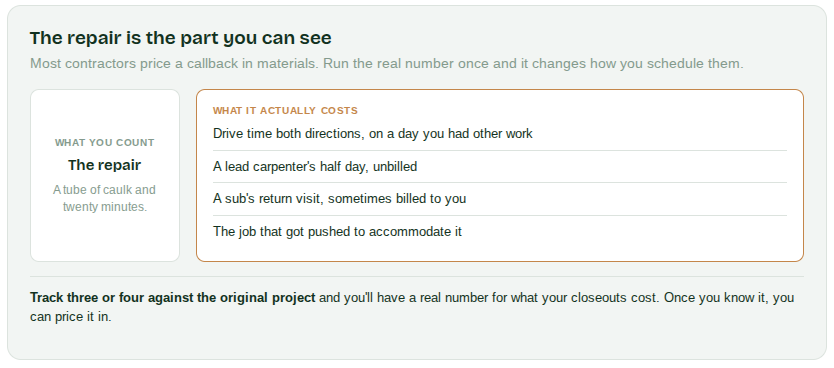
Run the real number once:
- Drive time both directions, on a day you had other work
- A lead carpenter's half day, unbilled
- A sub's return visit, sometimes billed to you
- The job that got pushed to accommodate it
The typical remodeling firm runs about five employees. At that size, one person leaving an active job to handle a callback slows down everything else that day.
Track a few of them against the original project in your job budget and you'll have a real number for what your closeouts cost. Once you know it, you can price it in. Right now it's invisible, which is why it never improves.
Knowing your callback cost lets you price it into the job instead of absorbing it.
Getting started
- Look up your state's construction statute of limitation and repose, or ask an attorney once so you know the number
- Write your warranty terms into your contract in plain language
- Photograph every room at closeout and store it with the job
- Hand the client a one-page maintenance sheet with the keys
- Start your free Handoff trial and keep the documentation with the project instead of on your phone
Callbacks are a documentation problem. Handoff keeps the record so the answer is already there when the phone rings.
Other FAQs about handling callbacks in residential construction
Does fixing something for free set a bad precedent with a client?
Only if you never name it. Doing the work silently every time teaches the homeowner there’s no boundary. Doing it and saying it was outside the scope gives you the same goodwill while making the limit clear for next time.
What do you do when a homeowner blames you for something you didn’t touch?
Go look before you respond, and bring your closeout photos. Most of these resolve the moment there is a dated image of the space at handover. If there is no record, the conversation becomes your word against theirs, which is a good reason to start photographing every finished job.
Should you check in with clients after the job to catch problems early?
A short call at thirty days and again around eleven months, right before a one-year warranty ends, catches small issues while they are still small. It also reads as confidence rather than worry, and it is one of the most reliable ways to earn a referral from a client who has already forgotten how good the experience was.