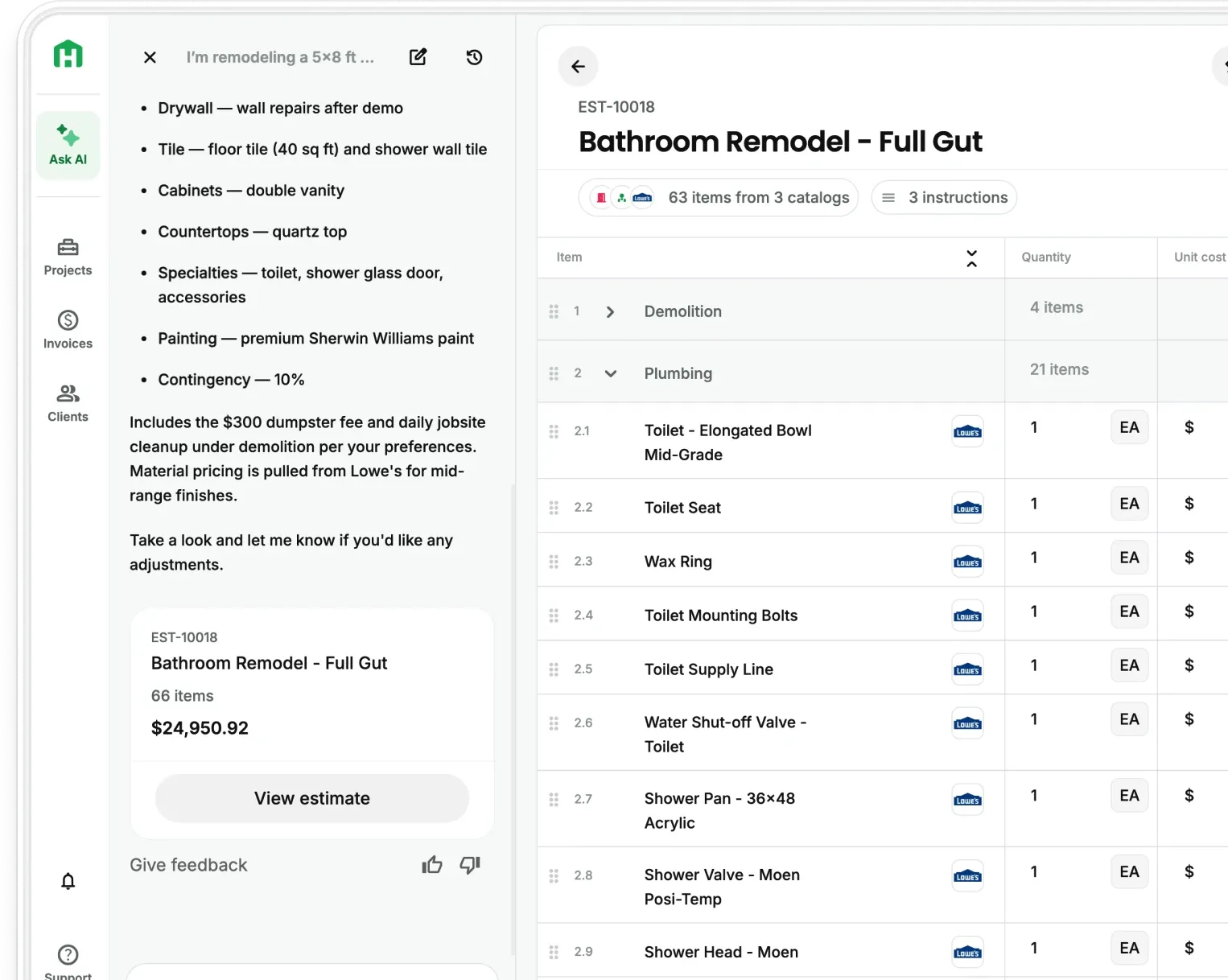
The client stood on his inherited roof, holding two estimates he never asked for. One was $245,000: the full tear-off fully scoped. The other was $120,000: the approach Forrest Tlustos actually recommended, pending a structural engineer's sign-off. Forrest had built both before ever setting foot on the property, from a scope of work and a dozen photos the client sent the day before.
"He just looked at me and didn't know what to say," Forrest recalls. "He said, 'I couldn't even get anybody to show up. You showed up on time and you already had two estimates for me.'" The client called his brother that afternoon: no need to call anyone else.
The job box
- Contractor: Forrest Tlustos, Built 48 Construction Management
- Market: Tucson, Arizona
- Licensed: Commercial and residential GC since 2019, solo operator
- Current work: Construction manager on a 47,000 sq ft warehouse-to-flex-space conversion, a ground-up SIP home build, lot scrapes, and small multifamily development
- Estimate turnaround before Handoff: One to two weeks on larger jobs
- Estimate turnaround now: Same day, often from the truck
The problem: Waiting two-weeks for estimates
Forrest never planned on becoming a contractor. He came from sales and marketing, learned the field as a commercial superintendent, and got licensed in 2019 after a Cornell real estate development course convinced him contracting was his path into building and holding small multifamily properties. He started in Tucson knowing nobody.
As a solo operator, his bottleneck was the one every one-person shop knows: the bid process itself.
"Somebody wants me to come do a bid…do the dog and pony show, measure a bunch of stuff, bring my messy notes home, and I leave them on the counter," he says. "Then two or three days later I'm going through notes that don't make half as much sense, I've got a bunch of pictures to sort through, and by the time I get all that done, now I've got to pull out my estimate form."
Bigger jobs took a week or two to turn around. Some opportunities weren't worth the monotony at all.
The new bid ritual: scope and photos before the site visit
Now the estimate starts before the walkthrough. On the roof job, Forrest asked the client two things on the first phone call: send over the scope of work, and take a dozen photos of the property from all sides. He fed both into Handoff and ran the estimate two ways: the full tear-off as scoped, and the lighter re-roof he suspected the structure could support.
By the time he climbed the roof for the first walk, the only thing his preliminary numbers had missed was the pack-out of the original house. He handed the client both documents on the spot, and recommended the cheaper one.
The family hired him without calling another bidder.
The same play works mid-relationship. When a commercial client mentioned a smaller side project he wasn't ready to deal with yet, Forrest visited the site on a Friday and sent the estimate that afternoon. The client's reaction: "How come you can turn an estimate and be ready to go when we've been dealing with this other thing for nine months?"
Why he trusts the numbers with AI Estimates
Forrest didn't take estimate accuracy on faith. He tested for it, and his testing shaped how he sees the wave of AI features hitting construction software.
"Everybody's realizing they've got to have some kind of AI," he says. "They're bolting AI onto what they already have, and it's not pretty. You can tell." The tell, for Forrest, is whether the AI actually knows your business: "Your agent [Handoff], you communicate with it. It knows where all your stuff is." A bolted-on assistant doesn't.
The difference showed up in his testing.
Before choosing Handoff, he ran the same set of plans through another AI-based estimating tool four separate times and got four different estimates with a million dollars of variance between them. "You can't do that. You're out of business," he says. He ran the same test through Handoff with a consistent prompt and got consistent numbers back.
He also tested the general-purpose route. Feeding plans for a $2.5 million light industrial project into a general AI chatbot produced a decent scope but priced the job at $4.5 million. "If you think you can run your plans through a chatbot, come out with an estimate, and put it out to a client, you're in trouble," he says. "You've got to go with a program that's built for this from the ground up."
That light industrial project, by the way, was bigger than what Handoff typically sees. Handoff is built for residential construction. The agent flagged that, kept working the plan set, and returned a scope and estimate Forrest calls "pretty darn solid." He'll soon have five GC bids on the same project to compare it against, and as construction manager, he walked in with a preliminary estimate, a detailed scope, and a realistic schedule before any of them.
How to win a construction bid in 3 steps, according to Forrest
Forrest's pre-walkthrough ritual, in three steps any contractor can copy:
- Get the scope and photos before the visit. Ask the client for whatever documents exist and a dozen photos of the property from all sides. Most will happily do it once you explain it helps you help them.
- Run the estimate both ways. If there's a cheaper path the client hasn't considered, price it alongside what they asked for. Options build trust, and trust closes.
- Show up with paper in hand. A preliminary estimate at the first meeting, clearly labeled as preliminary, beats a polished one delivered two weeks after the lead went cold.
What it changed about running his residential construction business
The part that surprised Forrest most isn't the estimating. "The project management aspect is now more important than the estimating part for me," he says. Handoff gives him the step-by-step document for every job: "I can print out a page for my guys and say, here's where we've got to be this week."
For a solo operator, that's the difference between a business and a treadmill. "If you're on your own, it's a must-have, because you're going to be able to go to sleep at night. You're going to have weekends," he says. "If you're a company that's doing well and you want to talk about doubling your revenue, it's actually feasible with the staff you have."
His verdict, after testing the alternatives: "It's a no-brainer. As you guys evolve, I evolve with you."
Want to show up to your next walkthrough with the estimate already done? Start your free trial and run your next lead's photos and scope through Handoff before the site visit.
Frequently asked questions
Can a solo contractor really compete with bigger GCs on bid speed?
Yes, and often win outright. Forrest turns estimates the same day from his truck while larger competitors take days or weeks, because the AI does the scope-building and pricing work a bigger shop assigns to staff. On his CM project, he produced a full scope, estimate, and schedule before any of the five GCs bidding the job.
Can you build an estimate from photos and a written scope before visiting the site?
Yes. Forrest's roof estimates were built entirely from a dozen client-sent photos and an engineer's scope of work, then verified during the first walkthrough. He labels these preliminary and firms them up after the visit, which still puts a number in the client's hands weeks before a traditional bid process would.
How consistent are AI estimates from one run to the next?
Consistency depends on the tool and the prompt. Forrest ran identical plans through another AI product four times and saw a million dollars of variance; with a consistent prompt in Handoff, the same test returned consistent numbers. His advice is to test any estimating tool the same way before trusting it with a bid.