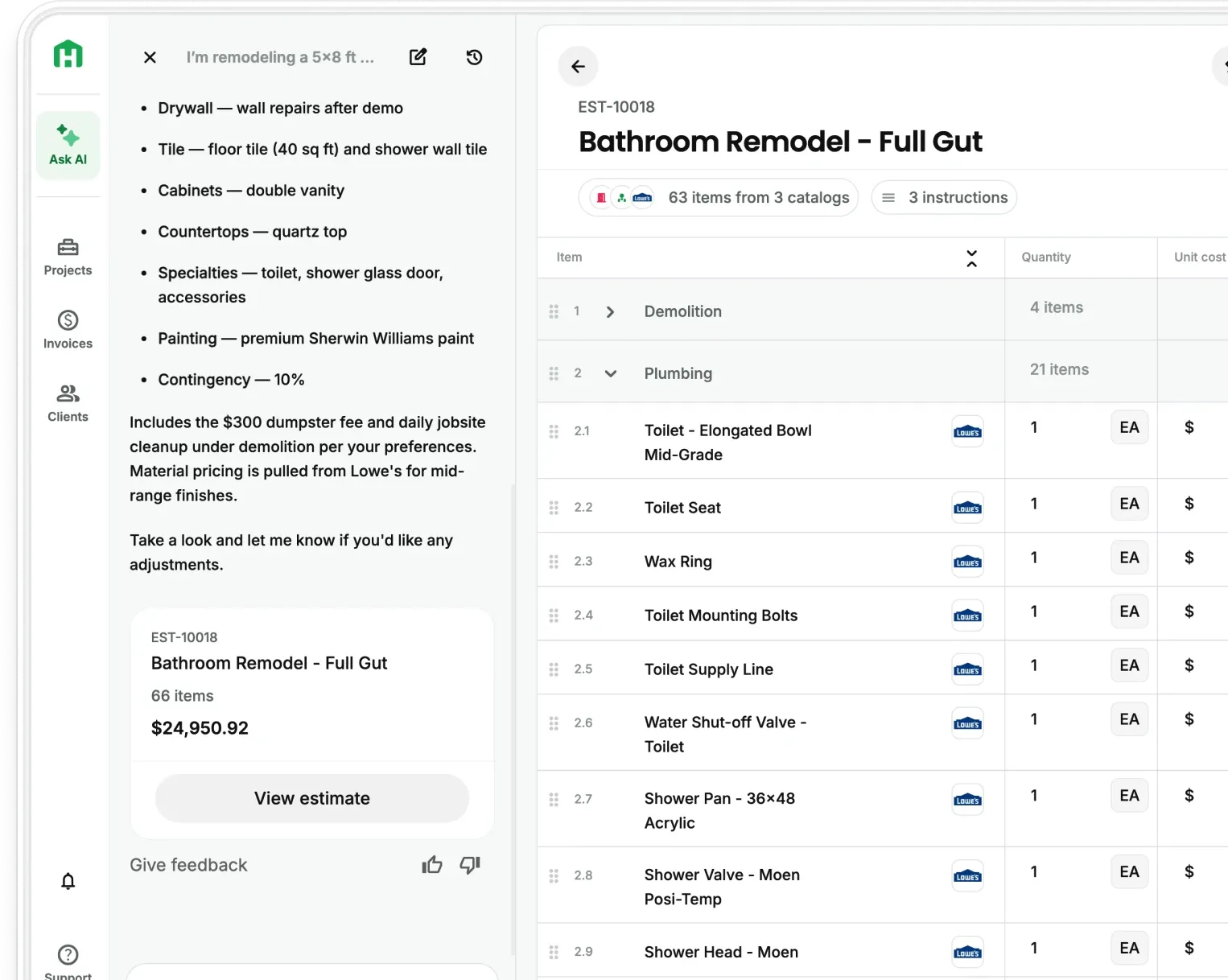
Bluebeam Was Built for the Enterprise. Handoff Was Built for Residential.
Bluebeam has 4 million users. That's a staggering number. But a completely irrelevant one for most residential contractors.
Bluebeam Revu is the tool of choice for commercial GCs, civil engineers, MEP specialists, and enterprise AEC firms with dedicated estimating departments and teams of people who do nothing but read blueprints and run quantities. It's powerful, precise, and built for that world.
If you're a residential contractor doing remodels, additions, or custom builds, that's not your world. And using the wrong tool for your world is costing you time you don't have.
Handoff AI was built specifically for your world. Here's how the two compare.
Bluebeam Takeoffs vs Handoff Takeoffs
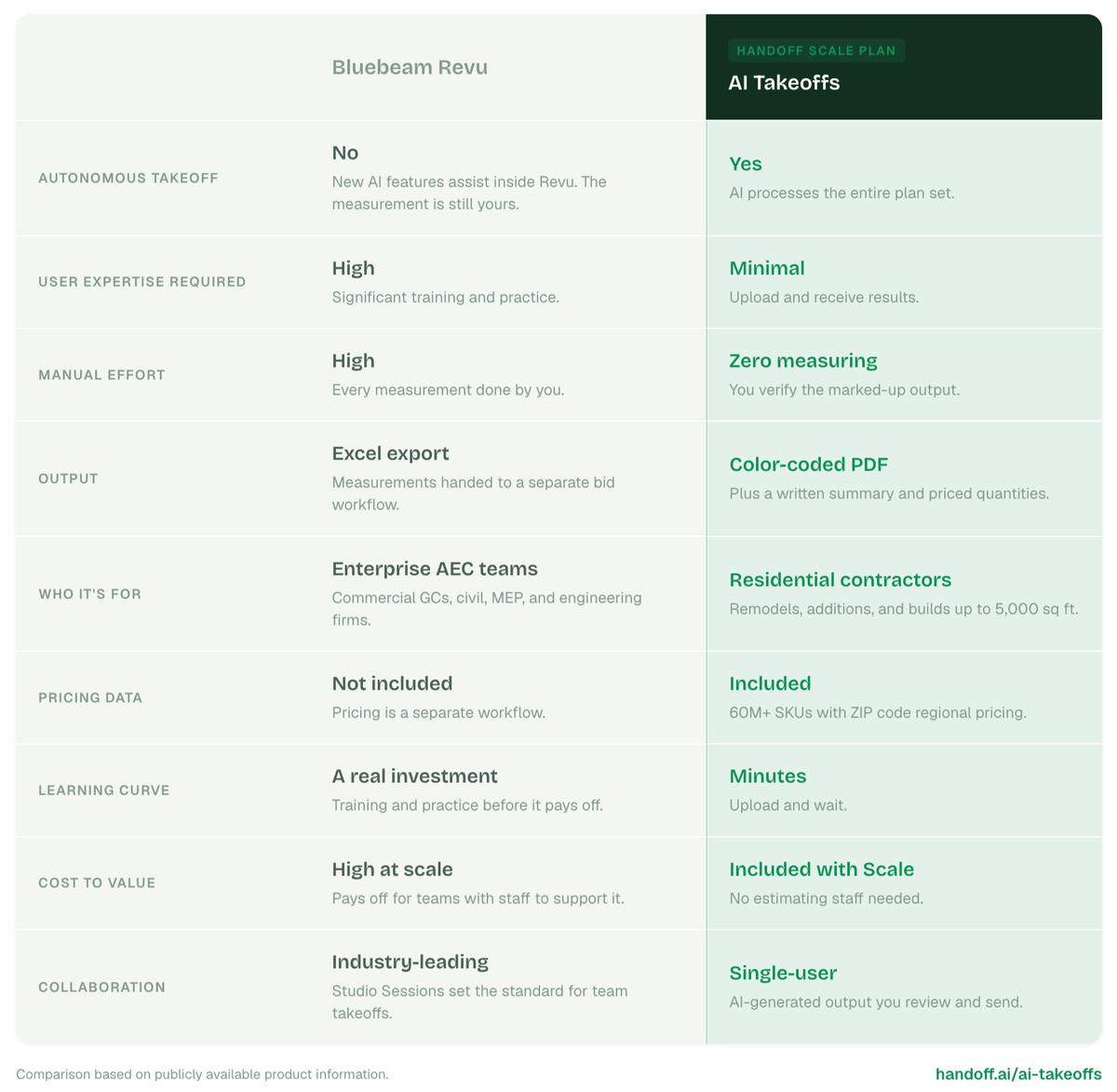
What Is Bluebeam? A PDF-First Enterprise Tool
Bluebeam Revu is a PDF markup and digital measurement platform built for the AEC (architecture, engineering, construction) industry. It lets you measure lengths, areas, volumes, and counts directly from PDF drawings faster than analog methods.
Its flagship features include:
- Quantity Link: Links measurement totals from multiple PDFs directly to Excel for bid calculations
- Visual Search: Identifies and counts repeated symbols across drawings automatically
- Studio Sessions: Real-time collaborative takeoff — multiple team members measuring the same set simultaneously
- Trade-specific workflow templates for general and specialty contractors
It's excellent at what it does. Enterprise case studies back it up: civil contractors tripling bid capacity, engineering firms estimating five times faster, specialty contractors winning 50% more projects.
Who Bluebeam is built for
Notice what's common in all of those case studies: the users are enterprise teams with dedicated estimators and the resources to learn and leverage a complex tool at scale.
Bluebeam's user base is primarily:
- Commercial general contractors managing large, complex projects
- Civil and infrastructure contractors (roads, utilities, grading)
- MEP (mechanical, electrical, plumbing) specialty contractors
- Architecture and engineering firms handling multi-trade documentation
- Enterprise construction teams with dedicated estimating staff
The learning curve is real. Getting meaningful productivity from Bluebeam requires training, practice, and a workflow built around it. That investment pays off at scale, but only for teams that can absorb it.
For a residential GC or remodeler doing 10-30 ground up builds a year without a dedicated estimator, the math doesn't work.
The Residential Contractor Problem: Bluebeam Gives You Tools, Not a Takeoff
Here's the core issue with Bluebeam for residential contractors: it measures. It doesn't connect to an estimate.
When you finish a Bluebeam takeoff, you have a set of measurements — areas, lengths, counts — exported to Excel. You still need to:
- Build the material list from those measurements
- Source pricing for every line item
- Apply regional cost factors
- Assemble the full bid document
That's a substantial workflow even after the takeoff is done. And the takeoff itself still required your time, your expertise in Bluebeam, and your familiarity with the plan set.
That doesn't change with Bluebeam's new AI. When using Bluebeam Max’s Claude-based integration on a residential plan, it can finish the styling and labels only after you trace the room corners yourself, or it can place exact shapes if you supply the wall dimensions for each room. Both paths start with you doing the measuring. Max makes Revu's markup smarter, but the takeoff still belongs to whoever is holding the mouse.
Bluebeam is a precision instrument. It gives you exactly what you put into it. If you have the skill, the time, and the team to use it well, it delivers. But it doesn't do the bid for you.
Handoff AI Takeoffs: Built Specifically for Residential
Handoff AI processes residential construction plans up to 5,000 sqft which covers the vast majority of residential remodel, addition, and new construction projects.
You upload your plan set. In under 2 hours, the AI delivers:
- A color-coded visual takeoff PDF — every area, length, and count measured and marked
- A written summary of quantities and scope, ready for estimate building
- Material quantities priced against 60M+ SKUs from Home Depot, Lowe's, and other major suppliers
- ZIP-code level regional pricing so you get your actual market costs, not national averages
No calibration. No clicking. No measuring. No Excel export to figure out next.
Handoff was trained on 100,000+ completed residential estimates. It understands residential construction scopes at depth because it's seen thousands of real projects across every trade type.
Bluebeam's Real Strengths
For the right user, Bluebeam is genuinely exceptional. Its Studio Sessions feature is the industry standard for collaborative estimation on complex multi-trade projects. If you're running a commercial GC operation or a large specialty trade business, Bluebeam's precision and team collaboration tools are hard to beat.
4 million AEC professionals didn't choose it by accident. For enterprise teams doing complex, high-value commercial work — Bluebeam is still the gold standard.
Why Residential Contractors Are Switching to Handoff
The residential contractor market looks fundamentally different from the commercial AEC market Bluebeam was built for:
- Most residential GCs and remodelers don't have dedicated estimating staff, and hiring one runs a median of $77,070 a year according to the Bureau of Labor Statistics
- Residential plans are far less complex than commercial multi-trade drawings
- Turnaround time matters, because homeowners collect multiple bids and slow answers lose the work
- Cost per takeoff needs to be manageable at lower job values than commercial
Handoff was designed specifically for this context. It doesn't require you to learn a complex tool. It doesn't require an estimating team. It doesn't output raw measurements that need a second workflow to become a bid.
It takes your plans and gives you a complete, priced takeoff that's ready to use.
For residential contractors who want to bid more jobs, win faster, and spend less time measuring — that distinction matters.
Other FAQs about Handoff vs Bluebeam takeoff software
How long does an AI takeoff take?
Handoff AI Takeoffs average 1-2 hours from upload to delivery. Compare that to 8 to 16 hours of measuring plans yourself, or the one to two week wait from an outsourced takeoff service. You can upload a plan set after a morning site visit and have the takeoff back before you leave the office.
Should I use Bluebeam or Handoff AI for residential takeoffs?
Bluebeam Revu is built for enterprise teams that do their own measuring and have the training to use a precision tool. Handoff AI is built for residential contractors who want the takeoff done for them: upload plans up to 5,000 square feet and get back a color-coded, verifiable takeoff in about two hours. If you have a dedicated estimating staff, Bluebeam earns its keep. If you don't, Handoff is the faster path from plans to bid.
How do I know the AI's measurements are right?
Every measurement is marked on a color-coded PDF, so you can check the AI's work against your plans line by line before anything goes into a bid. The takeoff also comes with a written summary that flags assumptions, missing details, and plan clashes for you to verify. You skip the measuring, not the control.