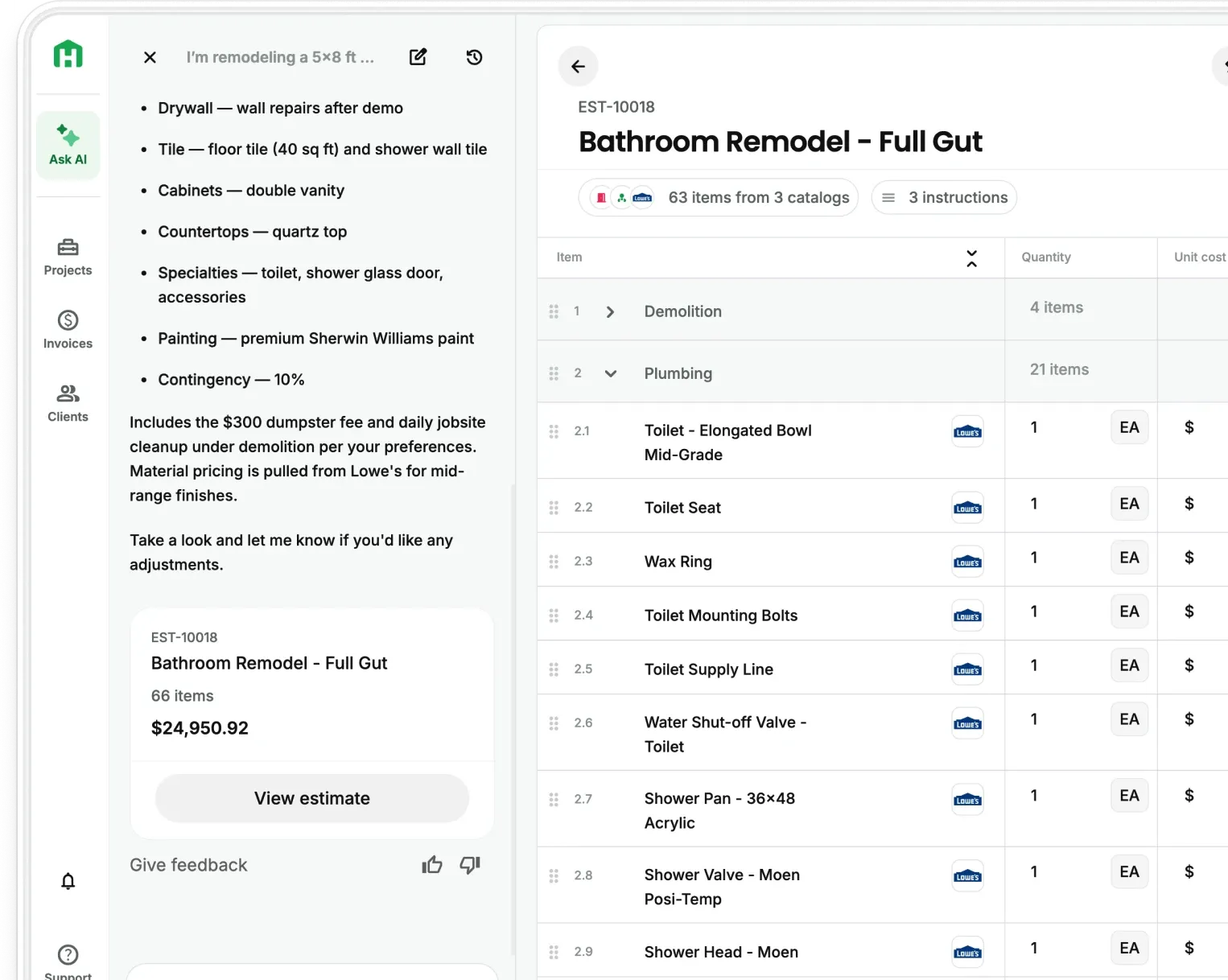
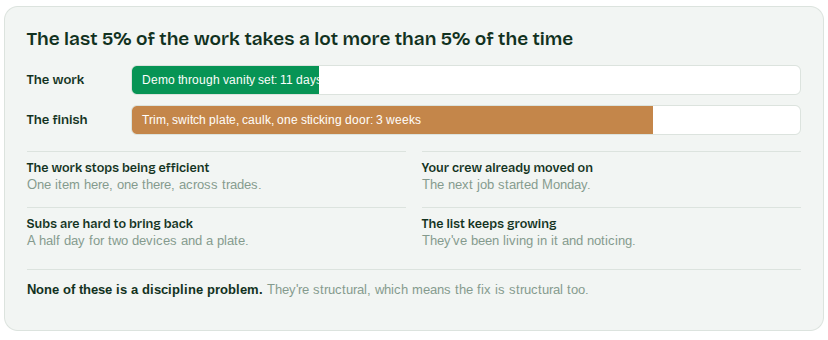
You demoed a bathroom, moved a drain, framed, tiled, and set a vanity in eleven days. Then you spent three weeks getting a piece of trim, a switch plate, a caulk line, and one door that sticks in humid weather across the finish line.
Everybody in remodeling knows this stretch. Nobody plans for it. But it's the part of the job that decides whether the homeowner remembers you as the contractor who transformed their house or the one who wouldn't leave.
Why the end drags in residential construction projects
The last stretch is harder than it looks for reasons that have nothing to do with effort.
- The work stops being efficient. The first 95% is dense. A tile day is a full day of tiling. The last 5% is one item here, one item there, spread across trades and locations.
- Your crew has already moved on. Mentally and often physically. The next job started Monday. Now somebody has to drive back across town to hang one closet door, and it feels like a step backward, so it keeps sliding to tomorrow.
- Subs are the hardest to bring back. Your electrician is on a new job. Coming back for two devices and a trim plate costs him a half day he'd rather spend somewhere else. The smaller the return trip, the harder it is to schedule.
- The list keeps growing. This one hurts. Every time you go back, the homeowner has been living in the space and has noticed three more things. Some are legitimate. Some are new. Without a closed list, there is no version of done.
Close the list before you start closing it out
The single biggest change you can make is to stop treating the punch list as something that accumulates and start treating it as something that gets defined.
Walk the job with the homeowner. Write the list together in front of them. Then say the sentence most contractors skip:
"This is the list. When these are done, the job is complete."
A defined list has an end. An undefined list has a mood.
What makes it stick:
- Write it with them present, not later from memory. Shared authorship makes it their list too.
- Date each item, so the list is a schedule and not a wish.
- Say what a new item means. Not that new items are forbidden. Just that something noticed next week is a separate conversation, and possibly a change order.
- Give them a copy that day. A list they can see is something they trust.
AI Documents can turn a walkthrough into a clean punch list you hand over the same day, instead of a photo of a notepad. The format matters more than it sounds. A typed, dated list reads as a commitment. A phone photo reads as a note to self.
Schedule the end like it's a job
The last 5% usually fails because it's the only part of the project that never gets a date on the calendar. Everything else was scheduled. The finish gets handled when you can get back over there.
Treat it as a real block of work:
- Pick a day and name it. Not a week. A day, told to the homeowner and to your crew.
- Batch by trade, not by room. Every electrical item at once. Every paint item at once. One return trip per sub, not three.
- Get subs booked before you need them. A sub asked two weeks out will come back for a small item. A sub asked Thursday for Friday will not.
- Protect it from the new job. The next project will happily eat this day. Someone has to decide it doesn't.
The Subcontractor Portal on Scale keeps your subs connected to the project rather than living in a text thread, so bringing someone back for a punch item is a message inside the job instead of a search through your phone for what you agreed to in April.
Watch what the end costs you
The last 5% of the work often eats a much larger share of the margin. Four return trips, a half day of a lead carpenter's time, two sub visits for twenty minutes of actual work, fuel and drive time on all of it. None of it is billable. All of it comes out of the profit you already booked.
You cannot manage what you don't measure, and this is the least-measured stretch of any job.
- Time Tracking on Pro and Scale puts crew hours against the project as they happen, including the return trips. On Scale, subs and vendors can clock in through the Subcontractor Portal without a paid seat.
- AI Budget Tracking on Pro keeps the approved estimate as a live budget, so labor and costs from the closeout stretch land against the job instead of disappearing.
Do this for three or four jobs and you'll have something more valuable than any single fix: a real number for what your closeouts cost. Once you know it, you can price it, schedule it, or attack it.
Keep the homeowner informed while you're not there
From inside your business, waiting on the electrician is a normal Tuesday. From inside their house, it's the eleventh day nobody came and nobody said why. That gap is where a happy client turns into an anxious one, and an anxious one starts inspecting.
The fix is small and unglamorous. Tell them what's happening even when nothing is happening.
Daily Logs and the Client Portal give them somewhere to look, so the update isn't dependent on you remembering to text at 8pm after a full day. A homeowner who knows the trim is arriving Thursday will wait until Thursday. A homeowner who knows nothing will start making a list.
Decide what you're going to eat the cost of
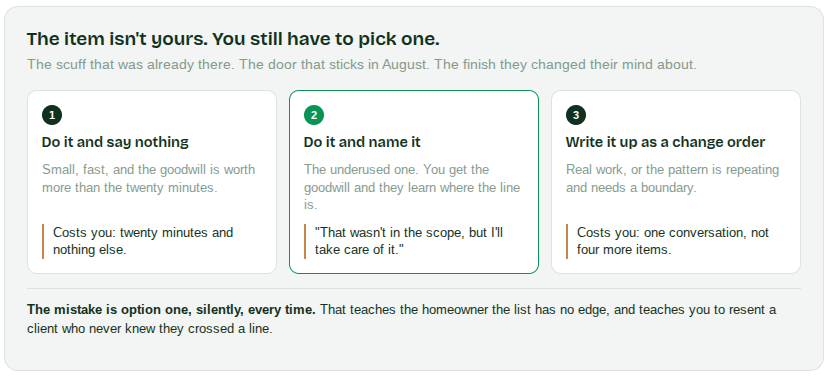
At some point on most jobs, you hit an item that isn't really yours. The scuff that was there before. The door that only sticks in August. The thing they now want in a different finish.
You have three options, and the wrong one is pretending you don't have to choose.
- Do it and say nothing. Right when it's small, fast, and buys goodwill worth more than the twenty minutes.
- Do it and name it. "That wasn't in the scope, but I'll take care of it." This is the underused one. You get the goodwill and the homeowner learns where the line is, which protects the next four items.
- Write it up as a change order. Right when it's real work, and especially if the pattern is repeating.
The mistake is doing it silently every time. That teaches the homeowner that the list has no boundary, and it teaches you to resent a client who never knew they crossed a line.
What a good ending looks like
The job ends on a date everyone knew about.
The list was written together, dated, and closed. The subs came back once, not three times. The homeowner heard from you during the quiet stretch, so they never started wondering. You know what the closeout cost you, so next time you priced it in.
Want to see what your closeouts actually cost? Start your free trial and track one job all the way through the last item.
Other FAQs about finishing a job with the right documentation
When should you create the punch list?
Walk it with the homeowner as the main work wraps, and write the list together on the spot. Creating it later from memory means you're guessing at their concerns, and guessing wrong adds a round trip.
What do you do when the punch list keeps growing?
Close the original list in writing with dates, then treat anything noticed afterward as a separate item to price or decline. The problem is rarely the new item itself. It's that nobody ever said when the first list ended.
How do you get a sub to come back for one small item?
Give them notice and batch the work. A sub asked two weeks out for one trip will usually come. A sub asked to make three separate visits for twenty minutes each will keep pushing you to next week, and they're not wrong to.