Most remodeling companies this size are two people. One of you is in the field. One of you is at the desk. And you go home to the same house.
Nobody hands you a manual for that. You figured out the business as you went, and you figured out the working relationship the same way, mostly by finding out the hard way which conversations should not happen at 9pm.
What nobody warns you about when your business partner is your spouse
The problem with working with your spouse is the business never leaves. A job runs over and it follows you to dinner. A client goes quiet on a $30,000 bid and it's still sitting there Saturday morning. You can’t have a hard week at work and come home, because home is where the work is.
And there's no HR, no third partner, no neutral person in the room. When you disagree about whether to take a job or chase an invoice, the disagreement has nowhere to go. It just becomes part of the evening.
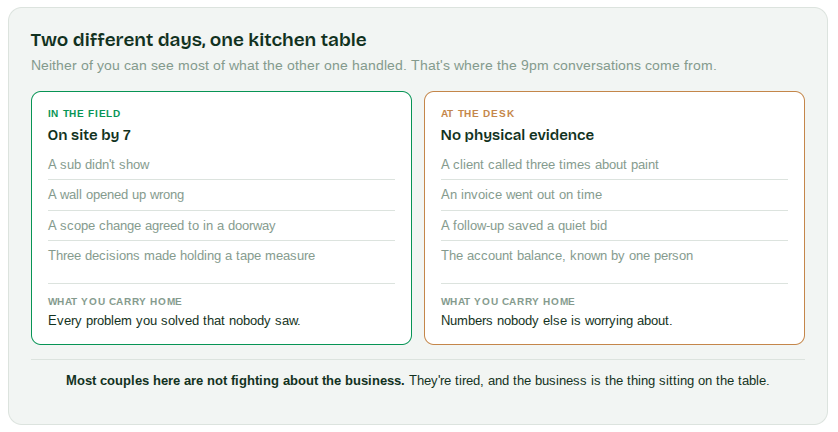
Most couples in this situation aren’t fighting about the business. They're tired, and the business is the thing sitting on the table.
The Site Manager: If you're the one in the field
You're on a site by 7. You're solving problems all day that nobody else sees. A sub didn't show, a wall opened up wrong, a homeowner asked for something that isn't in the scope and you handled it in a doorway while holding a tape measure.
Then you come home and get asked why the Hendersons haven't paid.
Here's what tends to help.
- Understand that not knowing is worse than bad news. When you don't relay what happened on a job, the person at the desk isn't relaxed. They're guessing. They're fielding a client call with no idea the schedule moved. The five seconds it takes to say the tile is delayed saves them an hour of working blind.
- Write down the doorway decisions. The change you agreed to at 10am is real money and a real schedule change, and if it only exists in your head, it doesn't exist in the business. This is the single biggest source of the "why is the invoice wrong" conversation.
- Say what kind of conversation you're having. "I need to think out loud for ten minutes" and "I need you to fix this" are different requests, and the person at the desk can’t always tell them apart. Naming it prevents half of the arguments that start as venting.
- Remember that the desk work is real work. It’s quieter and it happens indoors, which is not the same as easier. The follow-ups, the invoices, the client who calls three times about a paint color: none of that shows up as a finished bathroom, but the business does not run without it.
The Office Manager: If you're the one at the desk
You're holding the parts of the business that have no physical evidence. Nobody drives past a house and admires the invoice that went out on time.
You're also the one who knows the actual numbers, which means you carry a specific kind of worry alone. You know what's in the account. You know which client hasn't paid. And the person you'd normally talk to about it is the person who is already stressed about the job that caused it.
- Bring numbers, not moods. "We're tight this month" invites an argument. "We're $8,000 short until the Keller payment lands, and it's twelve days late" is a problem two people can solve together. The second one is also easier to hear after a ten-hour day.
- Pick the time deliberately. The worst moment to raise money is the moment they walk in the door. The best is a set time, once a week, that both of you agreed to in advance. Money conversations go better when nobody was ambushed.
- Ask for the information you need, specifically. "You never tell me anything" is true and unactionable. "I need to know by Wednesday whether the Kellers approved the tile change" is a request someone can actually fulfill.
- Say the hard thing early. The instinct is to protect them from more stress by handling it quietly. It rarely works. A problem you sat on for three weeks lands harder than the same problem would have on day one, and the person in the field usually feels managed rather than protected.
3 tips for easing the tension
Decide who decides
Pick the boundaries once, while nothing is on fire:
- Who can approve a change order under a set dollar amount without checking in
- Who talks to the client when the client is unhappy
- Who decides whether to take a job you're both unsure about
- What number a decision has to hit before it becomes a conversation
You’ll both violate this occasionally. That's fine. The value isn't perfect compliance, it's that "you should have asked me" becomes a shorter conversation, because there's an agreement to point at instead of a feeling to defend.
Get the information out of your heads
A lot of what looks like a communication problem is actually a visibility problem.
When the only way for one of you to know something is for the other one to remember to say it, you have built a business that runs on two memories at the end of two long days. That fails on the exact days you're busiest, which are the days it matters most.
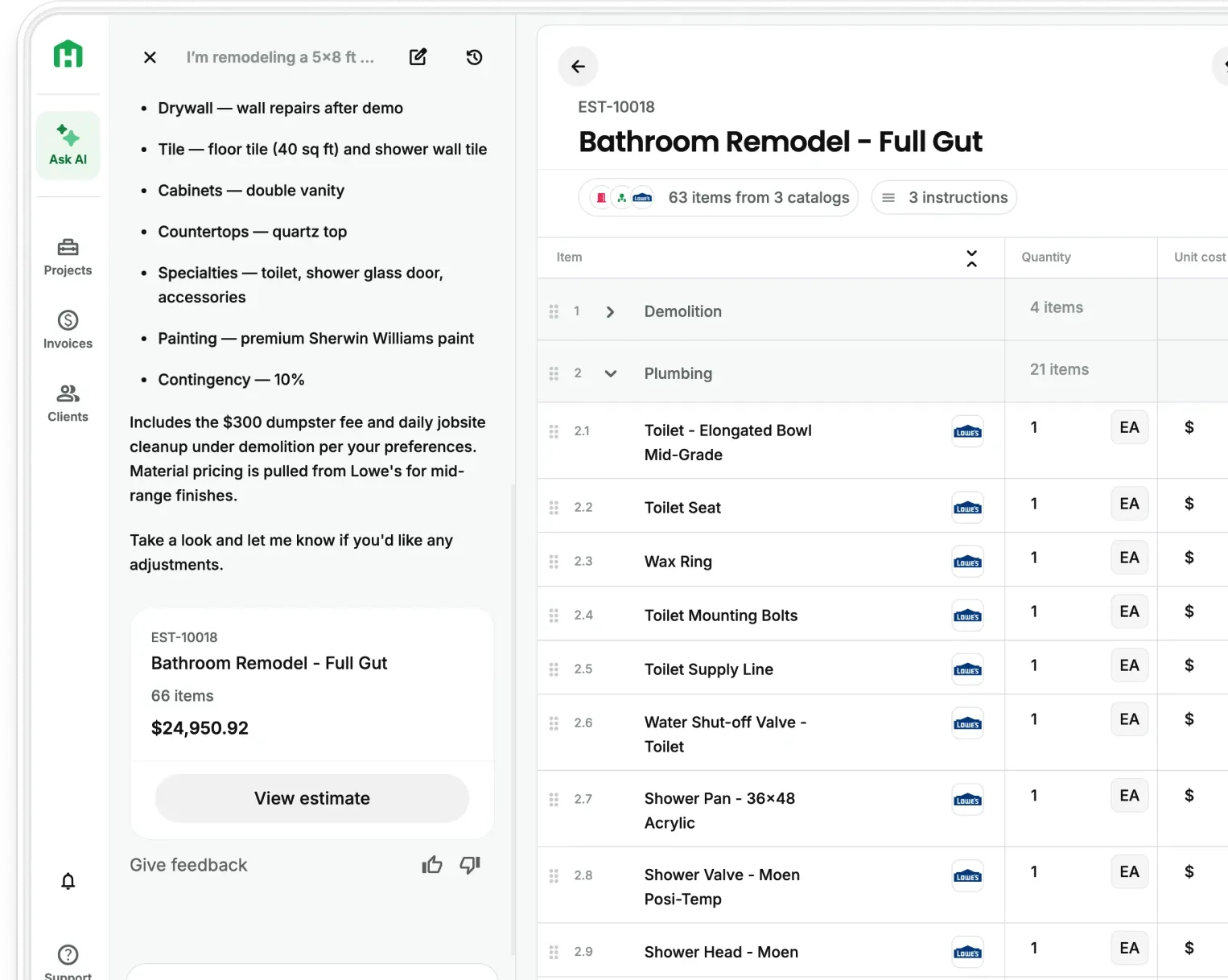
The fix is boring and it works: put the job in one job tracking system you can both see. Scope, change orders, photos, what's been billed, what's been paid. When the budget updates as the job runs, the person at the desk stops asking where things stand and the person in the field stops feeling interrogated. When the client can see their own project in a portal, fewer of their questions land on either of you at 8pm.
You can also just ask. Your AI Teammate can tell you which jobs are over budget or who owes you money, which means neither of you has to be the one holding that in their head, and neither of you has to be the one who brings it up.
None of this is a substitute for talking to each other. It removes the arguments that were never really disagreements, so the conversations you do have are about actual decisions.
Don’t forget to protect each other
There are two things you need to decide on purpose, because neither will happen by accident.
- Somewhere the business doesn't go. A meal, a morning, a drive. Not a rule anyone enforces perfectly, just an agreement that there is a place where you are two people instead of two departments.
- A standing time where it does go. Thirty minutes, same day every week, where you look at the jobs and the money together on purpose. Most couples doing this well have a version of this meeting. It sounds corporate for a two-person company, and it's the thing that keeps the business from leaking into every other hour.
The couples who make this work are not the ones who never disagree. They're the ones who stopped having the same disagreement every Thursday because they finally wrote down who decides what.
You built a business with the person you married. That's a harder thing than either of the jobs inside it, and most days you're doing it better than you think.
Want to stop being the only two places this information lives? Try Handoff free and put one job somewhere you can both see it.
Other FAQs contractors ask about navigating a business relationship with you spouse
How do you keep work conversations from taking over the whole evening?
Pick one standing time each week where the business gets your full attention, and one place it isn't allowed. Most couples try to do this by willpower in the moment, which fails on the weeks you're busiest. Deciding it in advance means neither of you has to be the one who says "can we not do this right now."
What do you do when you disagree about taking a job?
Decide the rule before the job shows up, not during it. Agree on a dollar amount or a job type that requires both of you to sign off, and agree that below that line, whoever's territory it is decides alone. Most of these arguments are about who gets to call it, not about the job itself, so settling the authority question once removes the argument permanently.
Should you and your spouse have defined roles, or share everything?
Defined is usually better, and most couples land there naturally: one in the field, one at the desk. The failure mode isn't the split, it's when the split becomes a wall and neither of you can see what the other is handling. Clear roles with shared visibility beats shared roles with unclear ownership, especially when you're both tired.