You priced the kitchen three weeks ago. Since then, your supplier sent a note: copper's up again, and the cabinet line moved too. The homeowner hasn't said a word. You know that won't last. Sooner or later the number on the contract and the number at the supply house are going to disagree, and somebody has to bring it up.
Most contractors wait to be asked. The ones who sleep better say it first, in plain numbers, with a couple of options ready. Here's how to do that without it turning into an argument.
Why bring up price changes before your client does?
A price change is easier to hear from you than to find on an invoice. When you raise it, it's a supplier issue you're handling. When the client raises it first, it can sound like a mistake you made.
You set the frame. ****You choose the words, the numbers, and the options, instead of reacting to a question. As a result, you keep the trust. A client who hears early knows you're watching the numbers, because you are.
Bonus: You now have room to fix it. Early notice leaves time to swap a material or adjust the scope, so you order now before the next move.
The year-over-year increase in copper wire prices is 27.2%, according to Construction Dive's September 2026 report on producer price data.
Those are national input prices, so your supplier's numbers will look different. The direction is the point. The Associated Builders and Contractors chief economist said the increases are "likely to weigh on profitability over the next several months," and you feel that squeeze on every supply run.
What should the proposal say before you sign?
The easiest price conversation is the one you had at signing. A few lines in the proposal do most of the work.
Start by providing a date on the price. Say how long your number holds. Builder Ron Marcella told JLC he keeps his estimates valid for seven days and orders materials right after the contract is signed. Then name the lines most likely to move. ****If copper, steel, or imported fixtures are in the job, tell the client on day one that those are the lines that can change. For fixtures and finishes the client hasn't chosen yet, price an allowance and explain what happens if they go over.
Here are two more tips we recommend:
- Ordering early: If a client wants the price locked, order the materials at signing. Marcella put it this way: "If a customer would like to guarantee pricing on the materials, I tend to want to order right up front."
- Have an escalation clause: Some contractors add one. NAHB publishes sample language that lets a builder pass on cost increases for named materials with written notice and supplier documents. NAHB also recommends having an attorney review any clause, so that's a call to make with yours.
How do you explain a price increase in plain words?
Keep it short. Your client doesn't need a lecture on producer price indexes. They need the item, the change, and a choice.
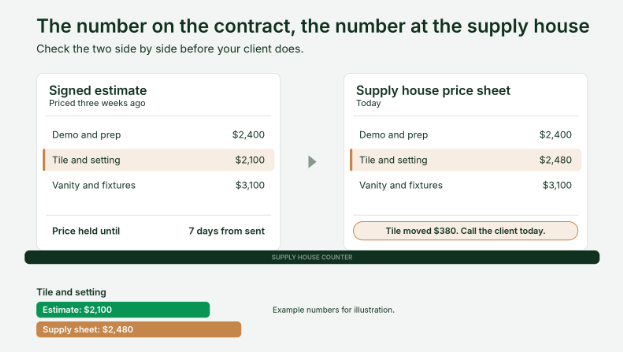
Say you priced the tile at $2,100 and it's now $2,480. You call the same day: "The tile moved $380 since I priced it. Here's the supplier sheet. We can keep it, or I can show you two similar ones."
Most clients can live with a price change. The ones who walk away are the ones who found out last.
So show the source. ****A supplier sheet or a screenshot beats an opinion every time. Then offer a choice. Keep it, swap it, or phase it. AI Proposals are on Flex, Pro, and Scale, and Scale lets you put up to five estimate options in one proposal and collect the client's feedback, so the keep-it-or-swap-it choice sits in one place.
Finally, put it in writing. If the change touches the contract, write a change order. AI Change Orders build a mini-estimate that shows what's different from the original agreement and go to the client for signature with photos attached.
From there, the day you hear about the move is the day to tell the client.
How do you keep estimates current so there's less to explain?
Part of the answer is staying close to your suppliers. The other part is construction estimating software with local prices built in, so the number you quote on day one starts closer to what you'll pay.
Instant AI Estimates prices each job by location, and Handoff's costs update daily for every city in the US. It's included on every plan.
If you buy at Lowe's, you can also connect your MyLowe's Pro Rewards account, so eligible materials price at your default store's actual rates. That works on every Handoff plan, and materials from your own custom catalog stay at your rates.
What if the client pushes back?
Some will, and that's fair. It's their money, and they've been shopping bids.
- Stay with the facts: The supplier sheet, the dates, and the line that moved. Keep your voice level and your numbers specific.
- Offer a swap or a phase: A similar material at a lower price, or a schedule that lets the part that moved wait.
- Ask what matters most: Budget, timing, or the exact product. The answer tells you which option to offer first.
- Know your floor: If the only way to hold the old price is to cover the difference yourself, a polite no is a fine answer.
Homeowners have watched grocery and gas prices move for years. Most of them understand more than you'd expect when you show your work.
What's the one habit that makes this easier?
Check your open estimates against what your suppliers are quoting now, on the same day each week. If something moved, call the client before they call you. AI Budget Tracking makes that check faster. It shows what you've spent against each line of your estimate, so a price move shows up on the line it hit.
You can't stop prices from moving. You can decide that your clients hear about it from you, early, with a plan.
Want to see local prices in your next estimate? Start your free 7-day trial, no credit card required, and price a job before you sign it.
Other FAQs about justifying material price changes
How long should an estimate stay valid when prices are moving?
There's no single answer. One builder told JLC he keeps his estimates valid for seven days and orders materials right after signing. Pick a window that matches how fast your own suppliers change, and put the date on every proposal.
Can you put a material price clause in a remodeling contract?
Some contractors do. NAHB publishes sample escalation clause language that covers named materials, written notice, and supplier documentation. Have your attorney review any wording before it goes into a contract.
Where can you check material price trends?
Associated Builders and Contractors publishes a monthly analysis of producer price data, and Construction Dive covers it. For your own jobs, your supplier's current quote is still the number that counts.